
Kagan vs. Barrett: can the Supreme Court police its own ethics?
DeLauro presses Kagan on an independent enforcement panel. Barrett signals skepticism, and the justices disagree on enforcement.
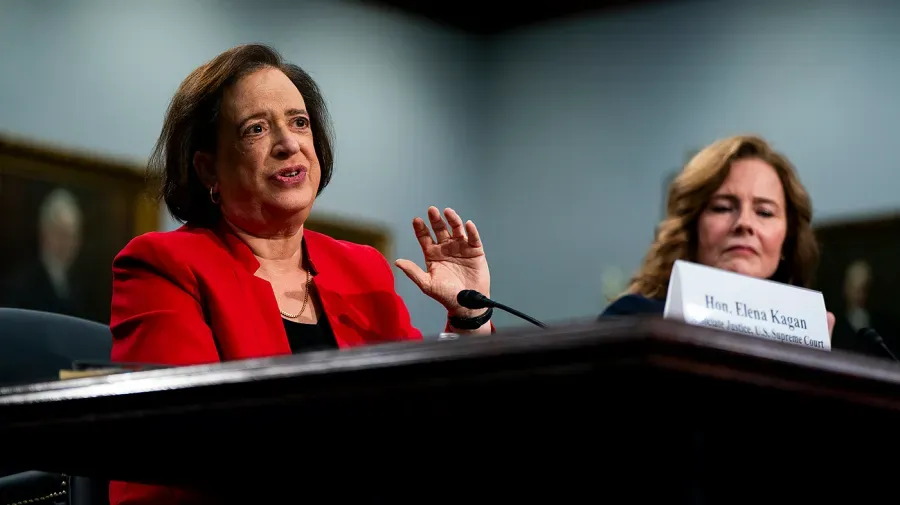
Supreme Court Justices Elena Kagan and Amy Coney Barrett split on Tuesday over whether the court needs an independent ethics enforcement mechanism. Rep. Rosa DeLauro (D-Conn.) asked Kagan about the idea she had floated a couple years ago.
Supreme Court Justices Elena Kagan and Amy Coney Barrett did not agree on how to enforce the Supreme Court's ethics rules. The Tuesday exchange came after Rep. Rosa DeLauro (D-Conn.), the panel's ranking member, asked Kagan whether she still supported an independent enforcement mechanism Kagan had discussed a couple of years ago.
In plain English: the question is not whether the justices have an ethics code. It is whether there should be a separate, independent body that can enforce it, or whether the current system, which depends heavily on internal processes and self-regulation, is enough. Kagan and Barrett shared differing views, and that split matters because ethics enforcement is less about paper standards and more about who gets to say “that’s a violation” when the stakes are highest.
This is where the Supreme Court’s structure collides with modern expectations. Courts are supposed to be insulated, impartial, and focused on the law. But in recent years, ethics scrutiny has moved from abstract ideals to practical enforcement questions across government. When people think of “independent enforcement,” they typically picture something closer to an inspector or compliance function that is not embedded in the same institution whose conduct is being evaluated.
DeLauro’s approach reflects that shift. As ranking member, she used her role to press directly on Kagan’s earlier position. That matters because a member asking “do you still support it?” is not a casual follow-up. It forces a public answer tied to a concrete policy concept: a mechanism that could reduce the perception that enforcement is too cozy or too internal.
The timing also sits inside a broader governance reality for high-trust institutions. Even when an organization has an ethics code, compliance becomes meaningful only when there is a credible pathway to consequences. Without that, critics argue that codes can become symbolic, a shield rather than a guardrail. Supporters of independent enforcement say it would strengthen legitimacy by making enforcement feel more objective. Opponents often worry about adding layers that could create new disputes, new pathways for political pressure, or new uncertainty in how a court operates.
Barrett’s differing view on Tuesday signals that the resistance to independent mechanisms is not merely procedural. It is philosophical about what “independence” should mean for the judiciary. If enforcement is externalized too much, critics of independent panels worry it could invite a recurring fight about jurisdiction, standard of review, or how allegations are handled. If enforcement stays internal, supporters worry it never fully escapes the optics problem: the same institution that is judged is also responsible for deciding whether it is being judged fairly.
For Kagan, the question DeLauro asked was also a consistency test. The idea Kagan floated “a couple of years ago” is now being challenged in public with a direct yes or no framing: has her support for the concept held up, or has the reasoning changed? When a justice engages that question, it is not just a personal preference. It is about institutional design, meaning what kind of legitimacy the court wants, and how it thinks enforcement should work for the justices themselves.
Executives and boards might wonder why they should care about Supreme Court ethics enforcement. Here is the second-order implication that travels beyond Washington: when major institutions debate enforcement credibility, it reshapes expectations for governance everywhere. Companies already operate under compliance frameworks where enforcement must be credible to maintain trust with regulators, customers, employees, and investors. If the Supreme Court is viewed as unable or unwilling to create meaningful independent enforcement, it can reinforce a broader skepticism that “codes without consequences” are not enough. If the court moves toward a more independent mechanism, it would be a high-visibility signal that enforcement design matters, even for institutions that prize insulation.
At the same time, a court ethics debate is not a normal corporate governance story. There is no board with a compliance officer, no audit committee chartered to oversee enforcement, and no straightforward analog for how independence is protected. So the stakes for decision-makers are subtle but real: the legitimacy of rulemaking and the credibility of enforcement shape how other institutions model their own compliance systems. In other words, this is not only about what happens to the court. It is about how the world interprets what “ethical enforcement” looks like at the highest level.
This story's Key Insights and Take-aways are locked.
Create a free account to unlock Executive Actions for one credit.
Register to UnlockAlways free for Executives Club members. Join the Club
More in Politics

LA County: DOJ's 20,000 'noncitizen' voter list is 'unreliable,' includes U.S.-born
Preliminary review by Los Angeles County election officials finds errors in the federal list, raising the stakes for voter roll integrity ahead of November.

Trump's $1.5B Pentagon chip investment lands in North Carolina
A $1.5 billion defense infusion for North Carolina chipmaking signals a new era of Pentagon-backed reshoring - here's what it means for the industry.

Nigeria confirms first Ebola case in Abuja, a woman just off a Uganda flight
Health Minister Muhammad Ali Pate says the patient flew in from Uganda, putting Africa's latest outbreak on Nigeria's doorstep.