

Looters missed it: 2,700-year-old Etruscan 'tomb of highest rank' unearthed
A monumental burial at Vulci, untouched by ancient thieves, reveals elite grave goods that could rewrite Etruscan history.
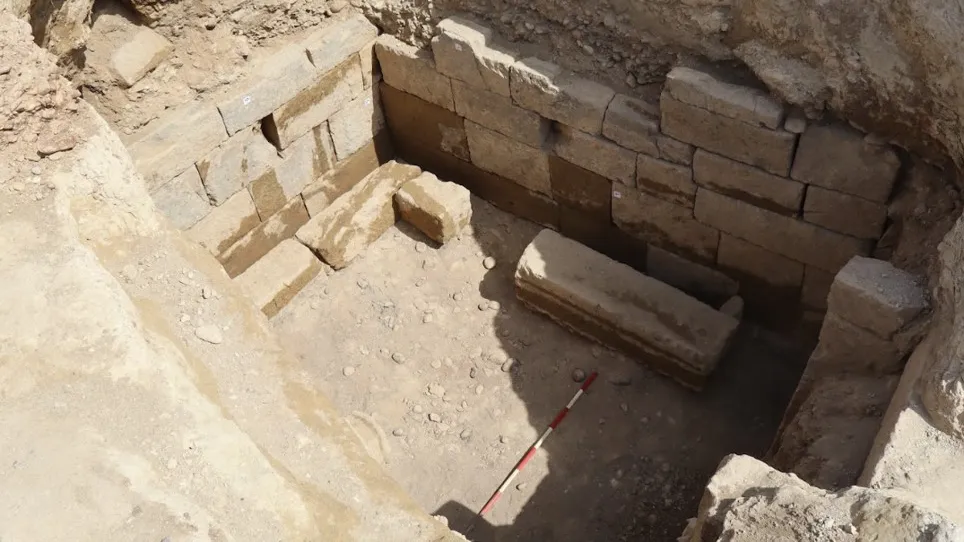
Archaeologists with the Return to Vulci project, co-directed by Christian Mazet of the British Museum, have unearthed a 2,700-year-old Etruscan tomb at Vulci, Italy. The discovery, which survived centuries of looting, contains weapons, chariot parts, gold, and a banquet set, indicating a burial of the highest rank.
After more than 130 years of searching, archaeologists have finally cracked the Gsell tumulus at Vulci - and what they found inside has survived centuries of tomb robbers. The 2,700-year-old burial, dubbed the Tomb of the Stone Chamber, is "of the very highest rank," according to Christian Mazet, an archaeologist at the British Museum and co-director of the Return to Vulci project. The tomb yielded a massive collection of grave goods, including weapons, gold and bronze plates, chariot parts, a rare pair of women's shoes, and a complete banquet set. Despite repeated attempts by looters over the centuries, the artifacts remained largely intact, preserved beneath the collapsed roofs of the tomb's three burial chambers.
The discovery builds on work from 1889, when French archaeologist Stéphane Gsell identified the circular enclosure of the burial mound but ran out of time and money to find the tomb itself. Now, the Return to Vulci project has located the burial chamber inside the "Gsell tumulus" - and it's much larger than expected. In the side chambers, archaeologists recovered a bronze tripod made on the Greek island of Rhodes, a nearly complete banquet set with vessels still in their original positions, and high-quality ceramics. Mazet told Etruscan Times that "there is no doubt that this is a tomb of the very highest rank."
The Etruscan cemetery at Vulci is renowned for its wealthy tombs, thousands of which were excavated in the 19th century. The Etruscans ruled central Italy for centuries before declining in the fourth century B.C. with the rise of Rome. Their language remains only partly understood, making archaeological sites like Vulci crucial for understanding their civilization. Gsell had estimated the tumulus at about 102 feet (31 meters) in diameter, calling it a "new Cuccumella," after the largest Etruscan burial mound previously found at Vulci, which measured roughly 230 feet (70 meters). Initial calculations from the Return to Vulci project suggest the Tomb of the Stone Chamber may be similar in size to Cuccumella, or perhaps even larger. "Everything tells us that it is one of the most monumental at Vulci," Mazet said.
The tomb and burial mound have been covered to preserve them, according to the Italian Superintendency of Archaeology, Fine Arts and Landscape for the Province of Viterbo and Southern Etruria (SABAP-VT-EM). Research will continue in 2027. For decision-makers in cultural heritage and tourism, this find underscores the enduring value of archaeological investment. The discovery not only enriches historical knowledge but also has the potential to draw global attention to Vulci, a site that already boasts thousands of tombs. As the project continues, the Tomb of the Stone Chamber could become a cornerstone of Etruscan studies, offering rare insights into elite funerary practices and trade networks that connected central Italy to the wider Mediterranean.
This story's Key Insights and Take-aways are locked.
Create a free account to unlock Executive Actions for one credit.
Register to UnlockAlways free for Executives Club members. Join the Club
More in Science

Alaska's 1,580-foot tsunami had warning signs. Scientists just found them.
Rapid glacier retreat, heavy rainfall, and thousands of tiny tremors preceded Alaska's 1,580-foot tsunami, a warning for every coastal community in a warming world.

The rare mutation that lets high-risk brains dodge Alzheimer's
Scientists found a natural defense against protein buildup, opening a new path to preventive treatments.

3,000 steps a day may halve Alzheimer's decline, study finds
New research links a modest daily walk to less tau buildup and nearly half the cognitive and functional decline, even for those with early signs.