
Lucid cuts 18% and nukes Marc Winterhoff COO role amid Uber-Nuro robotaxi push
The ex-COO said the partnership was built for speed and capital discipline. Now the spreadsheet matches the pitch.
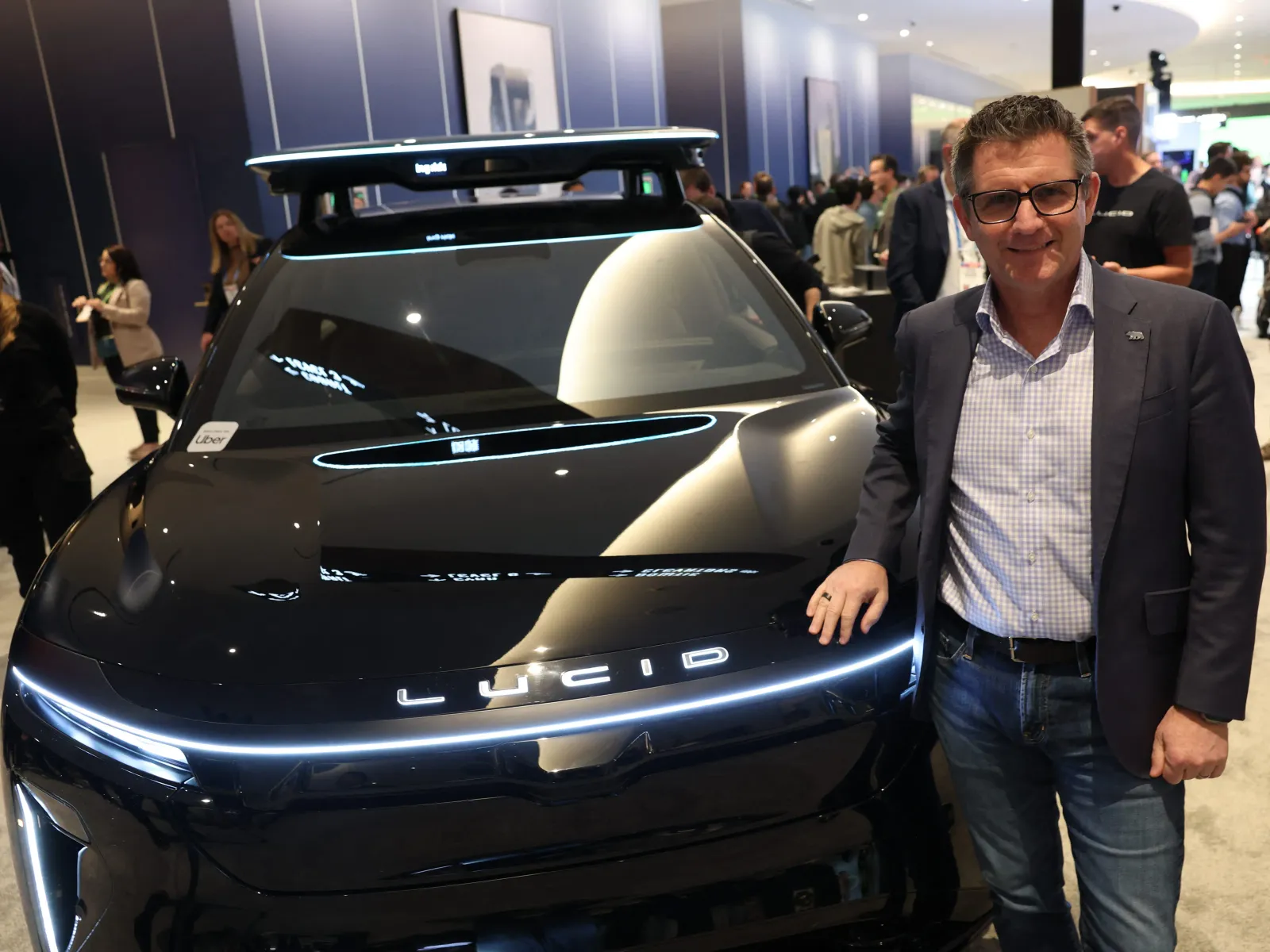
Lucid cut about 18% of its US workforce and eliminated the chief operating officer role held by Marc Winterhoff. The move advances the company's path toward profitability and positive cash flow while its robotaxi partnership with Uber and Nuro targets a commercial launch in San Francisco later this year.
Lucid just went on a belt-tightening mission and singled out operations itself. On Monday, the EV maker cut about 18% of its US workforce and eliminated the chief operating officer role held by Marc Winterhoff, according to a company securities filing. Lucid said the cuts are meant to advance its path toward profitability and positive cash flow, a direct signal that the company is trying to reduce cash burn at a critical moment in its growth story.
Winterhoff is also the person who previously described why Lucid’s robotaxi bet would not behave like a typical, cash-heavy moonshot. In April, he told Business Insider that the strategy was designed for “minimal deployment of capital investment,” so the company could offer fast robotaxi solutions through partners rather than building a full robotaxi operation from scratch. The headline move, and the Winterhoff strategy memo, line up: cut costs now, partner for robotaxis, and keep spending in check while the EV business fights for scalable profitability.
To understand why this is more than just corporate housekeeping, you have to zoom out to what Lucid has promised. At an investor day in March, Lucid laid out a sprawling plan: diversify its vehicle lineup with sub-$50,000 midsize SUVs, and pursue autonomous driving and robotaxis. But unlike a marketing slide, reality is measured in cash. Lucid “has yet to prove that it can profitably scale its EV business,” and that tension is why cutting costs while pursuing a robotaxi rollout through partners matters.
Winterhoff’s key argument was speed plus capital discipline, achieved via partnership. Lucid is pursuing robotaxis through a partnership with Uber and Nuro, targeting a commercial launch in San Francisco later this year. Winterhoff said Uber wanted a robotaxi ready for commercial deployment by 2026, and he argued that there was “literally nobody out there saying, 'Okay, we can do that,'” which helps explain why Lucid leaned on a route that could get to market faster rather than betting everything on an in-house autonomous vehicle stack.
He also made the financial case. Building the autonomous vehicle stack in-house would require “billions of investment,” with returns potentially not seen until 2030 or beyond. That timing gap is exactly where companies bleed: you can burn money for years, but investors and boards still want a credible path to cash generation. In Winterhoff’s framing, robotaxi is a “second leg” for Lucid to stand on next to personally-owned vehicles, meaning the company wants upside without turning robotaxis into a bottomless pit.
The partnership details underline the bet. Winterhoff said Uber is committing $500 million to supply at least 35,000 vehicles from Lucid, including 10,000 Gravity SUVs. The Gravity SUV will be retrofitted with Nuro's autonomous driving platform to deliver robotaxis for Uber. In other words, Lucid is trying to separate two problems that are usually tied together: vehicle manufacturing and robotaxi deployment. The manufacturing still costs money, but the autonomy integration pressure is shared with partners.
Now add the cash-saving lever Lucid just pulled. The restructuring is expected to generate about $158 million in annualized cost savings, Lucid said in the filing. The company is also eliminating the second production shift at AMP-1, its manufacturing plant in Casa Grande, Arizona. Lucid did not specify which vehicle programs or production lines would be affected, so investors will be watching output, delivery rates, and whether demand is soft enough to justify further production pullbacks.
And yes, analysts are already mapping this to the robotaxi plan. James Picariello, a senior analyst at BNP Paribas Equity Research, wrote in a note on Monday that Lucid remains on a “step road to breakeven.” He suggested the cost-cutting effort points to ongoing softness in demand for the Lucid Air sedan and Gravity SUV, and that the $158 million in savings does little to change Lucid’s cash-burn trajectory. Still, Picariello told Business Insider he does not see the latest cuts as a direct threat to the robotaxi plans, writing that he does not see “any real direct implication from LCID's cost-cutting effort announced today, and its 'contract manufacturer' partnership with Uber/Nuro.” In short: the board may be tightening the EV machine, but leaving the robotaxi pathway intact.
Importantly, Lucid’s spokesperson said Monday’s announcement will not affect the company’s robotaxi strategy or its Uber-Nuro partnership. Winterhoff, meanwhile, did not respond to a request for comment. Strategically, though, removing the COO role after it was held by the architect of the capital-discipline robotaxi pitch is its own message. For executives and boards across the EV and autonomy stack, the lesson is blunt: you can partner to reduce burn, but you still have to show progress toward cash profitability now. The robotaxi timetable can be fast. The runway still has to be longer than the burn rate.
This story's Key Insights and Take-aways are locked.
Create a free account to unlock Executive Actions for one credit.
Register to UnlockAlways free for Executives Club members. Join the Club
More in Business
Accenture’s $4.18bn play fails as AI fears spark a 20% worst-ever stock plunge
On Thursday, Accenture hit its biggest one-day drop on record after forecasting worries that AI could hollow out consulting.

SpaceX stock jumps 3% after it overtakes Amazon’s market cap
CNBC says SpaceX’s shares surge following its IPO Friday, forcing investors to reprice what “space” and “AI” are worth.
SpaceX’s first options day breaks U.S. records after a $85B IPO win
Big IPO, bigger options debut: what it means for investors, risk teams, and anyone benchmarking market appetite.