
Macron and Tusk map nuclear deterrence and satellites, as France-Poland defense ties deepen
At a Gdansk summit, the leaders outlined concrete steps on nuclear deterrence while Airbus and Thales sign a military satellite deal.
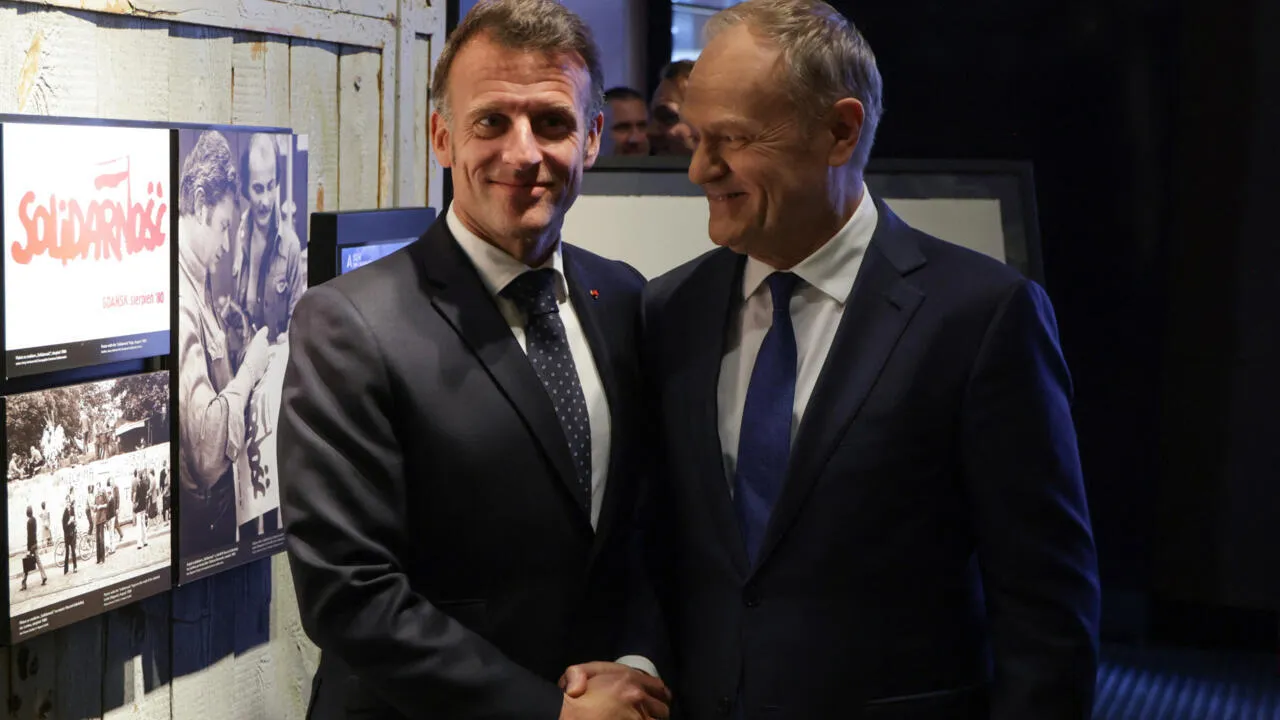
French President Emmanuel Macron and Poland's Prime Minister Donald Tusk used a bilateral summit in Gdansk to push deeper cooperation in defense, including work on nuclear deterrence and military satellites. The move gives decision-makers a clearer signal on how quickly Europe can align procurement, industrial capacity, and security policy around shared risks.
On Monday in Gdansk, French President Emmanuel Macron and Poland's Prime Minister Donald Tusk laid out plans meant to turn a “heightened security” moment into something operational. The headlines were about deeper defense alignment, but the details went right to nuclear deterrence, intelligence sharing, joint military exercises, and even the possible deployment of French aircraft capable of carrying nuclear weapons on Polish territory.
Macron said the work over coming months would pave the way for “concrete progress” on nuclear deterrence, a sensitive topic that has become more prominent in European defense debates. The practical list matters because it moves the conversation beyond slogans: intelligence sharing, joint military exercises, and potential basing arrangements for French nuclear-capable aircraft in Poland. On the other side, Tusk struck an upbeat tone, saying cooperation between the two countries “knows no bounds,” whether in nuclear matters or broader military coordination. He also posted on X to underline the political foundation: “Thank you for the lasting friendship and mutual trust.”
This is not happening in a vacuum. The Gdansk meeting was framed as the first concrete follow-up to a friendship and enhanced cooperation treaty signed in Nancy in May 2025, which elevated Poland to the rank of one of France’s closest allies, alongside Germany. In other words, the leaders are using a formal political upgrade as a platform to accelerate defense planning. And the symbolic touches are doing real work too: Macron visited a cemetery for French soldiers in Poland, echoing gestures made by Charles de Gaulle and Francois Mitterrand in previous decades. Those rituals may look ceremonial, but they often function as credibility signals in long-horizon alliances.
The summit also pulled the industrial layer into the same gravitational field as the military one. Alongside strategic discussions, a major industrial agreement was signed by Airbus, Thales, and Poland’s Radmor to develop a geostationary military communications satellite for the Polish armed forces. That is the kind of capability that becomes a force-multiplier long after a summit photo fades. It also links directly to other areas the leaders discussed, including space assets, early warning, and broader coordination. If nuclear posture and satellite communications are on the same agenda, it signals that the relationship is being built across the entire stack of deterrence and command-and-control.
Where this gets particularly interesting for executives is how it sits inside Poland's larger security balancing act. The source notes that Poland has embarked on an ambitious military modernisation drive, with defense spending expected to exceed 4.8 percent of GDP in 2026, one of the highest levels in NATO. Much of that investment is going toward US-made equipment, including F-35 fighter jets, Apache helicopters, Patriot missile systems, and Abrams tanks. So even as Poland strengthens defense ties with France, it remains strongly attached to its security relationship with Washington. That tension shows up domestically: President Karol Nawrocki opposes participation in the EU’s SAFE defence financing programme, arguing it could undermine national independence. For leaders thinking about procurement, industrial partnerships, or regulatory navigation, that means “Europe-wide funding” and “national control” are not aligned automatically. Defense spending targets can be huge, but decision rights are contested.
The summit also brushed up against Europe’s political machinery and Ukraine financing, because defense cooperation is often downstream of what European governments can agree on. Against this backdrop, Macron said he was “reasonably optimistic” about unlocking a €90 billion European loan package for Ukraine, suggesting shifting political dynamics in Europe could ease decision-making. That matters because if capital for Ukraine and allied defense becomes easier to unlock, it can accelerate downstream procurement cycles, industrial production timelines, and partner onboarding. It can also change how fast countries commit to shared initiatives like satellites, air defense, and long-range strike systems.
Macron and Tusk added another political thread by welcoming political change in Hungary following the electoral defeat of Viktor Orban, expressing hope that it would reinforce pro-European cohesion within the bloc. The implication for boards and strategy teams is simple: European defense integration is not just about technology and budgets. It is also about coalition stability, voting dynamics, and whether member states view “shared security” as compatible with their domestic politics. Finally, the leaders layered in cultural cooperation, with plans for a joint cultural season in 2027 and the Bronislaw Geremek Prize presentation, reinforcing that this is a relationship being built for the long haul, not only for the next procurement cycle.
For executives in defense, aerospace, space, or any business touching NATO-aligned procurement, the stakes are real. This Gdansk meeting is a concrete signal that France and Poland are trying to connect strategic deterrence concepts to procurement and industrial delivery, including communications satellites. If that momentum holds, it can reshape partner selection, speed up industrial qualification, and influence which capabilities become “must-haves” across aligned European forces. And if it fails, the risk is not just strategic misalignment. The opportunity cost is time, and in defense planning, time is a weapon too.
This story's Key Insights and Take-aways are locked.
Create a free account to unlock Executive Actions for one credit.
Register to UnlockAlways free for Executives Club members. Join the Club
More in Business

Anthropic’s Levant Alpöge cracks the Jacobian conjecture after 87 years
A Harvard valedictorian used Claude to hit a 1939 breakthrough, but the missing “why” is the real problem.

Uber buys Delivery Hero for nearly $15B, vaulting to top food delivery outside China
The deal doubles Uber's dual-services footprint and pushes a ride-and-eats bundling play into 50 more markets.

Epic and Google drop settlement bid, forcing rival Android app stores by July 22
Google told the court it is ready to carry third-party app stores starting Wednesday, July 22.