
Macron courts Oman on his first state visit, banking on neutral access amid Hormuz crisis
France and Sultan Haitham bin Tariq announce major French-company contracts, using Oman’s position to navigate regional risk.
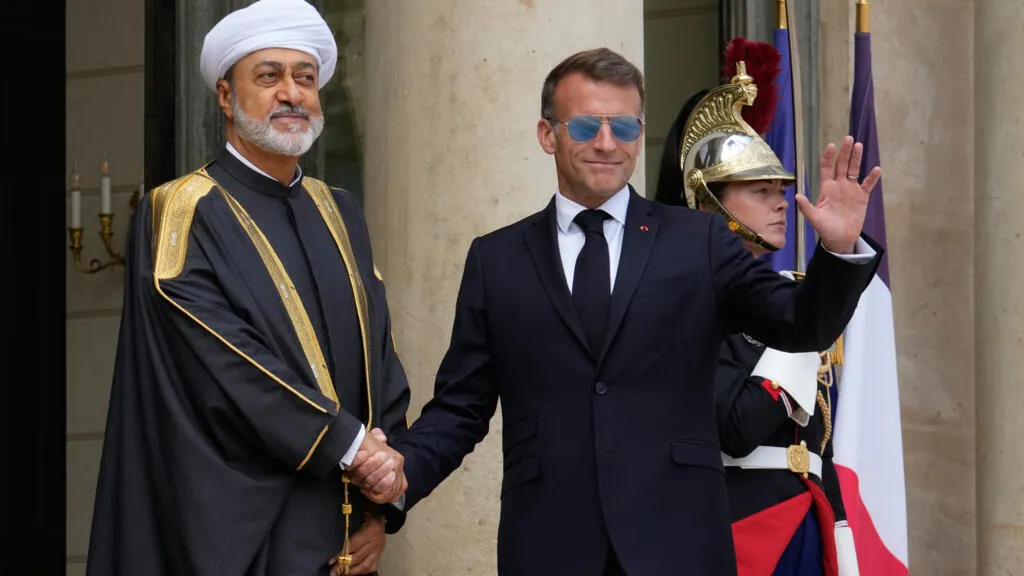
On his first state visit, French President Emmanuel Macron met Sultan Haitham bin Tariq of Oman and announced major contracts for French companies. The move signals France wants influence and commercial momentum through Oman’s long-standing role as a quiet, neutral player.
France is betting on Oman because the Middle East has been in crisis for months, and neutral access is suddenly a strategic asset. In Monday’s first state visit by French President Emmanuel Macron to Oman, Sultan Haitham bin Tariq and Macron announced a string of major contracts for French companies. The headline message is simple: France wants to strengthen relations with a smaller regional player that has been viewed for years as quietly neutral.
That matters because “crisis in the Middle East” is not just a headline. It can quickly become a real-world constraint on shipping lanes, insurance pricing, supply reliability, project timing, and political risk management. When a European leader publicly doubles down on a relationship with Oman at the exact moment the region is under strain, it is also a signal to markets: French firms can find pathways to business even when the bigger neighborhood turns volatile. In this case, the specific action is the announcement of major contracts for French companies during Macron and Sultan Haitham bin Tariq’s state visit.
To understand why Oman is the chosen vehicle, look at how regional neutrality functions in practice. Oman has often been perceived as a steady, non-combative channel in a part of the world where alliances can look brittle and fast-moving. In an environment shaped by heightened tensions around the Strait of Hormuz, the ability to operate with fewer public shocks can be the difference between a project that keeps moving and one that gets paused. France’s approach suggests it is not just pursuing market share. It is positioning for continuity.
There is also a business logic underneath the diplomacy. Major contracts do not only bring revenue. They also create long-term embedded relationships with regulators, local partners, and state-linked procurement channels. For French companies, being part of a government-backed deal during a period of regional instability can mean steadier pipelines, clearer contracting expectations, and improved odds of navigating permitting and operational approvals. For boards and investors, these are the unglamorous variables that drive risk-adjusted returns. In politically sensitive regions, “where you win” is often as important as “how much you win.”
The timing of the visit is part of the story too. Macron’s trip is described as his first state visit to France by the Sultan, which gives it a ceremonial weight, but also a deliberate political window. State visits are where governments publicly align objectives, not where they quietly compromise. Announcing a “string of major contracts” in that forum tells French corporate leaders that the government is not sitting on the sidelines. It is underwriting the relationship with tangible commercial outcomes.
Now zoom out one layer. For a large economy like France, regional influence can translate into leverage across future negotiations, from defense and infrastructure to energy and industrial cooperation. The Hormuz crisis creates uncertainty that can spill across multiple sectors, including logistics and energy demand. Even if individual French firms are not direct players in the most sensitive corridors, they still operate in an ecosystem affected by the same risk. When France strengthens ties with a neutral route-holder like Oman, it is essentially trying to reduce the probability that regional shocks become abrupt corporate interruptions.
Second-order implications follow. Other European governments and multinational companies will read this as a message about where deals will be protected, facilitated, or at least shielded from the worst of the chaos. Boards that have exposure to Middle East projects may take note, because government-to-government alignment can affect how quickly issues get resolved, how contracts get interpreted, and whether renegotiations are initiated under pressure. Even for firms without direct Oman exposure, France’s posture can hint at how peers may reallocate attention toward countries perceived as more operationally stable.
Finally, this strategy is about resilience. France is not ignoring the crisis; it is selecting a partner to build influence while staying relatively close to a known, neutral center of gravity in the region. The first state visit between Macron and Sultan Haitham bin Tariq, paired with announcements of major contracts for French companies, frames Oman as more than a backdrop. It is the operational hinge that France wants to hold onto while the broader region struggles to calm down.
This story's Key Insights and Take-aways are locked.
Create a free account to unlock Executive Actions for one credit.
Register to UnlockAlways free for Executives Club members. Join the Club
More in Politics

Glacial collapse, not rain, killed 180 in Nepal's Himalayan flood
The Himalaya's extreme geography hid the true cause of Nepal's catastrophic flood, a glacial collapse that turned a geological battleground into a mass-casualty zone.

Iran’s Esmail Baghaei says Oman talks start shipping via Hormuz, not US talks yet
Temporary route plans with Oman aim to restart commerce while Tehran says Washington dialogue is not on the table.

Standards watchdog opens probe into Reform UK deputy leader Richard Tice over interests
The parliamentary standards commissioner says it began an investigation on 28 July into a possible undeclared interest.