

Marco Casalaina says Microsoft IQ is the missing context layer for enterprise agents
Build 2026 turns “agents in production” into a platform bet: context, governance, identity, memory, and secure data access.
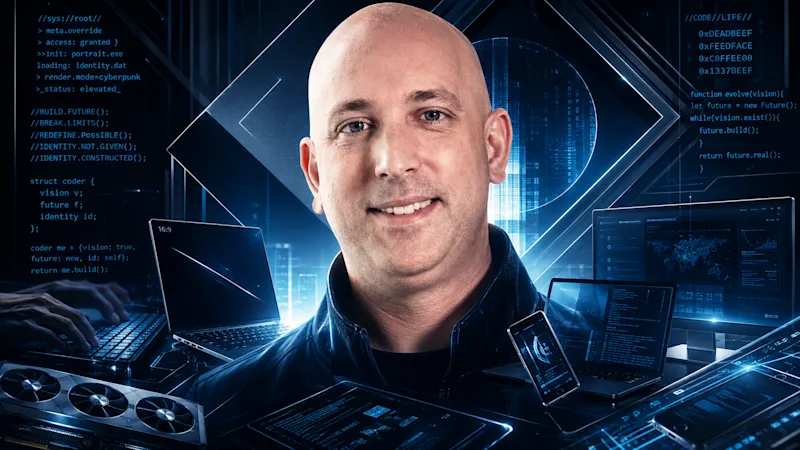
Marco Casalaina, Microsoft’s VP Products, Core AI and AI Futurist, used Build 2026 to lay out Microsoft’s agent strategy and the new Microsoft IQ context layer. For decision-makers, the message is simple: winning agent deployments will depend on reliable context and identity, not raw model access.
Microsoft’s Build 2026 wasn’t just another “agents are coming” moment. Marco Casalaina, Microsoft’s VP Products, Core AI and AI Futurist, made the platform case that the bottleneck for enterprise agents is context. His team is pushing Microsoft IQ as a context layer across GitHub Copilot, Microsoft Foundry, and Copilot Studio, with the core claim that agents will only work reliably in real companies if they can ground themselves in the right information, with the right controls.
Casalaina also tied Microsoft’s agent push to specifics: Microsoft announced Work IQ APIs coming June 16, plus Fabric IQ for structured business data, Foundry IQ for retrieval across enterprise knowledge and the live web, and Web IQ as a new agent-facing web search stack. In his framing, these IQs are headless, agent-facing building blocks that system developers and agent builders plug in, instead of end users hunting for a “magic” setting. If you are evaluating where to place bets internally, the implication is that the platform layer doing the context handoff will matter more than the prompt someone writes once and forgets.
To understand why this is landing now, zoom out to what “agentic AI” usually means in enterprises: software that can take actions, not just answer questions. The challenge is that enterprise work is fragmented across systems, with permissions, workflows, and data formats that rarely match a single unified “source of truth.” Casalaina’s answer is to build context at the stack level, then wrap it in governance and identity. At the base, he emphasized Microsoft’s model-choice approach, built on partnerships and in-house options. Microsoft has OpenAI GPT frontier models, offers Anthropic Claude models, launched Claude Opus 4.8 on Azure (on Foundry), and introduced new MAI models at Build. The MAI models are described as in-house frontier models designed for token efficiency, optimization, and customization, specifically built so customers can customize on their own datasets.
Then Microsoft moves up a level to hosted agents in Foundry, its managed agent capability. Casalaina described it as handling scaling, containerization, and other operational necessities, which is a big deal because enterprises do not want a pet project when they are deploying automation. On top of that sits the Foundry control plane, where developers can manage agents with observability into cost, tokens, and correctness. He pointed to continuous evaluations, sampled interactions, running evals, and checking that agents are not drifting over time. This is where “production” stops being a vibe and becomes a discipline: measurement, feedback loops, and guardrails.
At the center of the platform pitch is the “IQ” family. Casalaina said there are currently three IQs, and there will be four. Foundry IQ is positioned for knowledge, largely unstructured knowledge. Fabric IQ is designed for agents to access data customers have entrusted to the Microsoft Cloud in Fabric, Power BI, and related technologies, without forcing the agent to go through a Power BI report, which he called ridiculous. Work IQ is the agentic face of Microsoft apps like Outlook, Teams, Word, and SharePoint, meaning it governs how an agent interacts with those tools. Web IQ is the new agent-facing web search capability, including the ability to search the web, search through videos, and even perform some browsing tasks automatically. It is described as super fast and headless, meaning it is intended for agents rather than human users.
Importantly, Casalaina framed these as MCP servers. “All of the IQs are indeed exposed as MCP servers,” he said, characterizing MCP as an agent-facing, self-describing API with authentication layers and capabilities built in. Authentication is not a footnote here. He explained that Work IQ needs authentication so it can see and act on an individual’s email, Teams messages, and documents, and that “agent identity” is the next differentiator. Microsoft’s Entra system already supports declaring an agent with an identity; Casalaina said the update is that agents will have their own identity, their own Teams box, their own email inbox, and similar channels. Those agents can then use Work IQ to check their own email and documents.
For enterprise leaders, the “second-order” question is what happens after you turn on agents and they start doing work on your behalf. Casalaina addressed this with Agent Optimizer, which he said includes a new type of evaluation to determine more granularly whether an agent is actually working correctly. The optimization step can go back in, with consent, modify the prompt, and make modifications so the agent works more correctly going forward. In other words, Microsoft is trying to operationalize improvement over time, not just ship a model and hope for the best.
Finally, he anchored Microsoft’s strategy in model and platform positioning. Asked whether Microsoft is a model company, an infrastructure company, or a connector between models and work products, Casalaina answered “yes” to all of it, emphasizing commitment to model choice. His underlying point for boards and CIOs is that enterprises are not one-size-fits-all on models, and agent deployments are not one-size-fits-all on context. If Microsoft is right, the winners will be the platforms that combine access to capable models with reliable context, governance, identity, memory, and secure enterprise data access. And if you are betting on agents this year, that is the part you need to verify, not just the demos.
This story's Key Insights and Take-aways are locked.
Create a free account to unlock Executive Actions for one credit.
Register to UnlockAlways free for Executives Club members. Join the Club
More in Technology

OpenAI says 10,000 agents cracked a 90-year math problem in 88 hours
The company's claim is audacious, but one mathematician is pushing back. Here's what it means for AI-driven discovery.
Meta still serves child sexual abuse ads on Instagram in India - BBC report
A new report following the BBC Eye investigation says the ads are still there - what it signals for every platform with a self-serve ad engine.

White House yanks 'Build the Wall' game after Tetris Company copyright warning
The administration's arcade game vanished in hours - and the takedown playbook every brand can learn from.