
Martin Picard turns mitochondrial energy into a theory of mind
The biologist’s “energetic view of life” links cells, health, and experience, grounded in how mitochondria run biology.
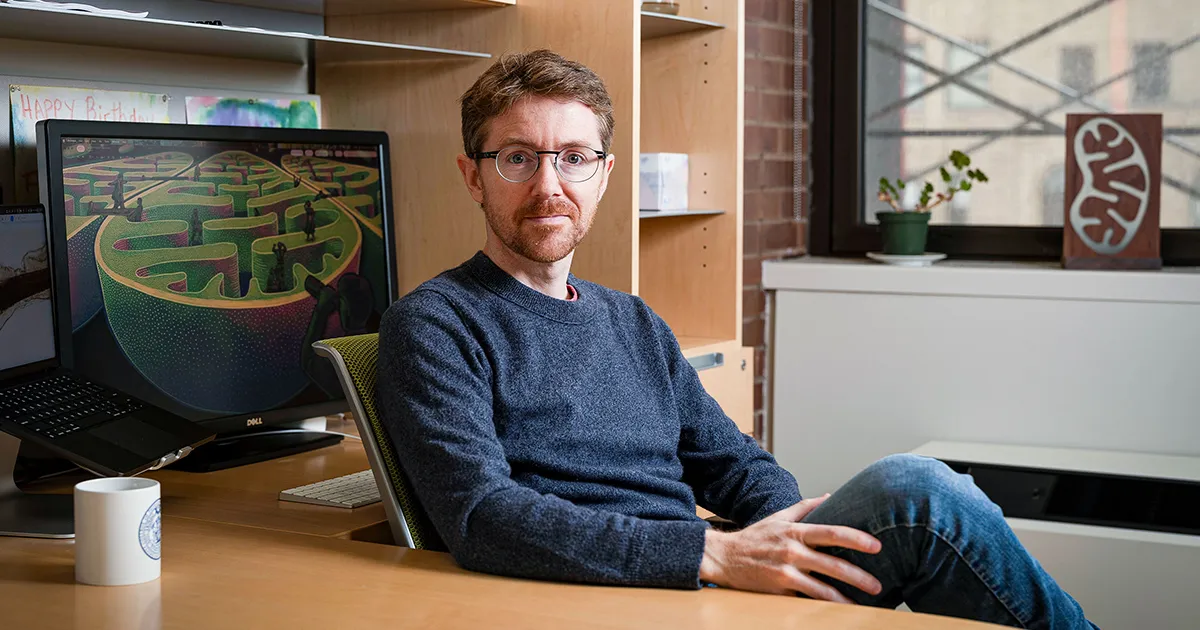
Martin Picard, a biologist, argues for an energetic view of life that treats mitochondria as a bridge between cells, health, and the mind. For decision-makers, the real consequence is whether biology funding and research priorities keep rewarding “energy-first” explanations of cognition and disease.
It was 9 a.m. on a Thursday, and Martin Picard was watching his blood flow from an IV in his arm through a hole in the wall. He sat in a twin bed inside a claustrophobic chamber, less than a shoulder's width from a stainless steel sink and a porcelain toilet, while a nurse pulled blood from his arm to a research team next door every hour over 24 hours, including while he slept.
That opening scene is not just the kind of detail science writers love. It signals what Picard is trying to solve with his “energetic view of life.” In his mitochondrial theory of mind, the body's strangest organelles are not passive background parts. They are central to how cells behave, how health emerges, and why living systems can produce something we experience as mind.
To understand why this matters beyond one person's lab schedule, zoom out to how modern biology and medicine typically work. Most frameworks try to connect genes, signals, and structures to outcomes like disease, recovery, and behavior. But Picard’s angle shifts the causal spotlight toward energy itself. Mitochondria are the organelles built to manage energy in cells. They are the machinery that helps cells turn fuel into usable biochemical work. If you treat energy flow as the organizing principle, the mitochondrion becomes a kind of translator: it connects metabolic state to downstream cellular behavior.
That “energetic” emphasis is a philosophical move too, and it has practical consequences. If your foundational explanation is energy, then experiments become about timing and coupling. You do not just ask whether something is present. You ask how it changes over time, in the living body, under real conditions. The hourly blood draws in the chamber are a direct expression of that mindset. The study setup forces repeated sampling across 24 hours, which makes it easier to examine how metabolic or physiological signals shift throughout the day, and how those shifts might relate to the broader claim that mitochondria link cells, health, and mind.
There is also a reason boards and investors should pay attention to theories like this, even when they sound lofty. Funding and regulation tend to move along the paths that produce measurable biomarkers, repeatable protocols, and defensible endpoints. An energy-first theory gives researchers a route to convert “mind” and “experience” into something testable through biological state. That does not mean the mind becomes a single metabolite. It means the theory tries to anchor the slippery idea of mind in physical processes that laboratories can measure, model, and eventually target therapeutically.
Of course, there is tension in any attempt to bridge levels of biology. Mitochondria operate in cells, while mind is about brains, behavior, and subjective experience. A theory of mind that starts in mitochondria has to earn credibility by producing evidence that the energy story scales upward. That is where careful experimental design comes in, the kind Picard is living inside: isolation, controlled conditions, and high-frequency data collection. It is also where second-order scrutiny shows up. Reviewers will look for causal direction, not just correlation. Regulators and clinical teams will demand safety, reproducibility, and clear criteria for interpreting results.
If Picard’s approach holds, it reframes what “health” means in research and medicine. Health is often framed as the absence of disease, or as restoring normal function. An energetic view treats health as an emergent property of energy management and cellular coordination. That shifts attention to mitochondrial performance, metabolic regulation, and the upstream drivers of energy imbalance. For executives overseeing research portfolios, the implication is straightforward: organizations that bet on mitochondrial biology may be positioning themselves for a future where energy-linked biomarkers guide diagnosis, monitoring, and perhaps interventions.
At the same time, this kind of work tests how organizations handle uncertainty. Boards do not get rewarded for certainty they cannot justify. They get rewarded for allocating resources to hypotheses with enough empirical traction to survive skepticism. Picard’s story starts with a body in a chamber and hourly samples across a day. It is the opposite of a purely speculative paper trail. It is a reminder that the best “big ideas” in science often begin with uncomfortable logistics, the kind that force researchers to measure what they claim.
So the strategic stakes for peers in similar roles are not just “what does mitochondria have to do with mind?” The stake is whether the next wave of biology and medicine will treat energy flow as an organizing principle strong enough to connect the cellular to the cognitive. If that connection tightens, it could influence where budgets go, what endpoints regulators accept, and how companies decide which platforms to scale. And if it fails, the same scrutiny will expose quickly whether the energetic theory can produce the evidence needed to make it more than a bold framework.
This story's Key Insights and Take-aways are locked.
Create a free account to unlock Executive Actions for one credit.
Register to UnlockAlways free for Executives Club members. Join the Club
More in Science

Alaska's 1,580-foot tsunami had warning signs. Scientists just found them.
Rapid glacier retreat, heavy rainfall, and thousands of tiny tremors preceded Alaska's 1,580-foot tsunami, a warning for every coastal community in a warming world.
The rare mutation that lets high-risk brains dodge Alzheimer's
Scientists found a natural defense against protein buildup, opening a new path to preventive treatments.

3,000 steps a day may halve Alzheimer's decline, study finds
New research links a modest daily walk to less tau buildup and nearly half the cognitive and functional decline, even for those with early signs.