
Mauritius becomes Artemis Accords' 70th signatory as NASA pushes Moon governance
A seventh African country joins the coalition, with NASA pointing to Apollo to Artemis navigation roots in Mauritius.
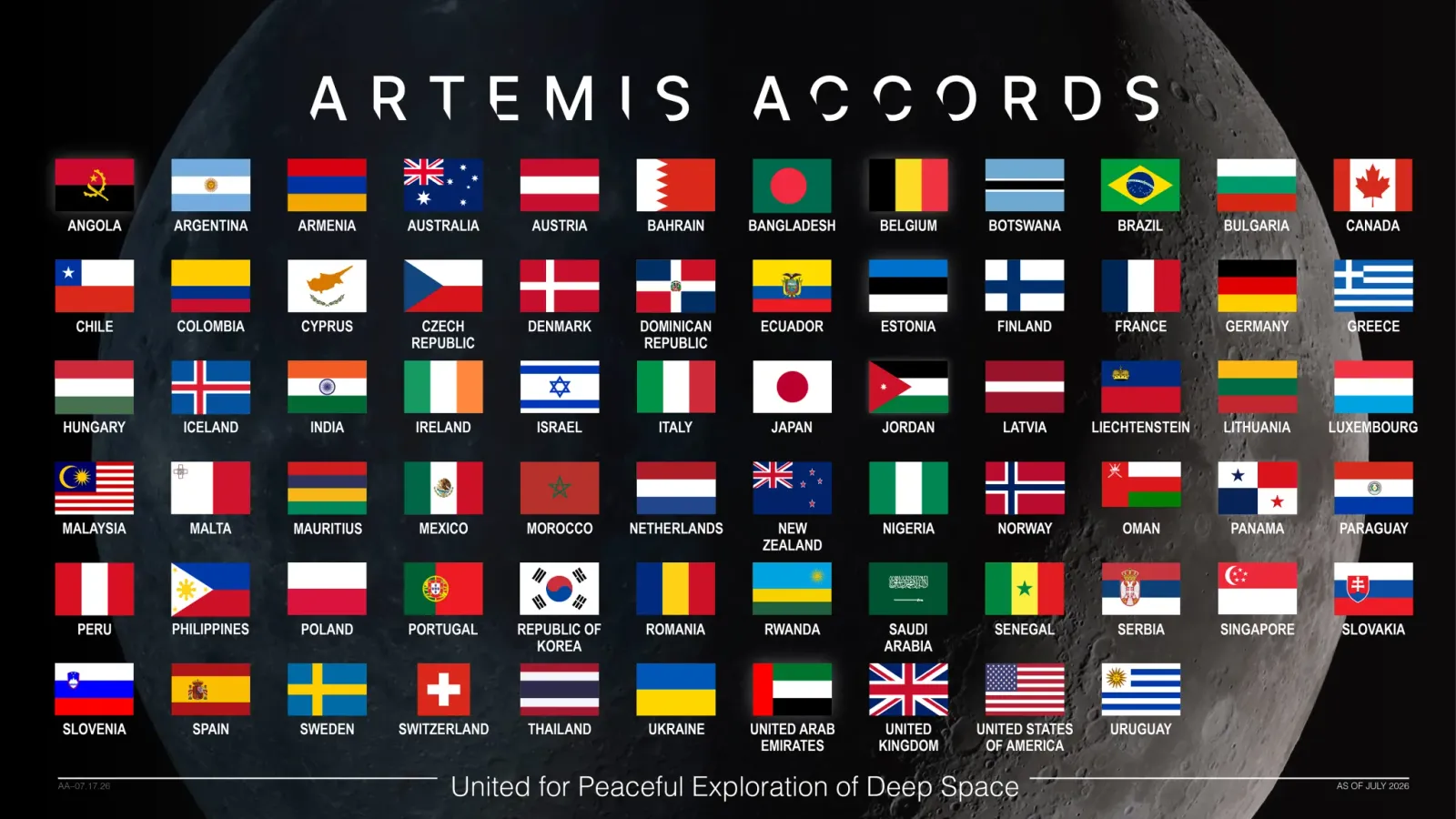
NASA welcomed the Republic of Mauritius as the 70th signatory to the Artemis Accords during a signing ceremony in Ébène, with NASA Deputy Administrator Matt Anderson delivering video remarks. Mauritius’ Permanent Secretary Navindsing Jugmohunsing signed on behalf of the country, expanding the coalition to a seventh African member.
Mauritius just officially joined the Artemis Accords, becoming the 70th signatory in a move NASA frames as more than paperwork. NASA’s Deputy Administrator Matt Anderson delivered video remarks at the signing ceremony on Friday in Ébène, telling viewers that the partnership is building “the foundation for future exploration while ensuring that space remains peaceful, accessible, and beneficial for all.” In other words: NASA is treating this as governance, not just exploration branding.
The signing itself also had an on-the-ground representative. Mauritius’ Permanent Secretary at the Ministry of Tertiary Education, Science and Research, Navindsing Jugmohunsing, signed the Artemis Accords on behalf of the Republic of Mauritius. The ceremony included U.S. Deputy Assistant Secretary of State for African Affairs Sarah Troutman and U.S. Chargé d'Affaires to Mauritius Craig Halbmaier as witnesses, underscoring that this is coordinated international policy work, not a purely technical milestone.
Why should executives care? Because the Artemis Accords are designed to shape how governments and companies behave before they even show up with spacecraft, instruments, or lunar operations. The Accords were established in 2020 by NASA and the Department of State, along with seven other founding nations, as interest in lunar activities expanded across both governments and private companies. That context matters: when more actors crowd into a shared environment, the biggest risk often is not innovation, it is interference, uncertainty, and disputes over what counts as acceptable conduct.
So the Accords introduced a first set of practical principles meant to enhance safety and coordination between like-minded nations exploring the Moon, Mars, and beyond. Those commitments include exploring peaceably and transparently, rendering aid to those in need, enabling access to scientific data, ensuring activities do not interfere with those of others, and preserving historically significant sites and artifacts through best practices.
NASA also ties Mauritius into the Artemis story with a specific operational history that goes beyond diplomacy. NASA first engaged with Mauritius through its early global mapping efforts, citing the nation’s strategic location. Between 1965 and 1980, NASA used several satellite missions to collect global measurements of Earth’s size and shape. As part of that work, NASA sent teams to Mauritius and other international tracking stations to support satellite photography for geodetic analysis. NASA says those observations strengthened navigation technologies used from Apollo to Artemis, and helped lay the foundation for the partnership reaffirmed today by the Artemis Accords. In executive terms, NASA is signaling that partnerships are earned through long-running technical reliance, not only through press moments.
That technical legitimacy feeds into a bigger policy push NASA references directly. Five years after the Accords were created, President Donald J. Trump’s National Space Policy directed NASA to establish a sustained lunar outpost, described in the source as “Moon Base.” NASA says it is putting the Accords principles into practice by inviting every signatory, including Mauritius, to take part in the endeavor. That is a key second-order point for leadership teams watching space business opportunities: governance and access are being linked to real operational plans, which can affect who qualifies for collaboration and how risk is managed.
There is also a forward-looking market implication hidden in the final lines. NASA expects more countries to sign the Artemis Accords in the months and years ahead as it continues its work to establish a safe, peaceful, and prosperous future in space. If you are an operator, investor, or platform builder in space, that translates into a slowly expanding map of “rules of the road.” Over time, those rules can become a baseline for partnerships, data exchange expectations, operational constraints, and reputational signaling. The more signatories join, the more likely it becomes that contracts, missions, and hardware roadmaps will be evaluated against these principles.
In short, Mauritius joining as the 70th signatory, and the seventh African country, is NASA’s way of tightening the governance fabric around the next phase of lunar activity. For executives and board members, the stakes are straightforward: when exploration scales, coordination becomes the differentiator. The Accords are positioned as the coordination mechanism, and NASA is using signatory expansion, technical history, and the sustained lunar outpost roadmap to make that mechanism real.
This story's Key Insights and Take-aways are locked.
Create a free account to unlock Executive Actions for one credit.
Register to UnlockAlways free for Executives Club members. Join the Club
More in Science

Alaska's 1,580-foot tsunami had warning signs. Scientists just found them.
Rapid glacier retreat, heavy rainfall, and thousands of tiny tremors preceded Alaska's 1,580-foot tsunami, a warning for every coastal community in a warming world.

The rare mutation that lets high-risk brains dodge Alzheimer's
Scientists found a natural defense against protein buildup, opening a new path to preventive treatments.

3,000 steps a day may halve Alzheimer's decline, study finds
New research links a modest daily walk to less tau buildup and nearly half the cognitive and functional decline, even for those with early signs.