
Meta VP Barak Yagour warns: 20 months to rebuild infrastructure for AI agents
Agent traffic is already breaking old assumptions at Meta. The fix is agent-aware capacity, governance, and reasoning-ready data.
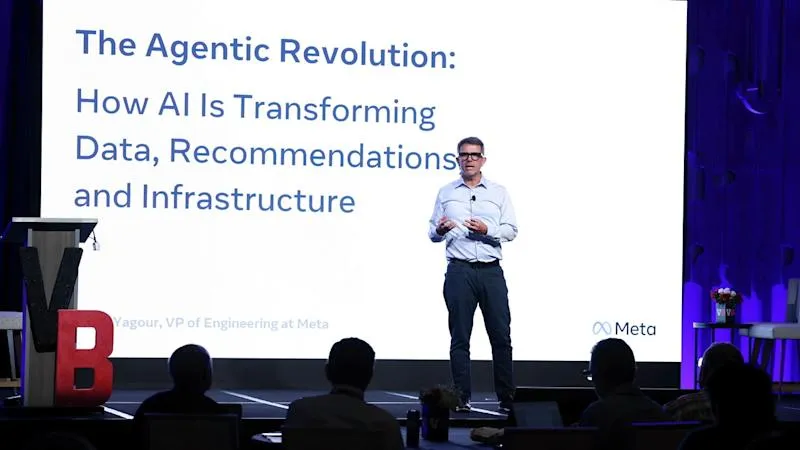
Meta infrastructure engineering VP Barak Yagour told VB Transform 2026 that agentic query demand is surging and enterprise infrastructure was built for humans, not agents. He says leaders have maybe 20 months to rebuild the stack for a world where humans and agents co-create at scale.
Barak Yagour, Meta’s VP of Engineering for infrastructure (the company’s data infrastructure organization), opened his VB Transform 2026 talk with a blunt timeline: “We spent 20 years building infrastructure for humans. We have maybe 20 months to rebuild the whole thing for a world where humans and agents co-create at scale… The window is open, but it won’t stay open for long.” His point was not motivational. It was architectural.
Yagour anchored the urgency in what Meta is seeing right now: agentic queries hitting Meta’s data systems grew 30x in a single half. In his telling, that kind of jump is an inversion of the baseline assumptions teams spent two decades building around. It is also a signal that infrastructure is about to become the bottleneck not just for model training, but for everything agents do after they “decide.” And in enterprise terms, it forces a re-think of capacity, identity, and velocity, because the systems that worked for human users are no longer the systems that map to how agents consume compute and data.
The first breaking point is capacity. Yagour described a world where load scales in ways humans do not prepare you for. “One engineer used to mean one unit of load,” he said. “Now one engineer spawns 10 agents, each spawning subagents. Your 1,000-person org can generate the load of 100,000 users practically overnight.” That is why he did not frame the answer as simply blocking agent traffic. Instead, Meta is moving toward infrastructure controls that can understand agent hierarchies, attribute cost back to the use case that spawned the agent tree, and throttle based on priority. In plain English: if you cannot measure and govern agent-driven load, you do not just risk outages. You lose the ability to decide what matters most.
Second comes identity. Infrastructure teams built access controls around people: human users, badges, and deployed services. Yagour said an agent does not fit neatly into those categories. It is not a human user, it does not carry a badge, and it is not a deployed service, yet it can make decisions on its own. That mismatch creates a security and compliance problem. If your controls cannot describe “who is asking” in a way that maps to agent behavior, then your policy layer becomes a guess.
Third is velocity, and it is where the argument gets very practical. Yagour cited a company-reported figure that GitHub Copilot writes 46% of the average user's code, then pointed out that faster code generation does not automatically speed up the pipeline around it: the code still has to be built, tested, deployed, and monitored. The agent might write in seconds, but the CI/CD pipeline does not get faster because the machine is the author. For operators, this is a warning about bottlenecks shifting. You can accelerate one part of the workflow and still starve the rest, until infrastructure is retooled to handle end-to-end throughput.
Data is where the pressure shows up most directly. Yagour said, “Data sits at the center of everything,” pointing to how it drives decisions, products, recommender systems, and next generation models. Meta is also rethinking how much autonomy to grant agents inside its own data systems. In February, the company shipped what Yagour called agentic data apps, and within three months, 63% of dashboards published across Meta were built using the new tooling. That matters because Meta also connected it to the earlier 30x rise in agentic queries.
The governance question is the obvious catch, and Yagour said it directly: human analysts historically sat between raw data and business decisions as a quality check. If agents start doing that middle work, you need guardrails that preserve trust. “Autonomy without governance is nothing but chaos,” he said. Meta’s approach is built around “trusted data environments,” designed to let agents explore data broadly while keeping outputs traced back to source and scrutinized. Yagour said sensitive fields are masked before an agent can reach them, and every access request is evaluated in real time against what the agent is trying to reach, why, and whether it is allowed. The framing was “exploring broadly while releasing narrowly.” The second-order implication for executives is that governance becomes a systems feature, not a manual process. If compliance depends on humans reviewing outputs, it will not keep up once agents scale.
Meta is also adjusting the data layer because Yagour argued that reasoning is more data hungry than correlation. “Reasoning is data hungry,” he said. Pattern matching can work with sparse, summarized signals, but reasoning needs the full behavioral history and interactions across every surface over time. To keep up, he pointed to two infrastructure shifts: real-time streaming replacing batch ETL for ranking pipelines. A pipeline that takes 24 hours to run is not viable when a model is reasoning about a user’s current intent. And storage is becoming schema-aware to stop GPU starvation by avoiding heavy overfetching. Meta previously stored user data as opaque blobs; now it is building storage that understands what it holds so it pulls only the columns and time ranges a query needs.
Those changes feed directly into recommendation strategy. Yagour said Meta is building toward 500 million queries per second and a petabyte per second of throughput for training data reads. He also cited that 42% of Instagram users told the company they want to fundamentally change the algorithm, not adjust a single session or setting. Meta’s response, in his view, is “fully conversational recommendations,” where users tell the system what they want more of and it reasons about intent rather than matching on keywords. He gave an example: the same search term, “soccer,” would return different results for a casual fan looking for highlights versus a club athlete seeking training drills, because the system would reason about which one is asking.
Yagour closed by framing agents, data, and recommendations as a flywheel, not a linear upgrade path: agents make data more accessible, better data enables reasoning, and reasoning creates new demands that push agents and infrastructure forward. And he put the clock on it again. If you are running infrastructure for human-driven traffic today, 30x agentic query growth in a half, dashboards built via new agentic tooling, and the scaling needs of reasoning models are telling the same story: you can either rebuild in time, or you can spend the next cycle reacting to outages, governance failures, and throughput walls.
For peers, the takeaway is simple and not gentle: the next platform battles will be fought in capacity controls, identity models for non-human actors, real-time data pipelines, and trusted data environments. Those are board-level risks disguised as engineering roadmaps.
This story's Key Insights and Take-aways are locked.
Create a free account to unlock Executive Actions for one credit.
Register to UnlockAlways free for Executives Club members. Join the Club
More in Technology

Google quietly links your phone number to every Android account on your SIM
Adding a SIM now ties your phone number to all Google accounts - and future accounts inherit it. Here's the security and privacy stakes.

Hijacker AI 'Skynet mode' runs 100,000 attack steps against exposed models
Symantec caught a criminal AI agent that borrows other models, steals data, and mines crypto; the only relief is no confirmed victims yet.

Nvidia's AI-financier shift faces its first big test as neoclouds stumble
A rout in neocloud stocks is forcing investors to weigh Nvidia's hidden exposure as both supplier and lender to the AI buildout.