

Nanyang’s Hirotaka Sato equips cockroaches with a diving suit that runs 3 hours underwater
A soft oxygen tank and tubes let cyborg insects survive flooded, low-oxygen conditions, with disaster-zone search in mind.
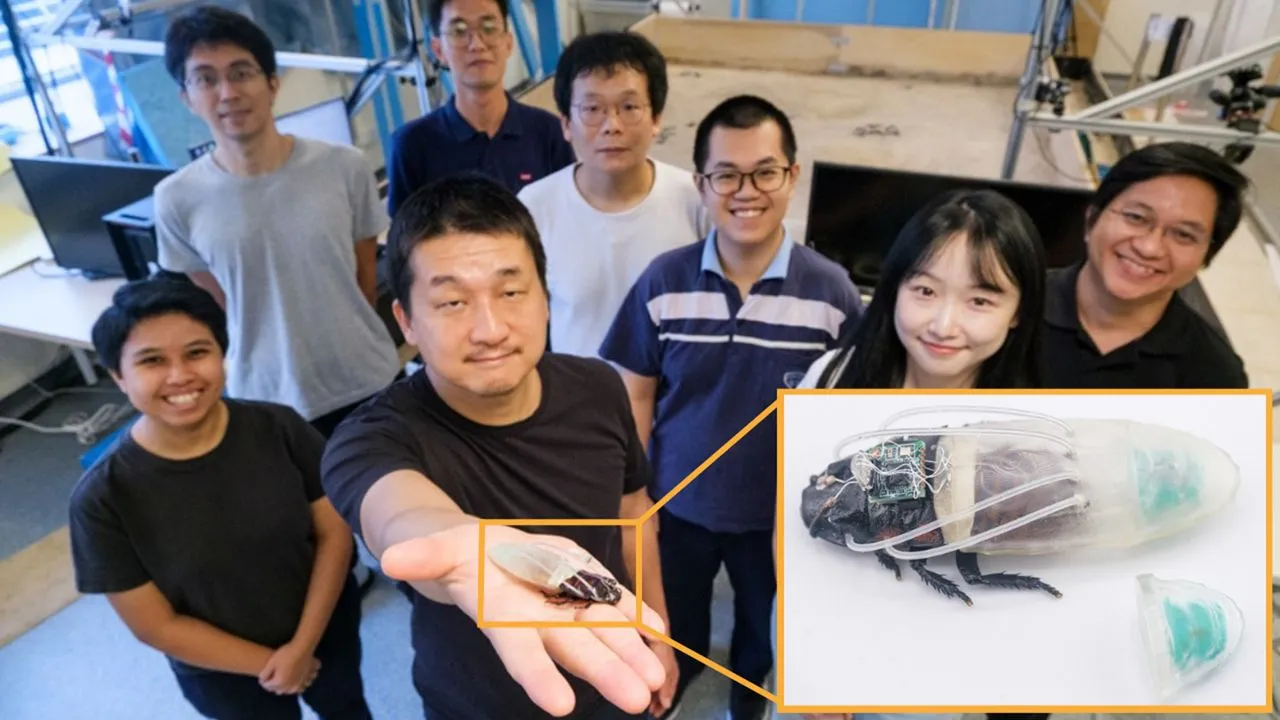
Hirotaka Sato, a professor at Singapore’s Nanyang Technological University, led work with Shinjiro Umezu’s team in Japan to build a waterproof “diving suit” for cyborg cockroaches. The system uses a chemical oxygen generator to keep the hybrid insects moving underwater for up to three hours, aiming at disaster-zone inspection.
Engineers built a waterproof “diving suit” for cyborg cockroaches that lets them roam underwater for up to three hours, even in low-oxygen conditions. The core trick is the suit’s oxygen supply: instead of relying on an external air source or a heavy battery, the design includes a built-in chemical oxygen generator that delivers gas directly to the insects’ breathing holes.
The work, published June 29 in Nature Communications, is led on the study by Hirotaka Sato, senior author and a professor in the School of Mechanical and Aerospace Engineering at Singapore’s Nanyang Technological University. His co-author Shinjiro Umezu, a professor at Waseda University in Japan, framed the approach as combining a soft waterproof shell with a “simple yet reliable chemical oxygen generator,” helping the insect keep its natural mobility while being protected from an environment it cannot normally survive.
If you are tracking why this matters, it is not just because “insects go swimming.” It is because underwater search-and-rescue is one of those problems that routinely runs into physical constraints. Human divers and robots have different tradeoffs. In the source, the researchers contrast cyborg insects with tiny robots: cyborg insects use the insect’s muscles for movement, while many robotic alternatives depend on high-power batteries that can consume energy quickly and run out of steam. In other words, the hybrid insect platform is being positioned as a way to extend operational time in places where conventional systems struggle.
That positioning leans on a broader idea already in the cyborg insect playbook. The source notes that cyborg insects have previously been used in search-and-rescue operations to access hard-to-reach areas, including rescue efforts after the magnitude 7.7 earthquake in Myanmar in March 2025 that killed at least 3,700 people and injured 4,800 more. The Myanmar deployment matters here because it signals the technology is not purely theoretical. It also raises a practical question for decision-makers: when teams are already deploying cyborg insects in rubble, what changes when the terrain becomes flooded pipes, drains, and tunnels?
The new diving suit is designed specifically for that pivot. The suit consists of a flexible shell, four silicone tubes that attach to the spiracles, and a transparent, 3D-printed oxygen tank. To generate oxygen, the researchers sprinkle manganese dioxide onto a highly absorbent sponge inside the tank, then inject a small amount of diluted hydrogen peroxide. In the presence of manganese dioxide, the hydrogen peroxide breaks down slowly to produce oxygen. Finally, the tank is sealed with ultraviolet adhesive to prevent leaks. The system is engineered to be small and light enough for the insect to wear, while still producing enough oxygen for long-duration underwater movement.
Biology does the rest of the wiring. The silicone tubes deliver oxygen into the thoracic spiracles, while the abdominal spiracles take in oxygen contained in the suit. The source makes the analogy explicit: the suit works like the oxygen tank used by human divers. And the team emphasizes practicality for the animal: the silicone tubes can be attached and removed without pain or harm to the cockroach.
In testing, the researchers used a cyborg Madagascar hissing cockroach (Gromphadorhina portentosa). They placed it in a water tank, then sent it into a plastic tube that simulated submerged and low-oxygen environments. With the diving suit, the cockroaches were able to roam underwater for up to three hours. That performance is the proof-point that the headline hook needs, because it is also what separates “cool demo” from “potentially useful search tool.” The prospect extends beyond cockroaches in principle: the researchers say cyborg insects, including locusts and beetles, could be used one day to inspect flooded infrastructure and other hard-to-access places.
For the next phase, the researchers point to improvements that go beyond oxygen. Next steps include potentially adding sensors and a navigation system, and testing the design in simulated disaster environments. For executives and boards, that is the strategic hinge: once you move from “survive underwater” to “sense and navigate underwater,” you start edging toward systems that could be integrated into emergency response workflows. Regulatory and operational realities will likely follow that arc, not arrive before it. In the near term, though, this study gives teams a concrete engineering module to build on: a waterproof, flexible shell plus an internal chemical oxygen generator, demonstrated to keep a cyborg insect moving underwater for up to three hours in controlled conditions.
This story's Key Insights and Take-aways are locked.
Create a free account to unlock Executive Actions for one credit.
Register to UnlockAlways free for Executives Club members. Join the Club
More in Technology

Google quietly links your phone number to every Android account on your SIM
Adding a SIM now ties your phone number to all Google accounts - and future accounts inherit it. Here's the security and privacy stakes.

Hijacker AI 'Skynet mode' runs 100,000 attack steps against exposed models
Symantec caught a criminal AI agent that borrows other models, steals data, and mines crypto; the only relief is no confirmed victims yet.
Nvidia's AI-financier shift faces its first big test as neoclouds stumble
A rout in neocloud stocks is forcing investors to weigh Nvidia's hidden exposure as both supplier and lender to the AI buildout.