

NASA awards nearly $600M for 4 Moon missions under Base Lunar by 2028
Astrobotic, Firefly, and Intuitive Machines will deliver three NASA science payloads per landing while infrastructure ramps up.
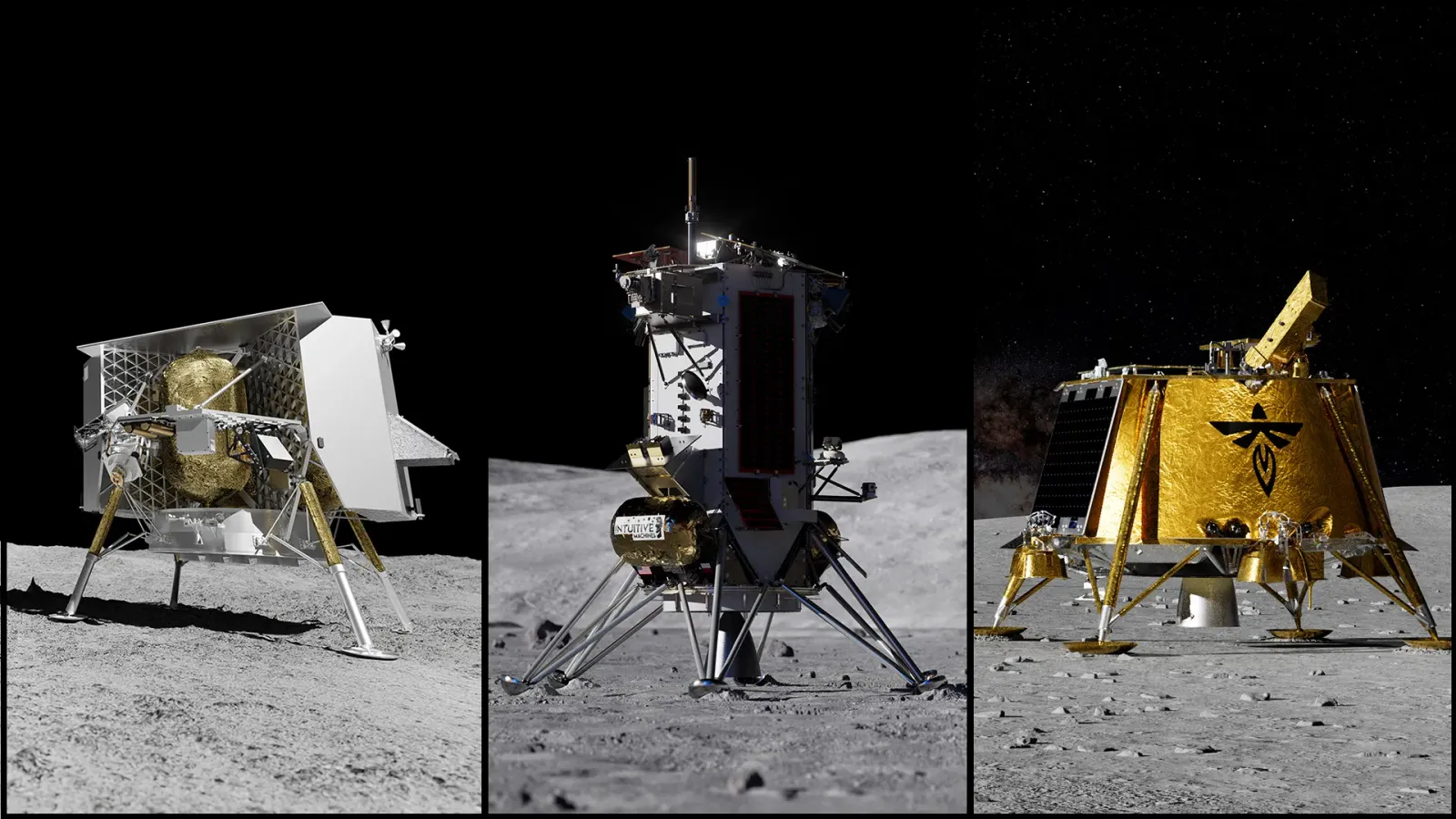
NASA selected Astrobotic, Firefly Aerospace, and Intuitive Machines to conduct four new lunar missions by late 2028 as part of the Base Lunar program. The awards total almost $600 million and are tied to delivering three specific NASA payloads per landing while NASA builds its first lunar outpost.
NASA just handed out big, specific Moon delivery contracts: it selected three commercial companies to fly four new lunar missions by the end of 2028, and the total value is “almost 600 million de dólares” for missions carrying NASA scientific payloads.
The money is not the headline for show. NASA is using these deliveries as a fast-learning pipeline for Base Lunar, a long-term initiative meant to support sustained human presence and expand science and commercial activity on the Moon. Lori Glaze, associated administrator in NASA’s Human Exploration and Operations Mission Directorate, framed it as acceleration: the awards show NASA’s commitment to establish a longer-term presence and to develop the capabilities needed to “prosperar allí” on the lunar surface. In other words, this is NASA outsourcing the boring but critical part of getting more stuff to the Moon on a predictable cadence.
Under the selection announced Tuesday, Astrobotic received $297.9 million total for two deliveries, while Firefly Aerospace and Intuitive Machines received $144.2 million and $148.3 million respectively for one delivery each. The contracts sit inside NASA’s Lunar Payload Services (CLPS) initiative, one of Base Lunar’s building blocks. A key operational detail matters here: each company will use “versiones actualizadas de diseños de módulos de aterrizaje que ya han volado,” updated versions of lander designs that have already flown. That is the point. NASA wants higher mission cadence with less reinvention per flight.
NASA’s internal logic is bluntly practical. Ryan Stephan, interim director of cargo landing modules for Base Lunar, said the agency is “building un campo de pruebas para las operaciones de Base Lunar” and that accelerating the cadence of adjudicating missions and launch opportunities lets the agency move quickly to learn, repeat, and improve. For executives and boards, this is the difference between a grand strategy slide and an operating rhythm: lander reliability improves when you run the process often enough to find failure modes early.
NASA is also using these missions to distribute the same three payloads across multiple landers. Each delivery will carry three NASA instruments to the lunar surface. First is SCALPSS, the Instrumento Cámara estéreo para el estudio de los chorros de propulsión en la superficie lunar. SCALPSS is a set of four cameras that uses stereo photogrammetry to create a three-dimensional view of how an engine plume impacts lunar dust as the lander descends. NASA says that by collecting data from different engines, fuels, and landing sites, the high-resolution stereo images will help build models to predict erosion of lunar dust and characteristics of ejected materials. That becomes increasingly important as larger, heavier spacecraft and equipment land closer together.
Second is LRA, the conjunto de retrorreflectores láser. It is a small, “cookie-sized” passive device made from eight quartz corner-cube prisms mounted in a dome-shaped aluminum frame. It reflects laser beams delivered by lunar orbiters or during landing-phase operations to help determine orbital position or navigate toward the surface. The payload is passive, requiring no power or maintenance. NASA notes these reflectors have already flown on earlier CLPS lander missions and on international lunar landers, and they will be used to build a permanent network of location markers on the Moon.
Third is LETS, the Espectrómetro de transferencia lineal de energía. LETS helps characterize the radiation environment across different transit trajectories and at different lunar surface locations. NASA describes it as derived from existing equipment, using a small but advanced silicon detector to measure incoming space radiation energy. The instrument provides information on radiation intensity and radiation type, which NASA says is the level of detailed radiation data it needs to design safer missions, protect astronauts, and plan long-duration exploration.
If you are wondering what comes next beyond these four missions, NASA has already outlined a pipeline for broader lunar infrastructure and industry participation. With 17 deliveries to the lunar surface already under multiple providers, NASA is “barajando planes” (considering plans) to send PROMISE, the Vehículo de Exploración Polar para Observación, Cartografía y Exploración In Situ, described as a development engineering version of the Perseverance rover used on Mars. Experts within NASA would define PROMISE opportunities to characterize lunar surface and subsurface and prospect for resources.
NASA also plans to request proposals in the coming months for lunar lander missions carrying (1) a technology demonstration of energy and avionics, (2) another set of scientific payloads, and (3) an optical image generator for the lunar south pole. Separately, NASA will publish an open call for Base Lunar technology demonstrations, and it will request proposals for a constellation of lunar communications and navigation relay satellites to improve connectivity between Base Lunar elements and Earth. The strategy link is explicit in the release: the June 30 awards will play a “papel fundamental” in establishing infrastructure for surface operations.
One more operational governance detail is worth underlining. NASA says the companies are responsible for initiating and executing the contracting processes, providing an evaluation of a similar pre-existing lunar lander, and incorporating lessons learned to improve overall mission reliability. That is effectively a built-in accountability loop. When agencies pay for missions tied to learned performance and reuse flown design heritage, reliability is no longer a vague aspiration. It becomes something measurable across multiple flights.
For leaders watching capital discipline and execution risk, this package signals how NASA is de-risking the next phase of lunar operations: ship the same proven payload set repeatedly, measure landing plume effects on dust, lock down navigation with passive laser retroreflectors, and map radiation with LETS. Meanwhile, NASA uses the delivery ramp as the scaffolding for a permanent outpost ecosystem. This is Base Lunar getting its test field, its data network, and its mission rhythm, all by the end of 2028.
This story's Key Insights and Take-aways are locked.
Create a free account to unlock Executive Actions for one credit.
Register to UnlockAlways free for Executives Club members. Join the Club
More in Science

Alaska's 1,580-foot tsunami had warning signs. Scientists just found them.
Rapid glacier retreat, heavy rainfall, and thousands of tiny tremors preceded Alaska's 1,580-foot tsunami, a warning for every coastal community in a warming world.

The rare mutation that lets high-risk brains dodge Alzheimer's
Scientists found a natural defense against protein buildup, opening a new path to preventive treatments.

3,000 steps a day may halve Alzheimer's decline, study finds
New research links a modest daily walk to less tau buildup and nearly half the cognitive and functional decline, even for those with early signs.