
NASA finds Kevlar/PBI webbing survives 37% oxygen, beating flammability limits
A specific 60/40 blend from Sturges passes NASA-STD-6001B Test 1 for lunar and Mars softgoods.
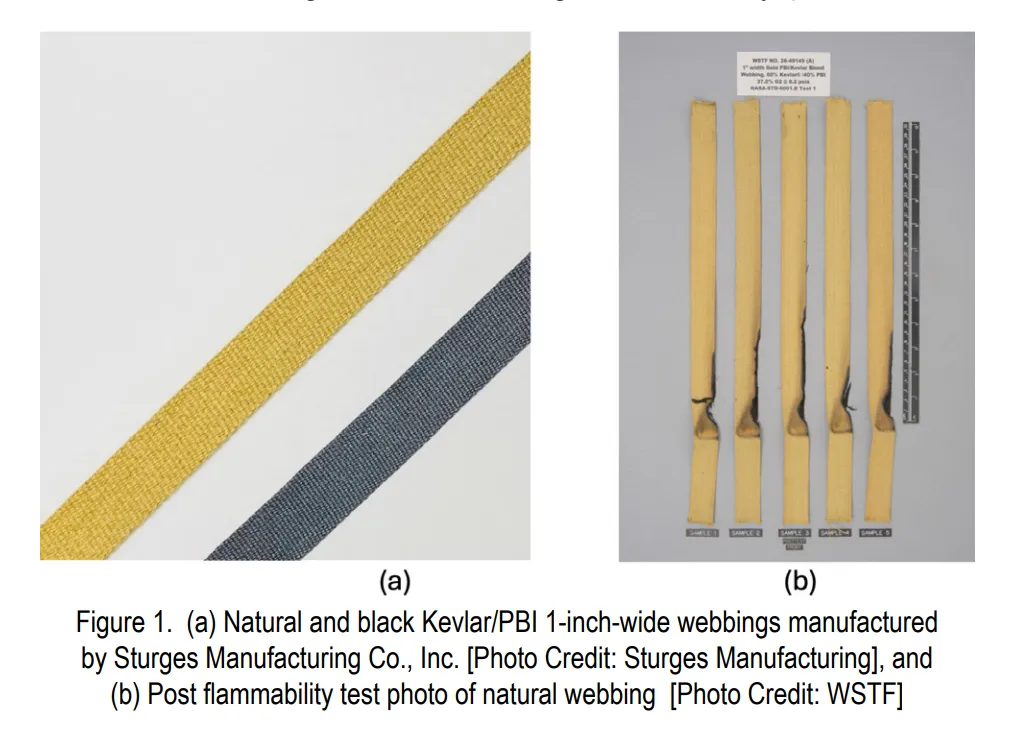
NASA reports flammability and offgassing testing for commercial-off-the-shelf webbings intended for elevated oxygen environments on future Moon and Mars missions. A 60% Kevlar and 40% polybenzimidazole (PBI) webbing from Sturges Manufacturing Company, Inc. (natural version) passed NASA-STD-6001B Test 1 at 37% oxygen and 8.2 psia in an unshielded J configuration.
NASA tested commercial webbing built for future lunar and Martian missions, and one specific blend cleared a key flammability hurdle: a 60% Kevlar and 40% polybenzimidazole (PBI) webbing from Sturges Manufacturing Company, Inc. (natural version) passed NASA-STD-6001B Test 1 at 37% oxygen and 8.2 psia. That result matters because these elevated oxygen environments are not hypothetical. NASA has planned them for future crewed missions to reduce prebreathe time before extravehicular activities.
Why this is a big deal: enriched oxygen increases the flammability risk, and webbings are used in real softgoods hardware. NASA says narrow woven fabrics, commonly referred to as webbing or woven tape, show up in applications like crew mobility aids, restraint nets, and storage bag handles. In other words, you are not just certifying a material in a vacuum. You are trying to keep the stuff that holds, restrains, and supports humans from turning into a fire risk when oxygen levels rise.
This NASA test sits inside a broader effort to make sure textile materials that meet NASA flammability requirements in elevated oxygen are available to the aerospace community as building blocks for softgoods flight hardware. NASA attributes that strategy to the NASA Engineering and Safety Center (NESC), and says it is being implemented by the Mars Campaign Office and Johnson Space Center, with NESC support. The first phase focuses on commercial-off-the-shelf (COTS) textiles that have high potential to meet flammability requirements. The logic is straightforward: if you can validate readily available materials early, you shorten development cycles and reduce the odds of late-stage surprises when hardware is already designed.
The central technical framework is NASA-STD-6001B Test 1, performed at the White Sands Test Facility (WSTF) to determine the maximum oxygen concentration (MOC) at 8.2 psia. NASA explains the MOC test as the maximum oxygen concentration at which a minimum of five samples tested pass the NASA-STD-6001B criteria at a fixed pressure. In this specific setup, the test used an unshielded J configuration where the cut edge of the webbing was not exposed to the flame, and the igniter impinged on the front surface of the material, including the lateral free edge of the webbing. Just as important: NASA notes flammability performance after wear and tear was not assessed in this phase. So the headline clearance is real, but the “what happens after abuse” question still belongs to later, configuration-level validation.
NASA tested one-inch-width natural and black webbings composed of 60% Kevlar and 40% PBI produced by Sturges Manufacturing, with available webbing widths ranging from 1/4 to 8 inches. The reported flammability results were MOCs of 37% oxygen for the natural webbing and 35% oxygen for the black webbing, both at 8.2 psia. Offgassing data are also provided for the natural webbing, which NASA describes as gold colored. NASA directs readers to more detailed test results via MAPTIS links, but the operational takeaway is that NASA is not treating this as a single-pass fail gate. It is collecting the kind of data that helps teams weigh both fire behavior and material emissions when designing softgoods systems.
NASA is explicit about what these findings do and do not guarantee. The results “should be used to select materials for incorporation into a final softgood product,” but the final flammability result depends on other components in the end item and must be tested in configuration. NASA also warns that individual textile results do not guarantee finished assembly performance. And it lists variation factors that can shift flammability characteristics, including dimensions, weave type and yarn size, density, treatments, color, fiber blend, edge finish technique, added features like hook and loop fasteners, and wear and tear. In practice, that means the board-level decision is not just “find a passing fabric.” It is “build a repeatable pathway from material qualification to assembly qualification without getting blindsided by system-level interactions.”
For executives and operators, this is a risk-management story dressed as a materials report. NASA’s elevated oxygen environment requirement creates a compliance pressure that can ripple across procurement, engineering timelines, and vendor qualification. Teams that choose from pre-qualified COTS options like this can de-risk early design. But the obligation remains to validate in full configuration, because NASA-STD-6001B textile success is only one layer in the certification stack. The strategic stake for anyone building for crewed operations is that fire safety failures are expensive, and schedule failures are even more expensive. NASA is essentially giving the market a narrower list of “likely candidates,” which can change what gets specified next, how quickly prototypes can iterate, and how confidently programs can move from bench testing to flight hardware.
This story's Key Insights and Take-aways are locked.
Create a free account to unlock Executive Actions for one credit.
Register to UnlockAlways free for Executives Club members. Join the Club
More in Science

Alaska's 1,580-foot tsunami had warning signs. Scientists just found them.
Rapid glacier retreat, heavy rainfall, and thousands of tiny tremors preceded Alaska's 1,580-foot tsunami, a warning for every coastal community in a warming world.

The rare mutation that lets high-risk brains dodge Alzheimer's
Scientists found a natural defense against protein buildup, opening a new path to preventive treatments.

3,000 steps a day may halve Alzheimer's decline, study finds
New research links a modest daily walk to less tau buildup and nearly half the cognitive and functional decline, even for those with early signs.