
NASA opened its first major new wind tunnel in 40+ years on July 31, 2026
A newly launched Flight Dynamics Research Facility at Langley will accelerate aeronautics, exploration, and Artemis-era landing performance.
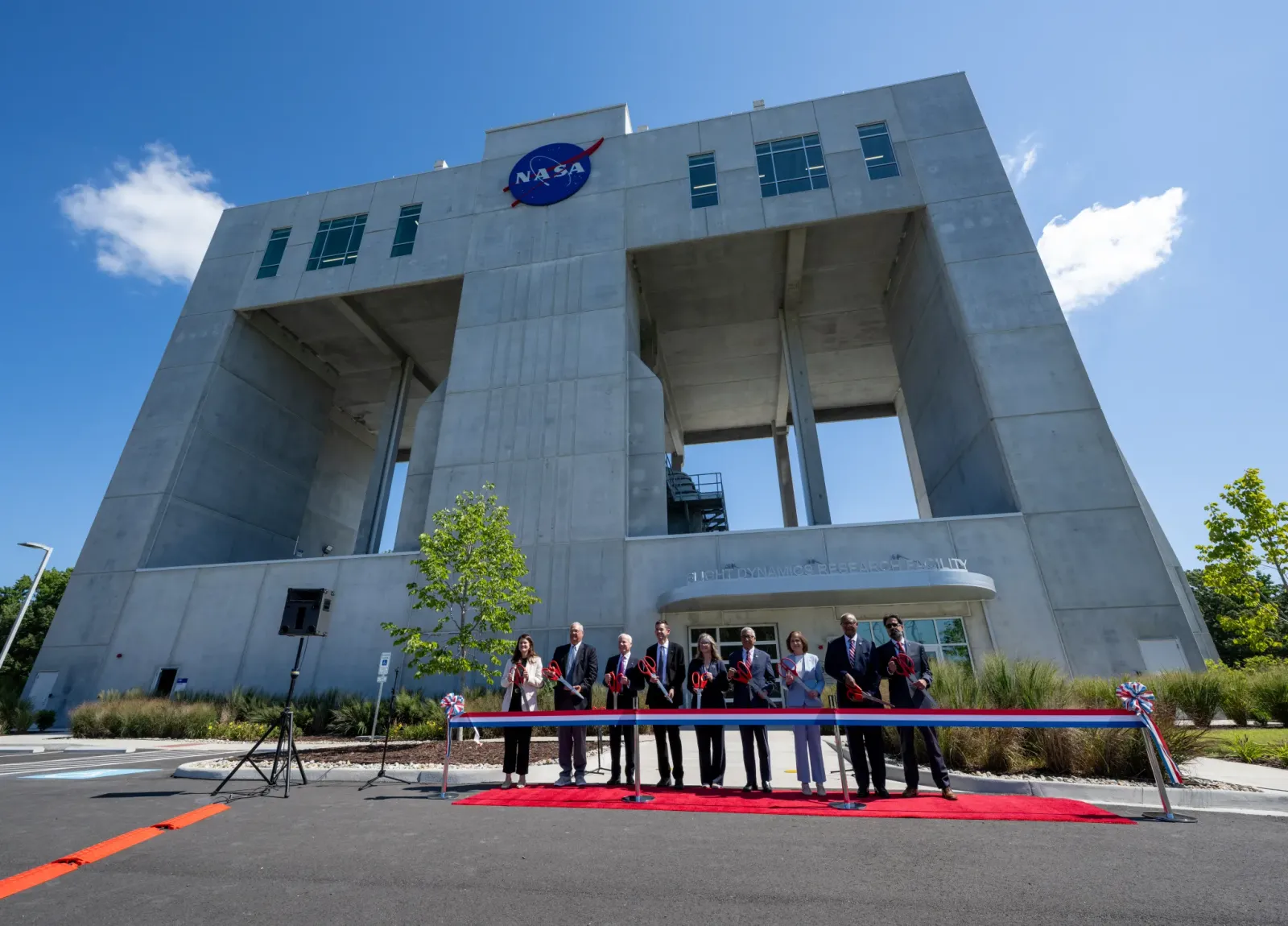
On July 31, 2026, NASA leadership and Virginia officials opened the Flight Dynamics Research Facility at NASA Langley Research Center in Hampton, Virginia. The first major new wind tunnel in more than 40 years is built to support research and technology development tied to NASA's aeronautics goals and exploration plans, including sustained lunar surface presence through Artemis and development of a Moon Base.
On Friday, July 31, 2026, NASA leadership and Virginia government officials opened NASA's first major new wind tunnel in more than 40 years, the Flight Dynamics Research Facility at NASA's Langley Research Center in Hampton, Virginia. This is not a ribbon-cutting footnote. It is a big infrastructure signal: NASA is putting fresh muscle behind the kind of aerodynamic testing that turns hardware concepts into things that can actually fly, land, and operate.
The facility is described as state-of-the-art and positioned to support research and technology development that will advance NASA's aeronautics, exploration, and science goals. The rationale is explicit in the announcement: helping establish a sustained human presence on the lunar surface through the Artemis program and supporting development of a Moon Base. In other words, this wind tunnel is aimed at the same uncomfortable question every serious space program faces. How do you reduce uncertainty before you bet missions, crews, and timelines on flight?
To understand why this matters to decision-makers beyond NASA, it helps to recall what wind tunnels do at the systems level. They let engineers test how vehicles behave under controlled airflow conditions, which is the aerodynamic reality-check for designs that must perform across changing speeds, angles, and configurations. When a program is trying to scale from prototypes to operational systems, testing capacity and capability can become a gating item. Not because people lack imagination, but because you cannot fully validate complex flight behavior by simulation alone. Updated facilities typically shorten the distance between design iteration and performance verification.
Now zoom out to the “why now” layer. NASA's move comes with a visible coalition of federal and state stakeholders in attendance at the ribbon-cutting, including Virginia Lt. Gov. Ghazala F. Hashmi; Jimmy Gray, mayor, City of Hampton; and Mike Waller, vice president of BL Harbert International Federal Division. Federal officials present include Edward C. Forst, administrator of the U.S. General Services Administration; and U.S. Rep. Robert “Bobby” Scott (D-Va.). NASA leadership included NASA Administrator Jared Isaacman, Dr. Trina Dyal, director of NASA’s Langley Research Center, and Amit Kshatriya, NASA associate administrator, alongside NASA deputy associate administrator Casey Swails. That lineup matters because advanced research infrastructure is rarely “just technical.” It is also procurement, workforce development, local economic positioning, and long-horizon planning under public oversight.
From a governance and regulatory framing perspective, the presence of the U.S. General Services Administration and members of the Virginia government underscores that large technical builds live in a world of contracts, facility management, and public accountability. Wind tunnels are long-lived assets. When the government spends to open a first major new facility in more than four decades, it is committing to decades of downstream testing, tooling, and program support. For agencies and contractors, that changes the practical math around timelines and risk. If the facility can support more advanced and sustained aeronautics and exploration research, it can also influence how quickly teams can converge on design parameters that keep missions within envelope.
The second-order implication is especially relevant to the Artemis and Moon Base language in the announcement. A lunar surface presence is not only about rockets and landing. It is also about the vehicle design choices that must survive a chain of aerodynamic and flight dynamics constraints earlier in the life cycle. Even for missions that happen in space, the road to reliability often passes through atmospheric testing, ascent and return dynamics, and the performance characteristics that determine margins. A modern wind tunnel can feed that process by improving confidence in how vehicles behave before they ever see full flight conditions.
For peers in adjacent roles, this is a reminder that the aerospace pipeline is increasingly constrained by infrastructure and validation capacity, not just by ambition. When NASA adds a new major testing facility at Langley, it is effectively expanding the agency's ability to de-risk technology development. That can ripple into contractor planning, research partnerships, and the pacing of aeronautics and exploration workstreams that compete for attention, budget, and engineering talent.
This story's Key Insights and Take-aways are locked.
Create a free account to unlock Executive Actions for one credit.
Register to UnlockAlways free for Executives Club members. Join the Club
More in Science

Alaska's 1,580-foot tsunami had warning signs. Scientists just found them.
Rapid glacier retreat, heavy rainfall, and thousands of tiny tremors preceded Alaska's 1,580-foot tsunami, a warning for every coastal community in a warming world.

The rare mutation that lets high-risk brains dodge Alzheimer's
Scientists found a natural defense against protein buildup, opening a new path to preventive treatments.

3,000 steps a day may halve Alzheimer's decline, study finds
New research links a modest daily walk to less tau buildup and nearly half the cognitive and functional decline, even for those with early signs.