
NASA’s CATNLF flight test strapped to an F-15 starts at 5 a.m. for 1 aim: less fuel burn
Inside the day-by-day grind to validate laminar-flow wing tech that could cut costs for future airliners.
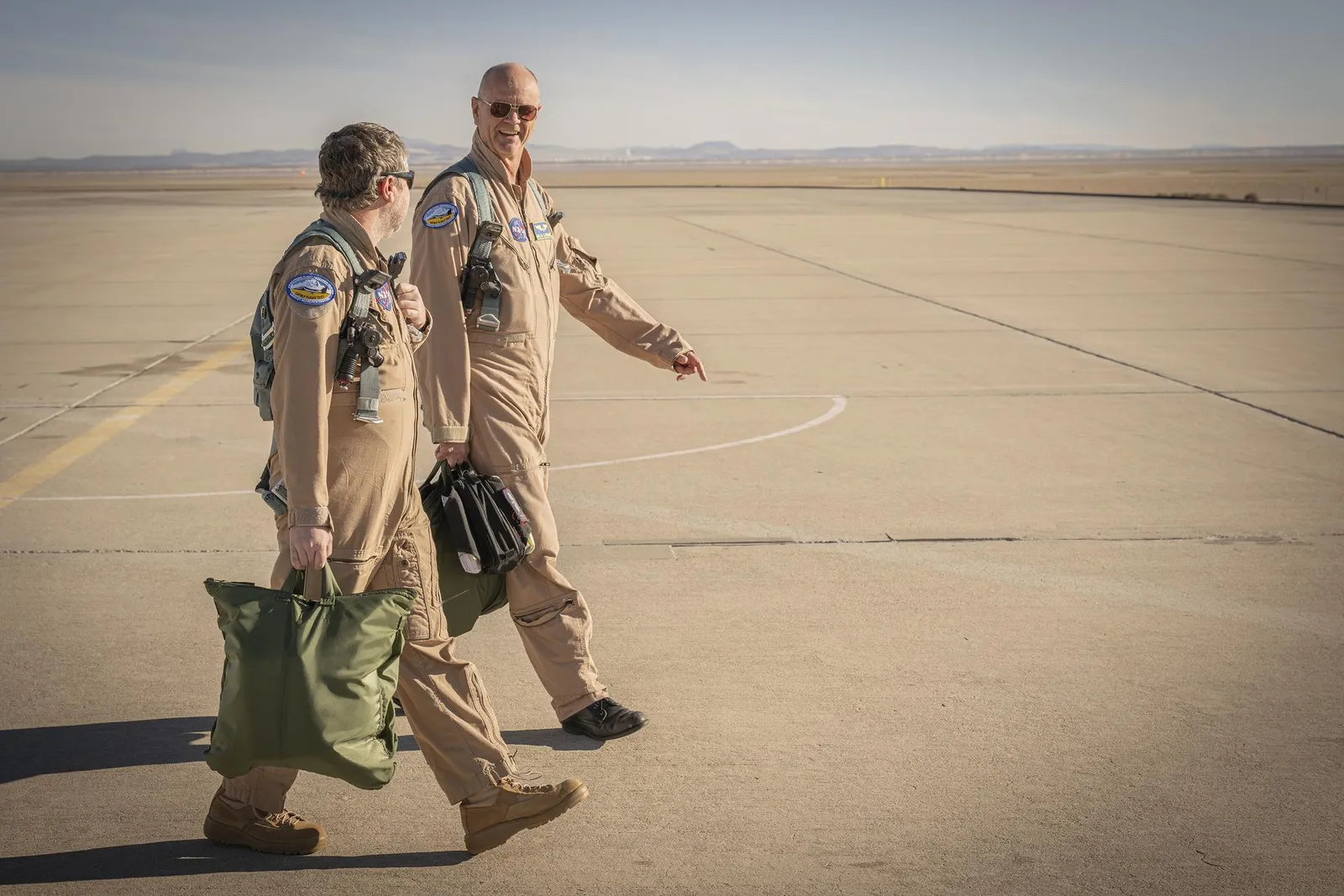
NASA’s Armstrong Flight Research Center in Edwards, California ran flight testing for its Crossflow Attenuated Natural Laminar Flow (CATNLF) initiative, including a scale-model CATNLF wing attached to the bottom of a NASA F-15 aircraft. If the laminar-flow concept works as intended, it targets reduced drag on wing surfaces, which translates into lower fuel costs for future commercial aircraft.
Flight testing at NASA Armstrong is a team sport, but today’s stakes are mercifully concrete: lower fuel burn for future airliners. That’s the whole point of NASA’s Crossflow Attenuated Natural Laminar Flow (CATNLF) initiative, which earlier this year tested a wing concept designed to maximize smooth, laminar flow of air. During the testing, researchers strapped a scale-model CATNLF wing to the bottom of a NASA F-15 aircraft, turning a 700-mile-an-hour research question into a real, measurable day of flight work.
The “day” starts before most people are dressed, with ground crew staging the aircraft at 5 a.m. and a full crew brief by 6 a.m. That timing matters because this kind of aerodynamics validation is not a single dramatic moment in the sky. It is a chain of preparation, suit-up, checklists, radio calls, step-by-step maneuvers, and then data download and debrief, all designed to answer one operational question: does this wing behave the way the models say it should?
So what is CATNLF, in plain English? It is a laminar-flow-focused wing design aimed at reducing drag on wing surfaces. Drag is basically the aerodynamic tax you pay to move through air. Reduce the tax, and you improve efficiency, which can mean lower fuel burn. NASA’s project team built a scale-model wing to test that idea in flight, specifically by trying to keep airflow smoother over the wing surfaces, closer to what “natural laminar flow” implies. Whether that smoothness actually holds up at real flight conditions is exactly why the test has to happen in an aircraft, not just in a lab.
Here’s what a typical CATNLF flight-testing day looks like at NASA Armstrong, Edwards, California. At 5 a.m., the aircraft is staged. If there’s a chase plane involved, that aircraft and crew get staged too. At 6 a.m., the team gathers for a crew brief. That includes pilots, engineers, maintenance technicians, project leads, researchers, and even the photographers and videographers, because everyone has a role in executing and capturing the mission. The brief covers the flight’s goals, weather reports, and final details.
By 6:30 a.m., the work shifts into control-room reality. Researchers head to complete checks that communications, displays, and instruments are operating correctly. The air crew then suit up in life support equipment, including custom-fit pressure suits, harnesses, helmets, and masks. If there is a photographer, videographer, or flight test engineer in the back seat, they suit up as well. This is the part many outsiders underestimate: safety and instrumentation readiness are not side quests. For flight testing, they are prerequisites for meaningful data.
Then it’s 6:45 a.m. to 7:30 a.m., a tightly sequenced run through aircraft and pilot procedures. The pilot completes preflight checks with the crew chief and technicians for the aircraft’s electrical systems, and the pilot and crew chief sign a flight preparedness report confirming the aircraft is ready to fly. Inside the control room, the team prepares to monitor the flight using the same set of test cards, a step-by-step plan for what happens in the air. At 7 a.m., the pilot and backseat crew members climb into their seats, strap in, and secure any gear. Preflight ground checks happen right before taxi.
At 7:15 a.m., the aircraft taxis, with the pilot coordinating with the control tower and the control room teams monitoring over radio. At 7:30 a.m., takeoff begins: the pilot accelerates down the runway, pulls back at the proper speed, and then coordinates with air traffic control at Edwards Air Force Base and the NASA Armstrong control room while flying to the designated test area. From 7:30 to 8:30 a.m., the team executes the test points. The test conductor relays each task. The pilot performs maneuvers one-by-one while the control room monitors the performance of the hardware, instruments, aircraft, or software throughout the sequence. After completing the test points, the pilot returns to base.
The day ends, but not loosely. At 8:45 a.m., the pilot lands and taxis to the ramp, where the crew chief meets the jet. Then the aircraft is towed into the hangar for maintenance. At 9:30 a.m., the pilot, project team, and mission control staff return for a debrief to capture lessons learned and document items for follow-up. At 10 a.m., the team downloads flight data for analysis. If two flights are scheduled, preparations for the second start immediately.
Why does this matter beyond one wing test on one particular F-15? Because commercial aviation is brutally sensitive to efficiency. When aircraft designers claim fuel savings, it has to survive real air, real turbulence, real measurement constraints. CATNLF is trying to validate an aerodynamics approach that could lower fuel costs by reducing drag through improved laminar flow. For decision-makers across aerospace, suppliers, and simulation-heavy product teams, this is a reminder that the “science” is inseparable from the operational execution: checklists, instrumentation integrity, and data discipline are how you turn a theory into a metric the market can underwrite.
And there’s a second-order implication for anyone building or evaluating next-generation aircraft tech: even if the objective is “just” drag reduction, the path runs through sustained validation campaigns. NASA’s team is not doing one-off hero flights. The cadence includes staging, staged readiness, structured test cards, controlled execution, debriefs, and immediate data download. That’s how initiatives like CATNLF move from an engineering concept toward something that could inform the next generation of commercial aircraft efficiency targets.
Last Updated Jun 30, 2026, and the details are clear: flight testing at Armstrong is a daily pipeline from ground prep to flight points to data analysis, all organized around one goal. If CATNLF delivers the promised laminar-flow behavior, that could reshape the cost equation for future airliners by making smoother airflow a source of real efficiency, not just an academic benchmark.
This story's Key Insights and Take-aways are locked.
Create a free account to unlock Executive Actions for one credit.
Register to UnlockAlways free for Executives Club members. Join the Club
More in Science

Alaska's 1,580-foot tsunami had warning signs. Scientists just found them.
Rapid glacier retreat, heavy rainfall, and thousands of tiny tremors preceded Alaska's 1,580-foot tsunami, a warning for every coastal community in a warming world.

The rare mutation that lets high-risk brains dodge Alzheimer's
Scientists found a natural defense against protein buildup, opening a new path to preventive treatments.

3,000 steps a day may halve Alzheimer's decline, study finds
New research links a modest daily walk to less tau buildup and nearly half the cognitive and functional decline, even for those with early signs.