

Nasdaq tumbles as Nvidia drops 16% in DeepSeek-sparked AI rout
A broad selloff hits AI infrastructure, forcing executives to reprice risk, capacity, and pricing power fast.

U.S. stocks were mostly lower as an AI rout was sparked by China's DeepSeek. Nasdaq led declines, and Nvidia fell 16%, with many AI infrastructure makers down in the double digits.
U.S. stocks slid broadly on the day, but the real story is how quickly the market punished AI infrastructure exposure. The Nasdaq led declines, and Nvidia sank 16%, with many makers of AI infrastructure falling in the double digits. This was not a slow fade. It was a spark that turned into a rout, with investors suddenly questioning what the next leg of AI spending should look like.
The headline number matters because Nvidia is not a “normal” chip stock in this cycle. A 16% drop is the kind of move that instantly forces everyone from portfolio managers to CFOs to ask the same question: is demand for the compute stack about to get repriced, delayed, or structurally changed? When markets move like this, it is rarely just about one company’s fundamentals. It is about how investors are mapping future cash flows across a whole supply chain, from chips and networking to the tools and systems that help build and run AI.
So what triggered the selloff? The WSJ describes an AI rout “sparked by China’s DeepSeek.” DeepSeek is positioned by markets as a signal related to the competitiveness of AI progress and the potential scale of impact from players outside the U.S. When that kind of signal hits, investors tend to react in a very specific way. They do not just trade the models. They trade the enabling layer. If investors believe the ecosystem might deliver meaningful AI capability with different cost structures, the market can quickly reprice the “cost-plus” world that AI infrastructure companies have benefited from.
This matters for decision-makers because AI infrastructure spending is a board-level theme, not a back-office one. During strong AI demand periods, capital markets reward companies tied to buildout capacity, high-performance compute, and the components that feed data centers. In the opposite direction, when the stock market decides to discount the spending curve, the pressure flows backward: guidance expectations become harder, valuations compress, and even companies with real operating traction can get marked down if investors shift their assumptions.
There is also a practical, market-structure angle. Broad AI routs tend to cascade. When a flagship name like Nvidia falls sharply, other “AI beta” stocks can get hit even if their individual fundamentals have not changed overnight. That is how you end up with “many” AI infrastructure makers down in double digits, not just one. In a day like this, correlations tighten and risk managers do the same thing humans always do under stress: they reduce exposure, across the bucket, until the picture clears.
Regulation and geopolitics loom in the background of any U.S.-China AI narrative, even when a single article focuses on price action. For context, the U.S. has spent years tightening rules around advanced semiconductors and their end use, and that has shaped how markets think about supply constraints and competitive dynamics. Against that backdrop, a signal that AI progress is accelerating from China side can read to investors as a potential shift in competitive equilibrium. Even without immediate policy changes described in the source, the market can still treat these events as part of a larger moving target: who can build what, with which inputs, at what cost.
Second-order implications for boards are immediate. When infrastructure stocks drop in sync, it is not just a trading story. It can change the cost of capital for AI-dependent companies, alter the willingness of investors to fund expensive capex cycles, and pressure management teams to show more convincingly that their products are essential rather than replaceable. For CFOs, the question becomes how to message durability when the market is trading on uncertainty. For CEOs, it becomes how to protect long-term customer relationships while short-term sentiment swings.
Strategically, peers should treat this selloff as a reminder that AI infrastructure valuations are tightly linked to how investors interpret the competitive trajectory of AI progress. If the market’s interpretation shifts based on an event like DeepSeek, the repricing can be fast, and it can spread beyond the origin point. Today’s Nasdaq weakness, Nvidia’s 16% drop, and the broad double-digit declines in AI infrastructure all point to one thing: investors are recalibrating the economics of the compute stack, and decision-makers need to be ready with clear answers about demand, costs, and the timeline for returns.
This story's Key Insights and Take-aways are locked.
Create a free account to unlock Executive Actions for one credit.
Register to UnlockAlways free for Executives Club members. Join the Club
More in Technology
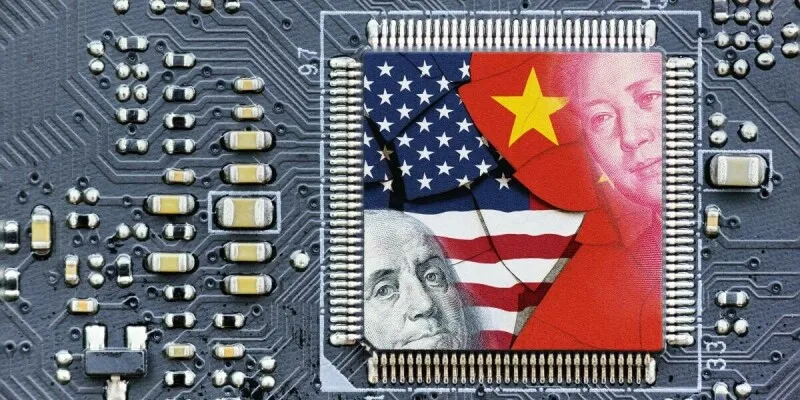
Kratsios alleges Moonshot distilled Anthropic’s Fable for Kimi K3 development
A White House science official claims covert large-scale distillation, plus access to Nvidia GB300 hardware.

Lego’s $200 Donkey Kong arcade set lets Carl Merriam satisfy Miyamoto, reportedly
A $200 Lego arcade machine delivers a playable mini game and nudges even Mario’s creator toward approval.
IBM CEO insists AI is not killing mainframes after stock crash from weak sales
After IBM’s stock fell on poor mainframe warnings, the CEO says AI disrupted budgets temporarily, reshaping enterprise planning.