

Nocs Provisions Lite View turns lunar eclipses into a grab-and-go scope, if you tripod
A 56mm, 9x-27x spotting scope can wow on the Moon and bright clusters, but not handheld at 27x.
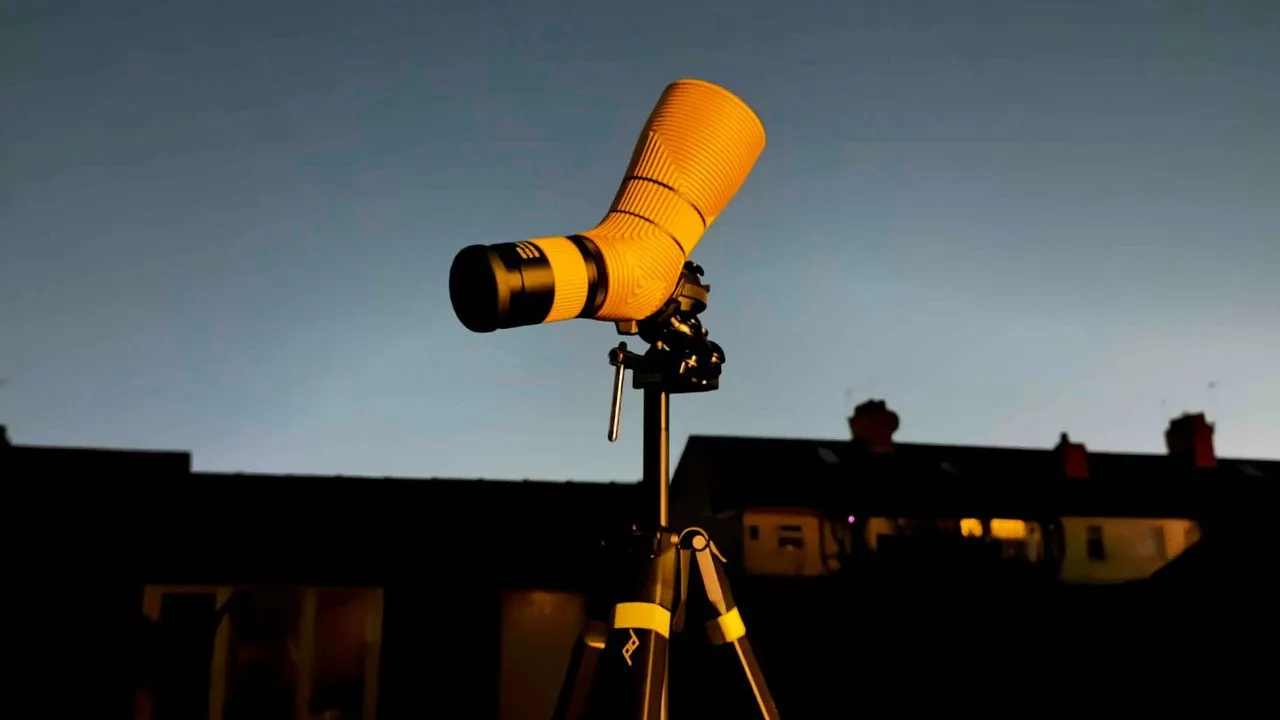
Nocs Provisions Lite View is a compact 56mm spotting scope with a 9x-27x zoom and an integrated tripod mount. For decision-makers deciding what to fund or recommend, it delivers real lunar value without replacing a telescope.
Spotting scopes usually live in birders' bags. The Nocs Provisions Lite View lives in a different fantasy: late-night lunar observing that does not require a full telescope setup.
This model packs a 56mm objective lens and a 9x-27x zoom range into a small, travel-friendly body, and Space.com’s review argues it can deliver surprisingly detailed views of the Moon and bright star clusters. At 9x, the lunar disk looks crisp and bright with a wide field that makes locating and centering easy. Push toward 20x and the terrain along the terminator starts snapping into satisfying relief, with crater chains and dramatic shadow texture. At the full 27x magnification, crater rims and fissures become more pronounced, but sharpness starts to soften and faint chromatic aberration creeps in along the lunar limb.
That mix is the product story here: the Lite View is not trying to be a premium optics instrument. It is trying to be the thing you actually bring when you want a moon, Jupiter’s moons, or a bright deep-sky target without turning the evening into a gear-management project. The review emphasizes the scope’s practical design choices, including a carry case and shoulder strap so you can sling it over a shoulder, plus a rugged wave-textured, rubberized grip. It even brings an integrated tripod mount, which matters because the scope is technically usable handheld at 9x, but stability becomes a problem beyond 12x. At 27x, even slight movement blurs the image significantly.
If you are thinking like an operator or investor, the second-order implication is straightforward: the “value” is not only in optics, it is in reducing friction from plan to execution. The Lite View is sized at 192 x 120 x 68 mm and weighs 567 g (1.2 lb). That weight and pocketability are exactly what make spontaneous lunar eclipses and travel observing plausible. In other words, this is a product engineered for throughput, not bragging rights. The integrated tripod mount is part of that thesis. For serious lunar observing, Space.com calls a tripod mandatory.
The review does call out the tradeoffs you would expect from a lightweight spotting scope. There is a trace of purple fringing and faint yellow coloration along the lunar limb in high-contrast areas, but it is described as not severe. Sharpness softens slightly compared to the sweet spot around 20x magnification, and in darker conditions chromatic aberration becomes more noticeable around the Moon. Beyond the Moon, performance is “surprisingly well” for a 56mm scope, with the Beehive Cluster (M44) appearing as a sparkling spray of stars, and the Orion Nebula (M42) showing a soft, misty glow under darker skies. The Pleiades (M45) benefit from the generous field of view at lower magnifications, presenting a striking cluster against black sky framing.
Jupiter also lands in a sensible, expectation-aligned category. The planet remains small and surface detail is not visible, but the four Galilean moons are clearly visible. The review makes the comparison explicit: the Lite View is not going to rival premium top-end ED-glass optics or a dedicated refractor telescope. Still, it uses HiFi fully multi-coated lenses and XDR roof prisms to deliver bright, reasonably sharp views overall, particularly at mid-range magnifications. It is an “it meets expectations for its size and price” outcome, not a miracle.
The practical “gotchas” are mostly about control. Space.com notes the scope’s focus wheel and eyepiece zoom ring are logically placed, but the focus wheel can feel slightly stiff at first and the zoom ring is looser. After some use, the focus wheel loosens and becomes smoother. The eyecups twist up and provide 18 mm of eye relief, which the reviewer found comfortable for spectacles. The scope is also waterproof and fog-proof only to a limited extent. It is rated IPX4, meaning water-resistant, and it will tolerate drizzle and damp conditions, but it is not fully waterproof or fogproof.
Then there is the physical irritation: the scope includes a large rubber mount covering the undercarriage’s tripod thread, and the reviewer says it needs to be removed using an included Allen key. The review calls it annoying and says it appears to serve no purpose. That is a small friction detail, but in a product like this, small frictions can cancel the “grab-and-go” promise if users hit them at the wrong moment, like when the eclipse is already underway.
Finally, the lens and spec sheet are part of the credibility. The Space.com review lists the field of view as 78-39 m at 1000 m (234-117 ft at 1000 yds), close focus at 2m / 6.6ft, and magnification 9x-27x. It also frames the viewing scenario clearly: turn it toward not just the Moon, but bright star clusters too, and mount it on a tripod for best results. The conclusion lands with a crisp segmentation: buy it if you want an ultra-compact travel scope and portability matters more than ultimate optical perfection. Don’t buy it if you want telescope-level planetary detail or if you plan to observe handheld at high magnifications.
The strategic stakes for executives and boards who touch product strategy are not about astronomy for its own sake. It is about designing offerings around real-world usage constraints. The Lite View is a reminder that “replacement” claims are risky. Space.com’s review effectively draws the line: this is not a replacement for one of the best telescopes. But for lunar lovers who value portability, simplicity, and rewarding close-up views, it delivers a balance that exceeds what the scope’s size suggests, as long as you respect the tripod requirement.
This story's Key Insights and Take-aways are locked.
Create a free account to unlock Executive Actions for one credit.
Register to UnlockAlways free for Executives Club members. Join the Club
More in Science

Alaska's 1,580-foot tsunami had warning signs. Scientists just found them.
Rapid glacier retreat, heavy rainfall, and thousands of tiny tremors preceded Alaska's 1,580-foot tsunami, a warning for every coastal community in a warming world.

The rare mutation that lets high-risk brains dodge Alzheimer's
Scientists found a natural defense against protein buildup, opening a new path to preventive treatments.

3,000 steps a day may halve Alzheimer's decline, study finds
New research links a modest daily walk to less tau buildup and nearly half the cognitive and functional decline, even for those with early signs.