
NSF plans decommissioning $368M Ocean Observatories Initiative, leaving Alaska to fly blind
Alaska’s fish managers, coastal planners, and researchers lose real-time ocean data as warming accelerates.
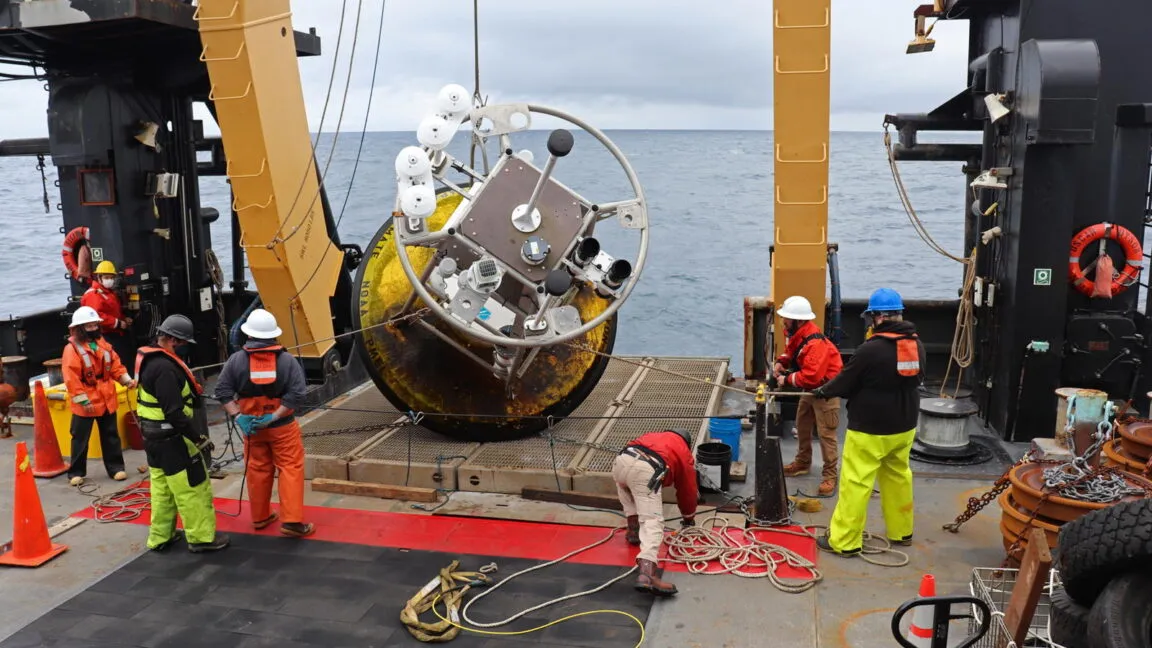
The National Science Foundation announced plans in May to decommission the Ocean Observatories Initiative, a nearly $368 million network of ocean monitoring instruments. For decision-makers in Alaska, the consequence is fewer real-time signals to plan fisheries and manage marine and coastal hazards.
Alaska is about to lose a real-time window into the ocean, and the cost is not small. In May, the National Science Foundation announced plans to decommission the Ocean Observatories Initiative, a nearly $368 million network of instruments that tracks ocean chemistry, wave action, water temperature, salinity, and more. The instruments do not just feed scientists. They feed fishery managers, coastal hazard planners, and even the military, helping them plan for what the ocean is doing right now, not what it did last month.
This matters in Alaska more than it does in many places, because the state’s ocean and weather are changing fast. The article notes that temperatures are warming twice as quickly as the global average. When your environment shifts that quickly, “data delays” stop being a nuisance and start becoming a risk. Decommissioning the monitoring network means Alaska and organizations that rely on these measurements could face a gap in detecting and responding to events like marine heatwaves or extreme wave action, at exactly the moment conditions are moving faster than historical playbooks.
So what exactly does the Ocean Observatories Initiative do, and why does decommissioning it cause anxiety rather than simple “upgrade later” optimism? The system provides real-time information that supports a long list of downstream users. That includes scientists studying ocean processes, fishery managers making harvest and management decisions, coastal hazard planners designing how communities prepare, and other mission-driven groups like the military planning and preparing for future conditions. In plain terms, it helps convert ocean variability into actionable signals.
The source makes a key point: the data is used in multiple decision loops. For fisheries, it can help inform calculations about how much fish can be harvested. For hazard planning, it supports timing and expectations around marine heatwaves and major wave action. You can think of it as a shared sensor layer across different institutions. When that layer disappears, every user has to guess more, or scramble to substitute partial signals with less complete information.
That scramble is where second-order problems start. Fisheries is a multibillion-dollar industry in Alaska, and coastal communities are especially vulnerable because so much of their economic and safety planning is tied to what happens offshore and along the shoreline. When monitoring systems are decommissioned, the immediate question becomes “what replaces the lost observations?” Even if other data sources exist, the article emphasizes this network’s breadth of measurements, including ocean chemistry plus physical conditions like temperature, salinity, and waves. Losing that mix can reduce both situational awareness and the ability to connect cause and effect across time.
There is also a regulatory and planning dimension. Coastal hazard planning is not a one-and-done exercise. It is iterative, and it depends on understanding the baseline and tracking changes. Marine heatwaves and giant wave action are not abstract threats. They can affect ecosystems, infrastructure, and day-to-day operations near the water. The same is true for temperature trends in a region warming faster than the global average. In these contexts, real-time monitoring can be the difference between earlier warnings and reacting after conditions have already shifted.
For boards, investors, and leaders across industries that depend on environmental signals, the important takeaway is not only that the ocean monitoring network is being decommissioned. It is that the decision sits at the intersection of federal science infrastructure, regional economic reliance, and high-frequency climate risk. The NSF decommissioning plan announced in May removes a shared capability that many users depend on, from harvest planning to hazard readiness.
If you lead an organization in or around fisheries, coastal services, insurance, climate resilience, maritime operations, or any business where ocean conditions influence budgets and safety, this should land like a governance alert. Monitoring is infrastructure. When it goes away, planning models lose inputs, risk assessments get noisier, and operational uncertainty rises. Alaska’s situation is extreme, but the underlying lesson travels: in a warming world where temperatures are rising faster than the global average in key regions, cutting the sensors that feed decisions can quietly reshape outcomes across an entire ecosystem.
This story's Key Insights and Take-aways are locked.
Create a free account to unlock Executive Actions for one credit.
Register to UnlockAlways free for Executives Club members. Join the Club
More in Business

SpaceX IPO: Wedbush calls a Tesla merger “holy grail,” Morningstar pegs $63 fair value
Trading starts June 12 at $135, but analysts are split over a $72-per-share “option premium” on orbital AI dreams.

Microsoft SkillOpt upgrades AI agent skills without changing model weights
Open-source framework turns markdown skill files into optimizable objects, boosting accuracy while keeping frozen model parameters untouched.

Britain’s regulator greenlights Novo Nordisk’s weight-loss pill on Thursday, needle-free win
Approval by Britain’s medicines regulator adds a new oral option and strengthens Novo Nordisk’s early lead versus Eli Lilly.