
OpenAI CEO Sam Altman’s prompt built a full website in 9 minutes, no coding
A non-coder copied Altman’s exact ChatGPT prompt and shipped a live group-trip site, plus where AI still trips up.
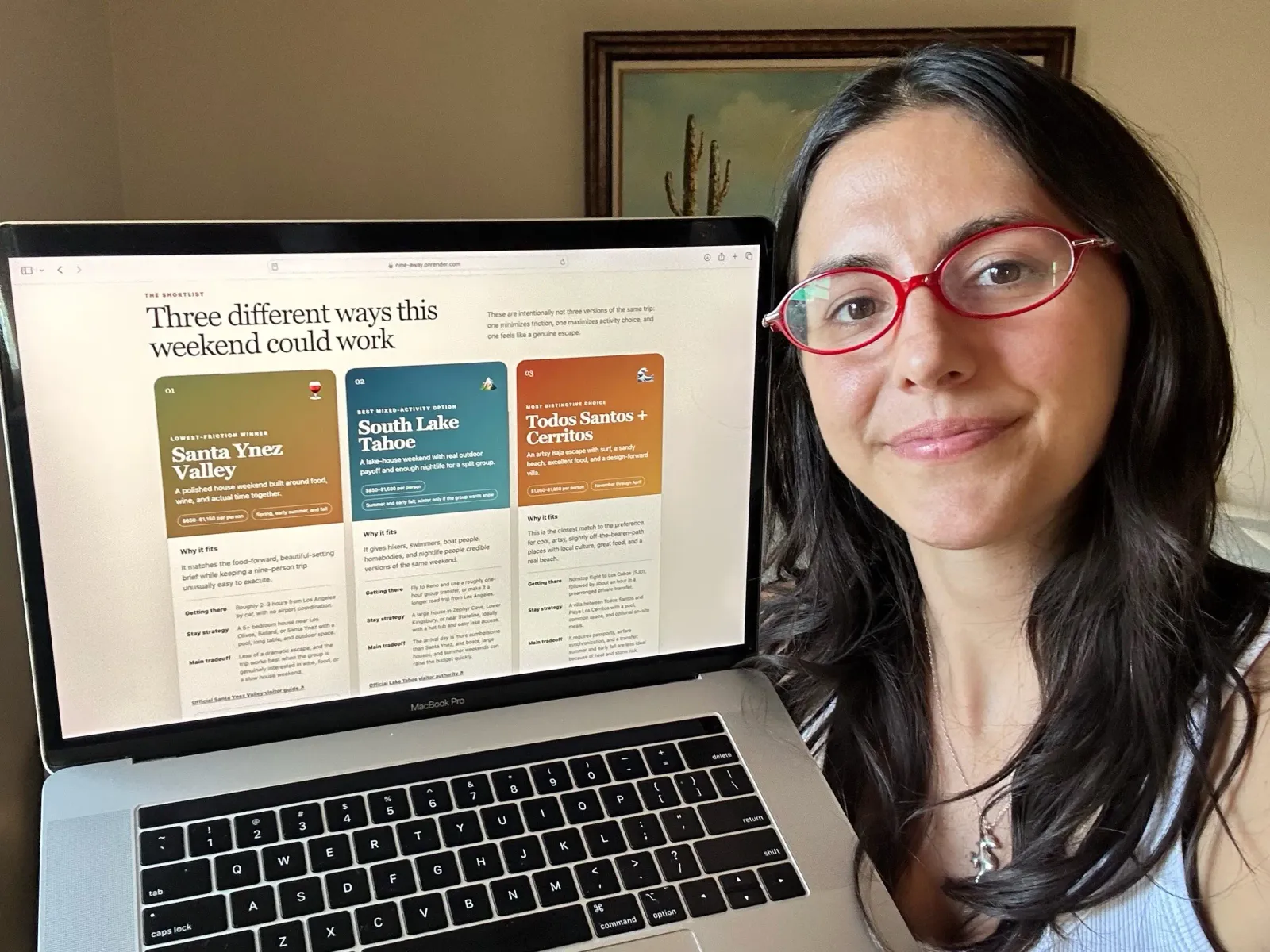
Sam Altman, cofounder and CEO of OpenAI, shared an exact ChatGPT prompt on X that BI columnist Kelsey Vlamis used to generate a fully working full-stack trip-planning website. For decision-makers, it’s a practical signal that “vibe coding” is becoming a workflow, not a novelty, with new product and governance implications.
Sam Altman, cofounder and CEO of OpenAI, posted an exact ChatGPT prompt on X. In nine minutes and 47 seconds, Kelsey Vlamis used that same text to generate three long-weekend trip options, downloadable source code for a complete website, and even an email draft to coordinate with friends. The punchline is simple: she built a fully functioning, group-voting site without writing a single line of code.
To understand why this matters, it helps to zoom in on what Vlamis asked ChatGPT to do. Altman’s prompt, sent from his phone, required far more than “suggest an itinerary.” It instructed ChatGPT to use his chat history to generate ideas, plan the best three options for a long weekend with 8 friends, then build a full-stack site where the 9 people could coordinate what they wanted in each place, reach group agreement, and finally draft an email in Gmail once the site was ready. That’s not content generation. It’s end-to-end application behavior: frontend interaction, back-end logic, and an output (reservation-ready coordination) that feels like a finished product.
Here is the part that will land with executives: Vlamis wasn’t just impressed. She was skeptical enough to try to break the result. Her first question was brutally practical: “Does this link actually contain a fully coded website?” ChatGPT’s response included a README file with what was in the project and how to install and deploy it. To her, the README read like “gibberish” because she had no technical coding skills. So she did what most non-technical stakeholders cannot afford not to do: she forced the system into a plain-language, step-by-step mode by telling it she couldn’t run anything locally.
The experiment quickly becomes a story about friction, not magic. Vlamis followed ChatGPT’s instructions even when they required familiar-to-developers steps: downloading Python, signing up for GitHub, and hosting the site using Render. She tested it locally on her Mac, then went live online. Her closest “coding” effort was copying and pasting short strings of code from ChatGPT into the Terminal app as directed. She paid $7.25 a month to host on Render. When she asked later about free options, ChatGPT recommended Cloudflare and suggested the process would have been just as simple if they had started there. In other words, the workflow worked, but AI still shows classic missteps around productization choices like “should I use paid hosting?”
That tension becomes more interesting when you factor in the actual platform layer OpenAI is building. When Vlamis reached out to OpenAI for the story, a spokesperson pointed to a recently launched feature called Sites. Sites lets users create, preview, edit, and host their sites all in ChatGPT for free with a Plus subscription, without third-party hosting services. The tool is in public beta and was already available in her account. Vlamis says ChatGPT, again, should have recommended Sites instead of third-party hosting. That matters because “vibe coding” is not just about generating code. It is about collapsing the whole dev loop: authoring, deploying, iterating, and reducing the handoffs that usually slow teams down.
Once the site was live, the app logic looked like a real collaboration tool, not a toy. Friends with access codes could create profiles, share budgets, vote on a destination, select available dates, check activities they were interested in, and comment with additional ideas. After everyone voted, the app could lock in the final destination and populate a new section with specific tasks that could be assigned and managed. Vlamis didn’t customize the prompt at all. She used Altman’s exact one, plus her personal ChatGPT history, and still got a usable outcome tailored to her interests.
Then came iteration, where most “AI built it” demos fall apart. The website wasn’t perfect, and she wanted changes. She transferred it into a Sites workspace and used another chat to rewrite her prompt to request small tweaks: adding the ability for users to edit or delete their comments, and moving the access code window higher up the page. ChatGPT worked for 14 minutes and eight seconds and deployed the changes. This is the workflow signal behind the hype: you can treat software delivery as a conversational loop, with deployment tightly coupled to the authoring environment.
For boards, investors, and operators, the second-order implications are clear. First, “regular people” do not need to become programmers to start building software-shaped solutions. Vlamis frames it as learning how to ask for tasks she didn’t know how to do. Second, the enterprise risk profile shifts. If applications can be generated and deployed quickly by non-technical users, governance has to move upstream: prompt standards, access controls, audit trails, and review processes become part of product operations, not just security. Third, platform strategy matters. If Sites can remove third-party hosting friction, that reduces the ecosystem lock-in that has historically constrained deployment pipelines.
Ultimately, Altman’s prompt is less about one weekend trip and more about what it demonstrates: a CEO-level example of how quickly the boundary between “idea” and “running app” is shrinking. The writer Jasmin Sun, quoted in the piece, warned that most people will not build even if given the ability, because many problems are not software-shaped. Vlamis’s experience suggests the opposite for the right user: after one successful vibe-coding exercise, she started seeing software-shaped solutions in her own life and is already thinking about what to build next.
This story's Key Insights and Take-aways are locked.
Create a free account to unlock Executive Actions for one credit.
Register to UnlockAlways free for Executives Club members. Join the Club
More in Technology

doubleAI's Maxwell rewrites code while it runs, claims 38x speedups
The Tel Aviv startup's code execution model formally verifies optimizations, turning AI into an agent for the hardware itself.
Saudi military official paid to fly OpenAI bugging suspect's family out, prosecutors say
A court filing says a Saudi military official funded the family's exit and Riyadh offered bail, putting foreign-influence risk squarely on AI boards.

AI researcher's 26,000-word claim: Neural nets aren't tangled after all
Nick Cammarata's Goodfire post has the AI world split - if he's right, monitoring frontier models just got a lot easier.