
Orcas “ram-to-fragment” dead sunfish into bite-sized pieces for calves
Two Gulf of California observations show coordinated hold-and-release smashing, with scientists calling it “ram-to-fragment.”
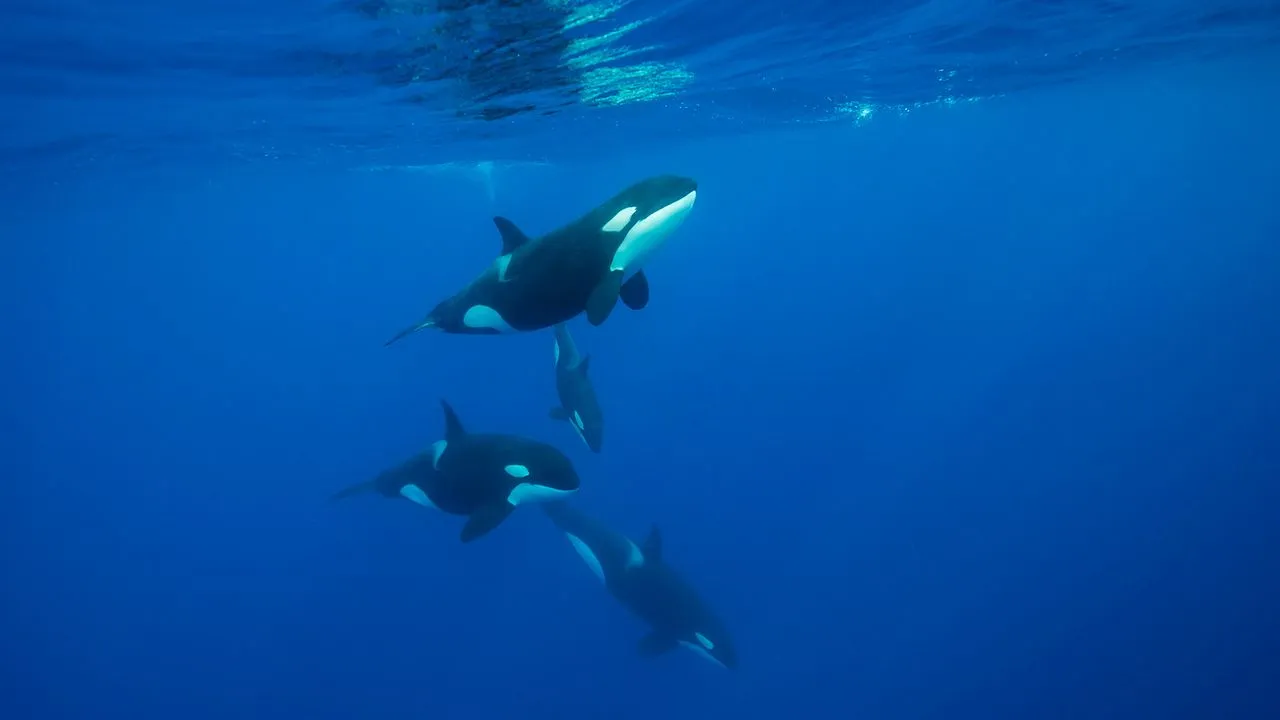
Researchers witnessed orcas in the Gulf of California working together to smash dead sharp-tail sunfish into fragments. The team, reporting in Frontiers in Ethology on July 23, dubbed the behavior “ram-to-fragment.”
If you think you already understand how orcas eat, the Gulf of California just got weirder. In two separate encounters, researchers observed one orca holding a dead sharp-tail sunfish in place while another rammed it at high speed, fragmenting the carcass into suspended pieces that a juvenile could then eat.
The scientists described the maneuver as “ram-to-fragment,” and they argue it may function like food processing for younger whales. One adult female orca held the sunfish (Masturus lanceolatus) by its tail-like clavus, released it an instant before impact, and an adult male then slammed into the fish belly-up. The collision produced a loud noise and made the sunfish’s tissue disintegrate, with a juvenile later feeding on the smaller fragments while adults fed on what remained.
To be clear, the sunfish were already dead in both events. In the first encounter, researchers also reported that the carcass appeared disembowelled, which matters because it shifts the question from “are they killing prey?” to “what are they doing to a bulky, hard-to-handle meal?” That distinction is why this is getting scientific attention. The investigators weren’t just watching a hunt. They were watching what looks like a repeatable technique for breaking a large body into digestible chunks, especially for younger animals.
The first event Ayres and colleagues documented happened in July 2024 near an offshore seamount off Baja California Sur, Mexico. In the video, Kathryn Ayres, a scientist at the conservation nonprofit Beneath the Waves, is heard exclaiming, “Oh my god!” Her point was not just surprise. She told Live Science, “It was unlike anything I'd witnessed before,” adding that moments like this are exciting because they may represent behavior not previously documented in detail, as reflected in the video.
The second encounter, credited to diver Héctor Franz for filming in September 2025, followed a similar sequence. The researchers reported that one adult orca stabilized the sunfish, another rammed it, and a calf later pulled tissue from the broken carcass. The pattern is what turns a single strange clip into a potential behavioral strategy. Still, the dataset is small: two observations.
That’s why the “so what” is less about certainty and more about incentive. Orcas (also called killer whales) are highly intelligent and social, and they commonly tear apart prey and share portions with calves and juveniles. In these new observations, young killer whales were present in both sequences, which fits the food-processing hypothesis. The study authors propose that the hold-and-release and fragmentation behavior could make it easier for younger whales to feed on the enormous bony fish that can weigh up to 4,400 pounds (2,000 kilograms).
Outside experts agree the observations are notable but caution against jumping too quickly from “looks like sharing” to “is parental investment.” Matt Hansen, a postdoctoral researcher at the Leibniz Institute of Freshwater Ecology and Inland Fisheries, not involved in the study, told Live Science that ramming isn’t new for killer whales. What may be new, he said, is the combination of hold-and-release sequences and the degree of fragmentation of carcasses. Meanwhile, Heather Hill, a professor and chair of psychology at St. Mary’s University in Texas, also not involved, emphasized that two observations are not enough to prove adults were deliberately feeding or teaching youngsters.
So what else could explain it? The researchers suggested possible alternatives. One idea is that the behavior could be playful, since orcas sometimes manipulate, toss, or strike prey without immediately eating it. But Hill argued the events looked more practical than playful. If it were play, she said, you’d expect multiple attempts with variations in speed, point of contact, force of impact, and initiators, because play typically explores without destroying the “toy” too soon. Instead, Hill noted the events appeared “one and done,” which points to functionality: eating the fish, modeling a foraging technique, and possibly sharing resources with a younger whale.
There’s also a more speculative microbiology angle. The researchers raised the possibility that dispersing the sunfish’s microbe-rich skin and gelatinous tissue could affect the surrounding water or expose orcas to potentially beneficial microbes. Hansen pushed back on the plausibility, telling Live Science that he didn’t see how dispersing skin into the water column would have a different effect from simply eating it. Unless, he said, the authors were suggesting something like using it “like a lotion on their own skin,” acknowledging the world is “weird and wonderful.” It’s not definitive, but the mere fact that scientists are thinking in those directions shows how far behavior ecology has moved from simple “hunt, eat, repeat.”
Zooming out, this also connects to other documented Gulf of California tactics. The researchers said the maneuver resembles coordinated attacks they had previously documented, where some orcas took turns ramming whale sharks (Rhincodon typus), the largest living fish. Prior footage from diver Kelsey Williamson showed orcas flipping a whale shark upside down to make it easier to prey on it. The common thread across these sightings is coordination and technique, not random violence.
For executives and operators watching the broader innovation ecosystem, the analogy is uncomfortable but useful. When teams repeatedly execute a complex sequence in the field, it can look like “culture” or “instruction,” even when the underlying mechanism is still being tested. In this case, the mechanism is still under debate, but the operational takeaway for science is the same: the real story is in the repeatable sequence. The report, published July 23 in Frontiers in Ethology, essentially flags a new behavioral label for how orcas may process large prey. And for anyone who funds conservation, builds marine policy, or manages environmental risk, better behavioral understanding feeds into everything from species protection priorities to how we interpret human impact in sensitive habitats.
Bottom line: the headline’s “explosion” metaphor is literal in effect, not necessarily intent. Researchers saw orcas fragment a dead sunfish through a coordinated ram-to-fragment sequence, with young whales then feeding on the smaller pieces. Whether that is primarily parental investment, observational learning, distribution of resources, or something else entirely remains circumstantial. But the observation is specific enough to demand attention, because it suggests killer whales may be running more than just hunting routines. They may be running a processing workflow.
This story's Key Insights and Take-aways are locked.
Create a free account to unlock Executive Actions for one credit.
Register to UnlockAlways free for Executives Club members. Join the Club
More in Science

Alaska's 1,580-foot tsunami had warning signs. Scientists just found them.
Rapid glacier retreat, heavy rainfall, and thousands of tiny tremors preceded Alaska's 1,580-foot tsunami, a warning for every coastal community in a warming world.

The rare mutation that lets high-risk brains dodge Alzheimer's
Scientists found a natural defense against protein buildup, opening a new path to preventive treatments.

3,000 steps a day may halve Alzheimer's decline, study finds
New research links a modest daily walk to less tau buildup and nearly half the cognitive and functional decline, even for those with early signs.