
Ousted defence minister Mykhailo Fedorov publicly clashed with Ukraine’s top commander, Zelensky begged unity
A public fight inside Ukraine’s military leadership plus city protests forced Volodymyr Zelensky to step in.
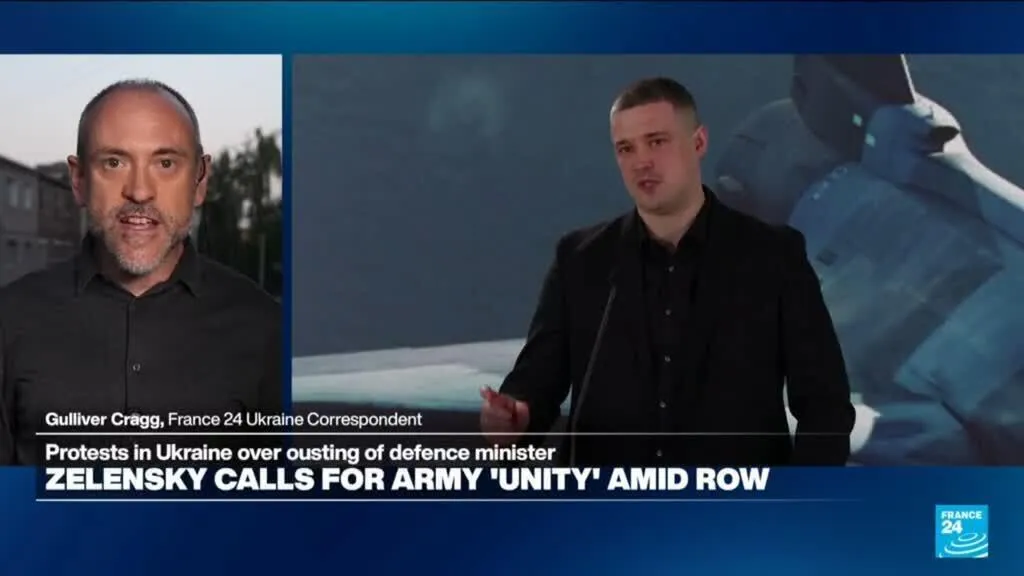
Ukraine’s ousted defence minister Mykhailo Fedorov launched public criticism at the army’s top commander on Thursday after being removed. The fallout is already dividing political and military authority and pushing Zelensky to publicly manage unity.
Ukraine’s ousted defence minister Mykhailo Fedorov went public with stunning criticism of the army’s top commander on Thursday, triggering a fresh scramble at the top of the chain of command. The immediate consequence was political: President Volodymyr Zelensky called for unity as signs of an emerging split in Ukraine’s military leadership started to show.
That call for unity matters because it came right after the conflict spilled into public view. FRANCE 24 reports that large protests erupted in several Ukrainian cities against the removal of Fedorov, who had been brought in about six months earlier. In other words, this was not a private disagreement that stayed behind closed doors. It became a visible legitimacy test, where public anger risks turning internal leadership tensions into a national storyline.
To understand why this moment has extra weight, you have to look at what Fedorov represented when he entered the defence role. France 24’s report frames his tenure around digitising and modernising an army that has been worn down after four years of fighting off the Russian invasion. That is a specific mission, and in wartime, “modernisation” is rarely abstract. It implies decisions about systems, processes, procurement, and how information flows. When a leader associated with those priorities is removed, it is not just a personnel change. It is an organizational reset, and resets shake up power centers that grew used to influence.
At the same time, the report highlights that the criticism was directed at the army’s top commander. That makes this a clash between two kinds of authority: political oversight and military command. In most governments, those roles are designed to check and coordinate each other. In wartime, that coordination becomes even more delicate because speed, discipline, and clear lines matter. A public exchange between senior leaders can signal disagreement over priorities, tempo, or execution, even if the dispute is really about something more procedural. Zelensky’s unity plea, then, reads like an attempt to stop the narrative from hardening into factions.
The protests in multiple Ukrainian cities raise the stakes further. FRANCE 24 notes that the removal of Fedorov drew large demonstrations. When protests gather around a specific figure, they turn that figure into a symbol, not just an official. That can force decision-makers into a difficult bind: either they reassure the public and try to contain the split, or they risk widening the political gap between those supporting the ousted minister and those aligned with the restructured leadership.
For executives and boards watching from the outside, this has a familiar corporate cousin: when leadership changes are perceived as ideological or strategic, internal stakeholders start aligning around identities and visions, not just outcomes. Digitisation and modernisation are exactly the kind of strategic themes that create natural supporters and natural skeptics, especially when the organization is operating under chronic stress. If parts of the system interpret the ouster as a rejection of modernization, they may resist whatever replaces it. If others interpret it as necessary course correction, they may push harder for a tighter chain of command. Either way, the company-equivalent is that “strategy” becomes “coalitions,” and coalitions behave badly under pressure.
Capital markets may not be directly pricing Ukrainian defence leadership today in a clean, spreadsheet-friendly way, but the logic still applies. When leadership instability affects operational execution, it affects stakeholder confidence. In wartime, the stakeholders include not only domestic institutions but also international partners who depend on steady coordination. Public splits complicate risk assessments, because partners cannot easily separate disagreement from disorder. Zelensky’s intervention is therefore not only about domestic calm; it is also a signal to external audiences that Ukraine is trying to keep its leadership coherent.
The second-order implications show up in how similar roles are likely to function next. If an out-going defence minister can publicly challenge the army’s top commander and trigger city protests, future office-holders may feel less constrained by typical escalation channels. That can push leaders toward visibility and away from internal problem-solving. Meanwhile, military leadership may tighten internal control to prevent public messaging from undermining authority. The result could be a more guarded system where officials communicate less openly, even when candor might improve outcomes.
Ultimately, this episode is a stress test for Zelensky’s ability to unify political direction with military execution. FRANCE 24 reports that the ousted minister’s public criticism and the protests forced Zelensky to call for unity amid signs of an emerging split in the top ranks. For decision-makers, the stakes are straightforward: in wartime, unity is not a slogan. It is an operating condition that determines whether strategy can be executed without the organization turning into competing agendas.
This story's Key Insights and Take-aways are locked.
Create a free account to unlock Executive Actions for one credit.
Register to UnlockAlways free for Executives Club members. Join the Club
More in Politics

Glacial collapse, not rain, killed 180 in Nepal's Himalayan flood
The Himalaya's extreme geography hid the true cause of Nepal's catastrophic flood, a glacial collapse that turned a geological battleground into a mass-casualty zone.

Iran’s Esmail Baghaei says Oman talks start shipping via Hormuz, not US talks yet
Temporary route plans with Oman aim to restart commerce while Tehran says Washington dialogue is not on the table.

Standards watchdog opens probe into Reform UK deputy leader Richard Tice over interests
The parliamentary standards commissioner says it began an investigation on 28 July into a possible undeclared interest.