

Perseverance finds macromolecular carbon on Mars, but NASA needs Earth samples to prove life
An international team reports MMCs in Cheyava Falls from Jezero Crater, adding evidence for organics, not answers.
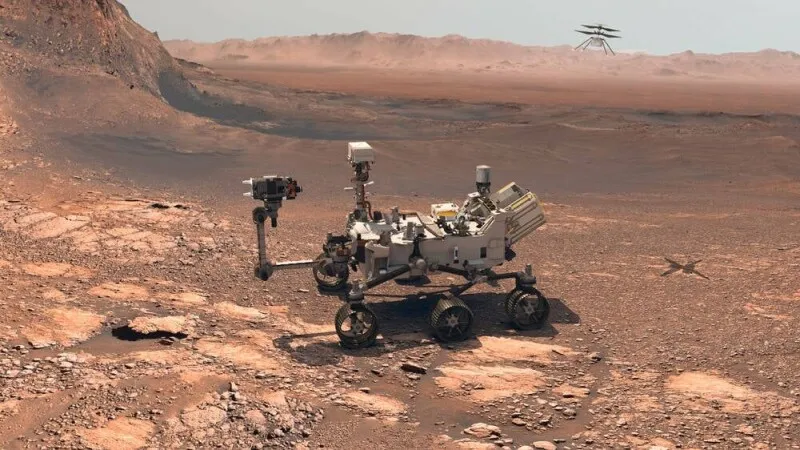
NASA's Perseverance rover, using SHERLOC and WATSON, helped an international team report signs of macromolecular carbon (MMC) in the Martian rock dubbed Cheyava Falls, in Science Advances Wednesday. The consequence for decision-makers: the science is moving, but only sample return can break the abiotic vs. biotic deadlock.
Yet another Martian rock finding is raising eyebrows on Earth. In a report published in Science Advances on Wednesday, an international team said it detected macromolecular carbon (MMC) in a rock on Mars called Cheyava Falls, using instruments on NASA's Perseverance rover. The data comes from Jezero Crater, where Perseverance has spent the entirety of its five-year mission, and it adds another layer to the growing case that ancient Mars had organic carbon and may once have been habitable.
Here is the part that matters: MMCs can be tied to life on Earth, but the instruments on Perseverance cannot confirm biology. The team explicitly notes that their detections could still come from lifeless sources. That is why the paper, and the project leaders behind it, keep circling back to one requirement: rocks need to come home. SHERLOC principal investigator and NASA Jet Propulsion Laboratory scientist Kyle Uckert told us in an email that the rover instruments were not designed to distinguish between rocks formed through biologic or abiotic processes, but they can identify compelling samples for possible return to Earth. The rocks Perseverance already sampled for this study are packaged, sealed, and waiting, according to Uckert.
To understand why this is such a big deal, zoom in on what Perseverance actually saw. The Cheyava Falls team credits two instruments on the end of Perseverance’s arm: the Scanning Habitable Environments with Raman and Luminescence for Organics and Chemicals (SHERLOC) and the Wide Angle Topographic Sensor for Operations and eNgineering (WATSON). Together, they found MMCs in Cheyava Falls. The source paper lays out the importance of MMC by analogy to Earth chemistry: MMCs found on Earth are often associated with organic compounds essential to life, including carbohydrates, lipids, proteins, and nucleic acids. There is a distinct possibility that MMCs found on Mars could have come from similar sources.
The team also connected this discovery to something earlier and farther away. Curiosity, which explored Mars in a different region, found evidence of similar materials in 2018 more than 3,500 kilometers away in Gale crater. The potentially organic matter detected by Curiosity was dubbed “kerogen.” From a strictly scientific standpoint, kerogen can be used interchangeably with MMC, but the Cheyava Falls team opted to avoid that terminology in order to “avoid implications of biogenicity.” In other words: they want the excitement, without stepping over the evidence.
This is where the skepticism gets real. The story is not that Perseverance found a clear fossil-like smoking gun. It is that it found a potentially life-relevant ingredient. Even the authors emphasize there are multiple potential pathways to form MMCs without life. Meteorite impacts and abiotic synthesis of organic matter are both on the list, and the paper spells out several potential abiotic routes on Mars, including condensation from igneous systems and associated volatiles, serpentinization, carbonation, and the electrochemical reduction of carbon dioxide in aqueous or hydrothermal fluids. The upshot: the Jezero Crater results keep building a credible “organics and habitability” narrative, but they do not shut the door on non-biological explanations.
That distinction is not academic. It is a direct contrast to a different kind of ambiguity NASA admitted it had in September of last year. In that earlier case, Perseverance drilled a core sample called Sapphire Canyon from the Cheyava Falls rock, and NASA said it contained potential signs of ancient life that it couldn't readily explain through abiotic processes, though non-biological explanations remained possible. The Register notes that then-acting NASA administrator and transportation secretary Sean Duffy said at a press conference last year, “A year ago we found what we believe to be signs of microbial life on Mars' surface,” and that after a year of review “the scientific community” came back “and said it can't find another explanation.” Since then, other Jezero Crater clues have also leaned on caution. In March, researchers reported signs of nickel compounds indicating the formation of enzymes related to bacterial biological processes, but those signs could also be explained by non-biological action.
So where does that leave the decision-makers? With a single strategic bottleneck: sample return. Both the Wednesday report and the research leaders behind it are unequivocal about what it will take to confirm life. “The instruments on the Perseverance rover were not designed to distinguish between rocks that formed through biologic or abiotic processes,” Uckert said, and again, they are able to identify compelling rocks for possible return to Earth. He reiterated that the sampled rocks for the study are packaged, sealed, and waiting for the possibility that something like that still happens. Yet he and co-lead author Ashley Murphy of the Planetary Science Institute declined to weigh in on timing when asked.
The Mars Sample Return plan itself is essentially scuttled at this point, according to the source, which makes this more than a science story. It becomes a technology and execution race. China is already pushing ahead with its own Mars sample-return mission, with launches planned for 2028 and a sample return targeted for around 2031. China also has a leg up in sample-return execution, returning samples from the far side of the Moon to Earth in 2024. The US has returned asteroid samples to Earth as well, but Mars is a much harder game. Life or no life, the ability to run the decisive “Earth-lab inspection” step will likely determine who gets the final word, and that is the kind of asymmetry boards and investors should recognize: when the decisive experiment is bottlenecked by logistics, the winner can be decided by project reliability as much as by discovery speed.
This story's Key Insights and Take-aways are locked.
Create a free account to unlock Executive Actions for one credit.
Register to UnlockAlways free for Executives Club members. Join the Club
More in Technology

Nvidia's $89B data center quarter: the 9 companies cashing in
The AI buildout is minting fortunes beyond GPUs, and memory, cloud, and cooling suppliers are riding the same wave.

Google quietly links your phone number to every Android account on your SIM
Adding a SIM now ties your phone number to all Google accounts - and future accounts inherit it. Here's the security and privacy stakes.

Hijacker AI 'Skynet mode' runs 100,000 attack steps against exposed models
Symantec caught a criminal AI agent that borrows other models, steals data, and mines crypto; the only relief is no confirmed victims yet.