

Phanteks EX5 to EX6 Max costs $110-$330, scraps fish-tank cooling for GPU-sealed air
New EX modular PC cases aim at thermal efficiency by compartmentalizing the GPU chamber and directing fresh airflow.
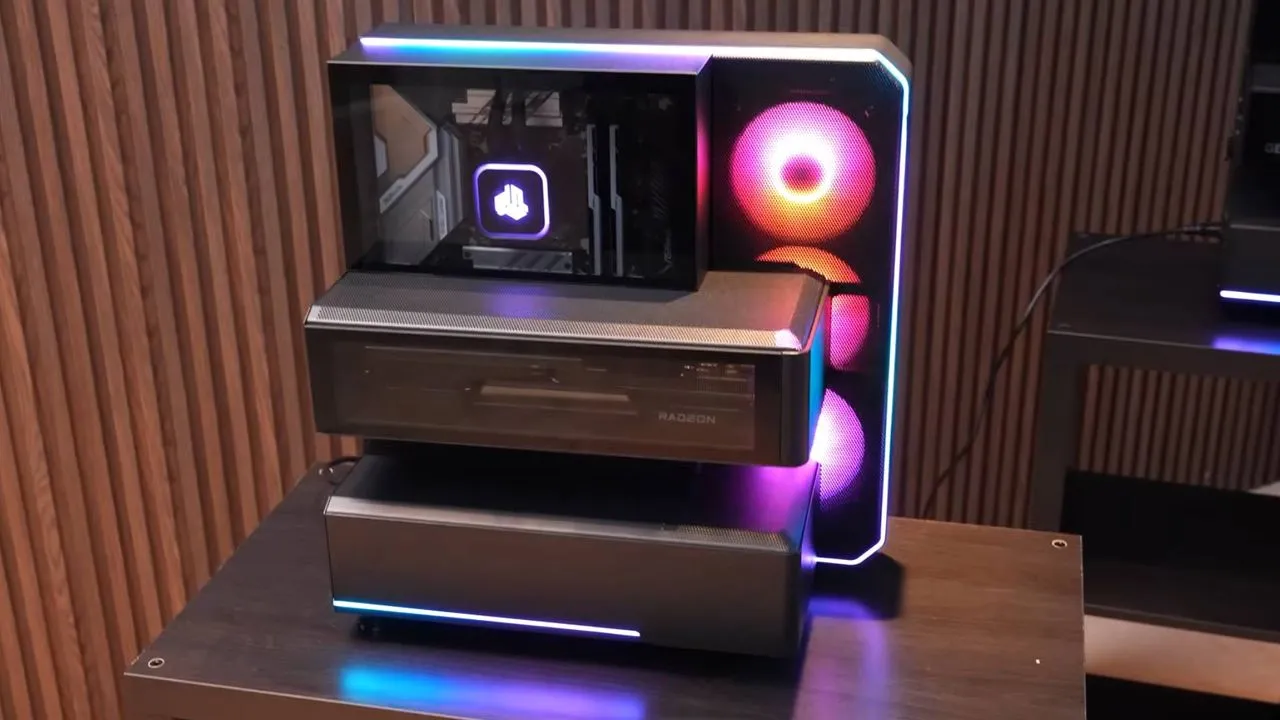
Phanteks revealed the EX series of modular PC cases at Computex, starting with the $110 EX5 and scaling to the $330 EX6 Max. The shift is operational as much as aesthetic: a compartment strategy isolates the GPU and changes airflow so companies and builders need fewer extra fans.
PC building has had a visual rule for years: glass panels everywhere, RGB glowing like a nightclub, and the whole rig looking like a fish tank. Phanteks is trying to break that spell with its EX lineup, which includes the entry-level Phanteks EX5 at $110 and the top-end Phanteks EX6 Max at $330. The core idea is simple, and it matters for anyone paying for performance or reliability: instead of letting hot GPU air swirl around the case, the EX design gives your graphics card its own compartment and uses directed, non-recirculated airflow to improve thermal efficiency.
Here is the practical payoff up front. Phanteks says the directed airflow from its side-mounted cooling system helps deliver fresh air squarely at the hottest components like the GPU, which it frames as reducing the need to fill the case with additional fans. In the EX6 Max, the strategy goes further with opaque aluminium compartments and a rubber gasket for the GPU. The gasket essentially seals the top of the graphics card chamber from the bottom to minimize the risk of hot air recirculating. In other words, the case is not just a frame for parts anymore. It is part of the cooling system.
If you are thinking, “Isn’t this just another case gimmick?” you are not alone. The EX series was first unveiled during Computex earlier this month, but many builders got distracted by other showfloor draws, including the Sanrio cases mentioned in the coverage. That is where the deeper analysis comes in. Der8auer, a heavyweight hardware creator, reportedly provided a deep-dive that informed the framing of the “another way to do modern case design beyond the ubiquitous fish tank look.” For operators and product people watching the market, that is a clue about how consumer tech moves now: mainstream aesthetics may dominate until a credible performance-focused teardown flips the narrative.
Technically, the series is tiered, and each tier tells you what Phanteks believes customers will trade off. The most affordable model, the Phanteks EX5, costs $110 and requires you to source your own cooler. Every other model in the lineup comes with a side-mounted cooling system included, which is the feature used to explain the performance and airflow behavior. The coverage also points out that this design directs fresh, non-recirculated air, which is a different airflow philosophy than simply adding more fans and hoping for the best.
The mid-tier options land where most purchasing decisions actually happen: balancing price, convenience, and cooling completeness. Between the $110 and the $330, Phanteks places a few steps. The EX5 Plus includes a custom cooler plus tubing management for $160. Then the EX5 Max includes the cooler and tubing management and adds a 6-inch LCD display for $230. For decision-makers trying to anticipate what customers will adopt, the inclusion of displays and the way the cooling architecture is packaged matter. These are not just “add-ons.” They are how the product communicates value, especially when the thermal story is not visible through transparent panels.
Then there is the flagship: the EX6 Max. At $330, it replaces detachable tempered glass windows with opaque aluminium compartments. It also includes high-performance X30 fans, its own special AIO liquid cooler, and a 10-inch LCD display built into the case. The coverage adds a more behavioral detail: its RGB light strips can be configured to track GPU temps, illuminating more of the strip the hotter the graphics card gets. That is effectively a user-facing control loop, even if it is not changing the physics. It changes how builders and teams diagnose what is happening during heavy workloads.
Finally, the schedule is close enough to matter. According to TechPowerUp, the EX5 case is expected to drop in August, while the EX6 cases should show up sometime in September. For executives and investors, the strategic stake is not merely whether one case sells. It is whether the industry continues to pivot from “cooling by volume of fans and aesthetics” toward “cooling by architecture.” If modular compartmentalization and non-recirculated directed airflow become the baseline expectation, other brands will need to rethink case design, accessory ecosystems, and how they prove thermal efficiency without relying on the familiar fish tank look.
In a market where GPU performance keeps climbing and thermals stay the limiting factor, the EX series is a reminder that cooling is an integrated product feature, not an afterthought. Boards and product leaders in adjacent hardware categories should watch for this pattern: when credible builders and reviewers validate a new design philosophy, it can accelerate adoption across the ecosystem. The question is whether you treat “case design” like a cosmetic decision, or like a thermal system that can move the whole user experience.
This story's Key Insights and Take-aways are locked.
Create a free account to unlock Executive Actions for one credit.
Register to UnlockAlways free for Executives Club members. Join the Club
More in Entertainment

Entertainer Russell Brand denies 7 sex charges amid accuser's 'couldn't breathe' claim
The alleged victim's account sharpens the reputational and legal stakes for Brand, his platforms, and any business tied to a public figure under criminal scrutiny.

Russell Brand's accuser 'bewildered and confused' as he denies 7 sex charges
The criminal case against the comedian is a live test of how media companies manage talent risk when serious allegations go public.

'It's a Magic Trick': Ballet Experts Say Rosalía's SNL Pose Is Impossible
Three ballet experts tell Rolling Stone Rosalía's gravity-defying SNL stillness shouldn't be possible - and why the debate is now part of the show.