

Physicists watch Hawking radiation recoil in a fiber black hole experiment (Nature, July 1)
They detected the ultraviolet “Hawking partners” and the back reaction that reshapes the analogue event horizon.
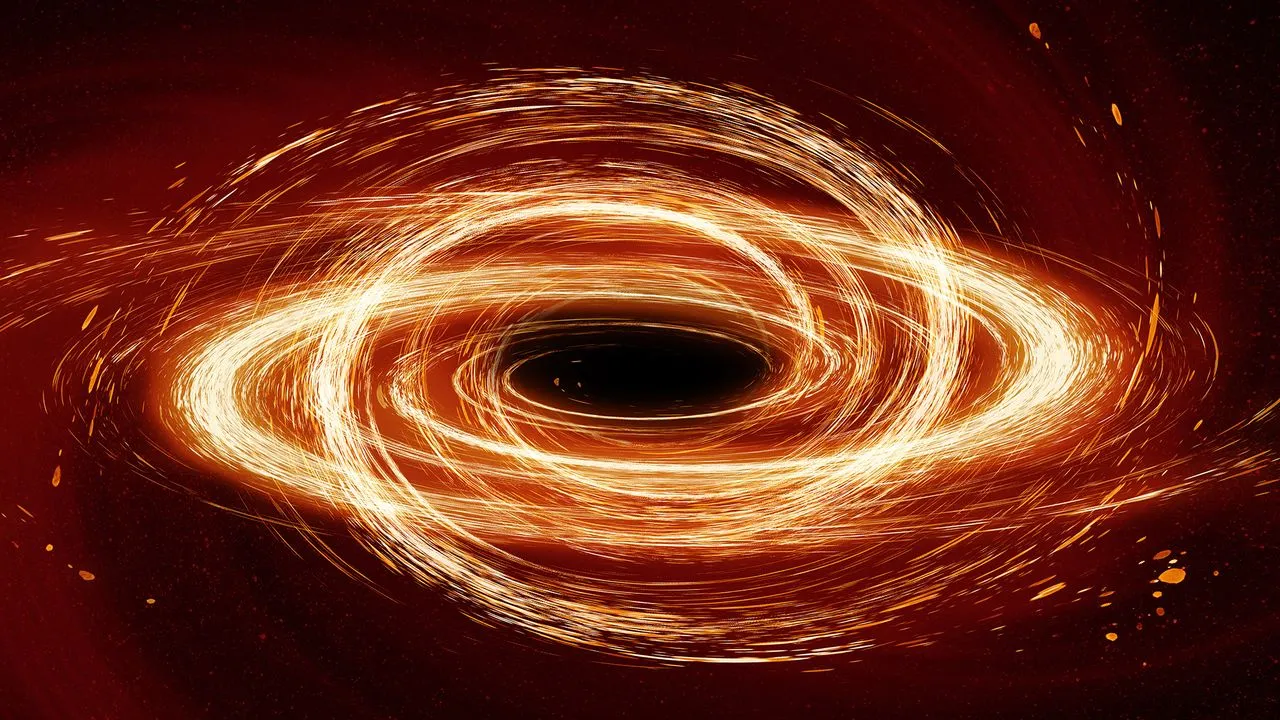
An international team led by physicist Ulf Leonhardt (Weizmann Institute of Science) built a tabletop black hole analogue out of light and reported results in Nature on July 1. The experiment not only saw Hawking radiation, it also measured the long-sought back reaction that shows energy flowing back into the system.
Physicists finally got the most elusive part of Hawking radiation on camera: the light glow, and the recoil that comes with it. In a tabletop experiment described in a study published July 1 in the journal Nature, the team coaxed Hawking radiation out of a thin strand of optical fiber and detected both the ultraviolet radiation and its “back reaction” - the way the radiation feeds energy back and reshapes the simulated black hole that produced it.
The payoff is immediate and oddly satisfying: the ultraviolet light behaved “exactly as Hawking predicted” for a thermal emitter. The researchers saw radiation with a definite temperature and a spectrum that fades steadily toward higher frequencies. Crucially, this held even in a regime where the usual textbook description of a black hole should break down, addressing a central worry in Hawking’s framework: what if the radiation needs physics at scales we cannot directly trust?
To understand why this matters, zoom out to why Hawking radiation is famous in the first place. Black holes sit at the crossroads of big, normally incompatible theories. As Leonhardt explained to Live Science via email, “Jacob Bekenstein predicted that black holes have an entropy and a temperature, and Hawking calculated the thermal radiation of the black hole.” In Hawking-Bekenstein radiation, quantum physics, general relativity, and thermodynamics all have to play together, even though those fields “are normally in conflict with each other.” That conflict is not academic for the experimenters. It is the reason real Hawking radiation is so hard to study: astronomers have not seen it from an actual black hole, and probably never will, because the glow is far too faint across the cosmos.
So the strategy has been to build black hole analogues in the lab. These analogues obey the same equations as black holes, without requiring a real astrophysical event. Teams have used flowing water, ultracold atoms, and now, in this study, light itself. The core trick behind any analogue is a moving medium. Leonhardt offered a simple picture: “Imagine a swimmer in the sea with a current faster than he can swim. He is swept away.” Beyond a black hole’s event horizon, that “current” corresponds to space itself effectively moving faster than anything that can travel, so nothing can escape.
To recreate that horizon, the researchers needed a material that appears to move at the speed of light. They found it in nonlinear optics, where “light acts like a material.” The experiment starts with a thin photonic-crystal fiber, a strand of glass patterned with tiny air channels that let scientists fine-tune how light moves through it. An intense, ultrashort “pump” pulse travels through the fiber and subtly changes how the glass bends light, creating a moving “speed bump” that races along with the pulse. Then a second, much weaker “probe” pulse runs into this moving front. Where the probe can no longer keep up, an artificial horizon forms, and the black hole analogue is born.
The team then chased two things at once: Hawking radiation itself, and the partner dynamics that imply energy conservation is not optional. Theory says Hawking radiation is created in pairs: one partner escapes, while the other carries “negative” energy and falls inward. In this fiber system, the inward partner shows up as ultraviolet light. “We counted photons in the ultraviolet that correspond to the Hawking partners beyond the horizon,” Leonhardt said. “They have a wavelength around 233 nanometers. This was our signal.”
But the headline moment is not just detection. For years, researchers assumed the analogue would build up Hawking radiation through a cascade: step-by-step conversions through intermediate forms. The Nature study reports something cleaner. Instead of a cascade, the pump and probe light produce the Hawking pair in a single direct interaction. That single-step picture matters because it suggests the mechanism might transfer more directly to other analogues, and it gives theorists a simpler target for what to model.
Then comes the back reaction, the long-sought “how the system pays for the glow” part. Making Hawking radiation should nudge the source that created it because energy has to come from somewhere. For a real black hole, that nudge is tied to losing mass, the gradual evaporation process described in Hawking’s landmark 1974 paper. Until now, no experiment had captured that recoil in a direct way. Here, the researchers saw it in the spectral fingerprint: producing the radiation shifted a small fraction of the pump pulse’s own light to a slightly different color, creating a lopsided pattern in the spectrum. That asymmetry, absent in earlier experiments, is described as the fingerprint of the back reaction.
This also lands on another thorny puzzle in black hole physics: the trans-Planckian problem. Hawking’s prediction can be traced back to where it was born, but the calculation runs into territory no physicist can vouch for, the Planck scale, where space and time are thought to lose familiar meaning and known physics gives out. A key question, Leonhardt said, was whether Hawking radiation would still show up if the “tiny starting waves” are smaller than nature’s smallest scale, where the physics is unknown. Remarkably, the glow stayed perfectly thermal even in this extreme regime.
Where the story goes next is also operationally clear. The team has so far used ordinary laser light, which reproduces the Hawking radiation spectrum but not its deepest quantum weirdness. Their next step is to “go quantum,” with the goal of exploring quantum features such as entanglement, the ghostly link expected to tie each escaping Hawking particle to its lost partner. If they succeed, it would turn a thermal light analogy into a more direct test of Hawking’s quantum claims, with less hand-waving about what the analogue is really standing in for. For anyone tracking the frontier where theory meets instrumentation, this is one of those rare experiments that does not just observe a prediction, it observes the system’s accounting as well.
This story's Key Insights and Take-aways are locked.
Create a free account to unlock Executive Actions for one credit.
Register to UnlockAlways free for Executives Club members. Join the Club
More in Science

Alaska's 1,580-foot tsunami had warning signs. Scientists just found them.
Rapid glacier retreat, heavy rainfall, and thousands of tiny tremors preceded Alaska's 1,580-foot tsunami, a warning for every coastal community in a warming world.

The rare mutation that lets high-risk brains dodge Alzheimer's
Scientists found a natural defense against protein buildup, opening a new path to preventive treatments.

3,000 steps a day may halve Alzheimer's decline, study finds
New research links a modest daily walk to less tau buildup and nearly half the cognitive and functional decline, even for those with early signs.