
PLATON replaces millions of detector parts with one light block, aiming to upgrade 3D particle tracking
A light-field camera plus photon sensors and AI reconstructs fast 3D particle paths, with simulations pointing to detector-level gains and better PET scans.
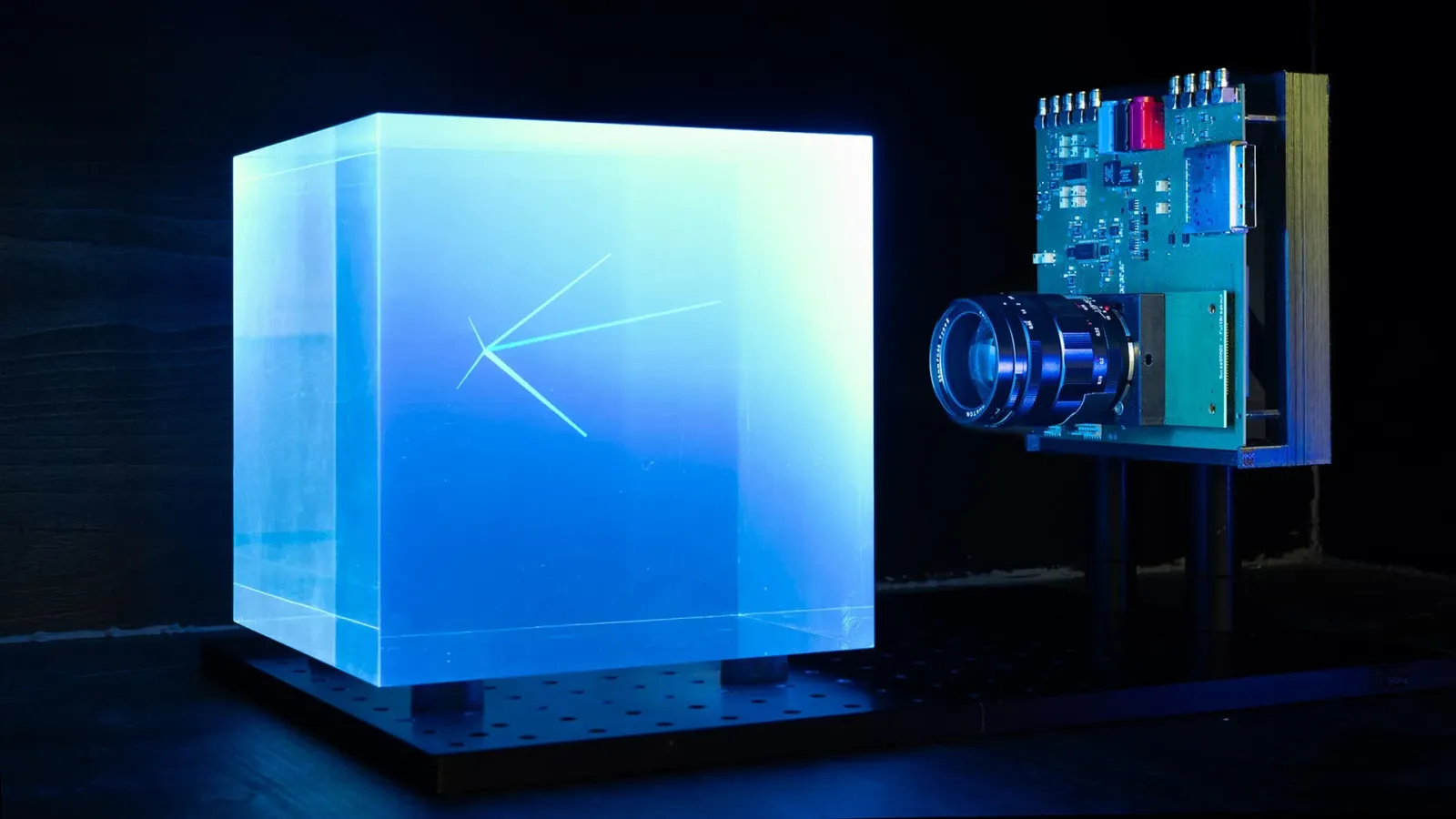
Scientists developed a new particle detector called PLATON designed to replace millions of tiny detector components with a single block of light-producing material. It uses a light-field camera, highly sensitive photon sensors, and AI to reconstruct particle paths in fast, detailed 3D, and simulations suggest it could match or surpass today’s best detectors while scaling more easily.
There is a quiet revolution brewing in how particle collisions get measured, and it starts with a blunt idea: stop building particle detectors out of millions of tiny pieces. The new detector, called PLATON, is built around a single block of light-producing material, and the goal is to replace the sprawling detector architecture that currently dominates many advanced experiments.
PLATON combines a light-field camera, highly sensitive photon sensors, and AI to reconstruct particle paths in fast, detailed 3D. That is the core promise right out of the gate. The detector is not just “better images,” it is a different measurement pipeline: instead of manually inferring what happened through a dense arrangement of components, it captures the light field and uses AI reconstruction to map where particles traveled.
If you run physics labs, hardware teams, or funders who care about experiment throughput, this “single block” framing matters because scaling detectors is usually a nightmare of cost, assembly complexity, and reliability. In many modern detector designs, the system is a mosaic. You need countless small detector elements, and each one adds manufacturing effort, calibration overhead, and points of failure. PLATON’s concept tries to compress that complexity by collapsing functionality into one light-producing material block, while still keeping the detector sensitive by pairing it with highly sensitive photon sensors.
The second big question for decision-makers is whether this kind of architectural simplification can keep up with the best existing performance. Here, the source is explicit that simulations suggest PLATON could match or surpass today’s best detectors. That is a meaningful claim because particle detectors are not forgiving. They often live or die by resolution, speed, and the quality of reconstructed trajectories. A detector that reconstructs in fast, detailed 3D has to handle both the data rate and the geometry of particle tracks, and the fact that PLATON uses AI for reconstruction signals a modern shift: the detector can be engineered to feed a computational model that turns optical signals into track information.
From an operational standpoint, the “far easier to scale” angle is arguably as important as the accuracy promise. Hardware scaling affects timelines. It affects budgets. It affects whether a detector upgrade is even feasible for a growing set of experiments, rather than being locked to a bespoke, once-in-a-decade build. If PLATON’s approach really reduces the number of tiny detector components that must be manufactured and assembled, then scaling becomes less about choreography across thousands of parts and more about producing and integrating the light-producing block with the camera and photon sensors.
There is also an applied-health reason this story deserves attention: the technology may lead to sharper PET medical scans. PET, or positron emission tomography, relies on detecting signals produced by events in the body and then reconstructing where those events occurred. Better 3D reconstruction and improved detector performance can translate into clearer images, which matters for clinical decisions and for research quality in medical imaging. The source is careful by saying “may,” but the direction is clear: the same capability that reconstructs particle paths in physics experiments could also enhance image reconstruction in medical settings.
Now zoom out to the market and regulatory reality. Medical imaging systems and particle detectors sit in different ecosystems, but both face scrutiny around performance validation and reliability. In medical contexts, sharper scans are not automatically a win without evidence that image quality improvements translate into clinically meaningful outcomes, consistent calibration, and safe operation under real-world conditions. In research environments, performance claims still have to survive experimental runs, detector aging, and long-tail failure modes that simulations cannot fully capture. For executives, the practical takeaway is that PLATON’s simulation-backed promise is the starting line, not the finish line. If subsequent prototypes and test campaigns confirm that it truly matches or surpasses today’s best detectors, and if scaling is indeed easier, PLATON could shift the cost and complexity curve for next-generation measurement systems.
For boards and investors thinking about the broader pattern, PLATON is a useful signal: the field is moving toward hybrid systems where optics and sensors feed computational reconstruction, rather than relying solely on brute-force sensor granularity. That approach can reduce hardware sprawl, but it also elevates the importance of algorithm performance, calibration workflows, and data quality control. If PLATON delivers as promised, it could become a template for how future detectors are designed, built, and scaled, with consequences that ripple from fundamental research instrumentation to medical imaging technologies like PET.
This story's Key Insights and Take-aways are locked.
Create a free account to unlock Executive Actions for one credit.
Register to UnlockAlways free for Executives Club members. Join the Club
More in Science

Brandon Flowers fires back on ‘Paradise’, replying to Phil Collins’ ‘Another Day In Paradise’ dig
The Killers frontman’s new single is the second preview of solo album ‘Thrasher’ and a pointed cultural counterpunch.

Ancient Egyptian princesses used weapons: reassessment of 5 Middle Kingdom royal mummies
A long-running debate over symbolic vs practical burial weapons gets a new answer from bones, not wishful thinking.

Princess Ita Sameh’s dagger wasn’t décor, bone changes suggest real archery and fighting
A study of six Middle Kingdom royal mummies links arm and hand loading to habitual weapon use, not symbolism.