

Progressive logger Troy Jackson dominates Maine delegate vote for Platner replacement
Saturday delivered 319 of 500 open slots across eight counties, setting up a high-stakes fight for Senate momentum.

Maine’s progressive candidate Troy Jackson, a logger and former state Senate president, dominated Saturday county meetings selecting delegates to replace scandal-plagued former nominee Graham Platner. The delegate rush immediately positions Jackson as the likely front-runner heading into the crucial Senate race against Republican Sen. Susan Collins.
WISCASSET, Maine - Progressive logger Troy Jackson went on offense in Maine’s rushed delegate selection process to replace scandal-plagued former nominee Graham Platner, and Saturday turned into a rout. Across eight counties, Maine Democrats chose 319 of the 500 open delegate slots on Saturday, with Jackson-aligned candidates carrying an overwhelming majority, according to a POLITICO analysis of released delegate slates and lists of elected delegates.
This wasn’t just a “nice win.” Jackson’s performance in the first day was so dominant that he announced he would host a celebratory tailgate during Sunday’s delegate selection caucus in York County. And because this “flash pseudo-primary” happens immediately ahead of the party’s next steps, the winner gets thrust into the national spotlight in what the source describes as arguably the most important offensive opportunity for Senate Democrats this fall: the race to unseat Sen. Susan Collins, the only Republican running for reelection in a state that President Donald Trump lost in 2024.
How did Jackson pull this off so quickly? The POLITICO reporting paints a picture of hyper-organized retail politics, starting at the local level and moving fast. Jackson campaign activity spanned rural Calais near the Canadian border to progressive Portland, in high school gyms and over Zoom calls across eight counties. The organizing didn’t look like abstract messaging. It looked like people showing up with shirts, flyers, and a plan for delegate votes. At a Friday evening rally in Portland, Jackson told over 100 supporters, “I’m asking for your vote, but I’m also asking for more than that,” pushing them to organize, talk to neighbors, show up to county meetings, and bring more people into the movement.
Saturday’s outcome also suggests the power of union-backed infrastructure when time is short. Jackson’s longtime union allies were described as flexing organizing muscles to out-maneuver rivals while Jackson’s campaign dominated the slate selection. POLITICO notes that volunteers from more than a dozen unions are endorsing Jackson, which matters in a process where the unit of influence is not a TV ad or a broad statewide message, but a seat at a county table.
Jackson’s rise has a clear throughline: labor, progressive policy alignment, and a record that puts him in “the mold” of the oysterman who dominated the Senate primary. The source connects Jackson’s appeal to his longtime track record of backing similar policies, and his alliance with progressives, including Sen. Bernie Sanders’ (I-Vt.) backing in Jackson’s gubernatorial run. In this delegate scramble, that alignment helps explain why Saturday’s slates landed the way they did: when voters and delegate nominees are already primed for a certain policy lane, rapid coordination can translate quickly into delegate seats.
The timeline is part of what makes this story high stakes. The process was created by state and local Democrats in the two weeks after Platner exited. Platner dropped out four days after Platner denied the accusation. In the scramble that followed, Jackson called for Platner to exit the race and then became the candidate best positioned to consolidate the progressive labor wing fast enough to survive a crowded field of more than 10 candidates heading into the second day of county conventions.
Sunday still matters, even with Jackson’s lead. On Sunday, eight more counties will select 181 more combined delegates. Another 101 Democratic state committee members are already chosen, and their votes are described as less clear since they are not being elected as part of any slate. Together, this builds toward 601 delegates who will pick the party’s nominee next weekend in the “crucial Senate race.” Even when delegates are selected as aligned with a candidate, they are not formally pledged. They can still change their votes at next week’s convention, so Jackson’s Saturday advantage is powerful but not an engraved result.
There are also operational frictions that matter for how executives, party leaders, and campaign managers think about “control” in political systems. Delegate nominees were sometimes listed on slates for multiple campaigns, creating confusion. Bellows’ delegate slate included enough nominees in each county to account for alternates allowed under state rules, while Shah’s and Jackson’s campaigns did not, which caused confusion among Shah and Jackson supporters in Hancock County over where to assign additional votes. A specific example: Nina Milliken, a state representative who coordinated Jackson’s delegate slate in Hancock County, was initially listed as a Shah delegate when Jackson’s campaign released their slate; Shah’s campaign later removed her. Milliken called it “nonsensical” that she was on Shah’s list and said the process has been “profoundly messy.”
Meanwhile, not everyone treated delegation as an automatic proxy for candidate alignment. The source notes that some voters were dissatisfied, including people who felt cut out because campaigns coordinated delegate slates in advance. Others argued the party did the best it could under the timeline laid out in state law. Richard Zandler, a 75-year-old Democrat from Southwest Harbor who ran as an uncommitted delegate on Saturday, lost and expressed dismay that his independence weakened his chances of being elected. He also suggested the slate setup favored donors and people who had worked on campaigns after the primary. A person running to back Shah said the campaign contacted them to participate because they previously donated to Shah’s gubernatorial race, underlining how networks and prior support can shape who gets the delegate “invite” in fast-moving political logistics.
Why should business-minded readers care? Because delegate selection is a corporate governance problem in political clothing. The incentives are local and time-bound. Control can be won through coordination, but it can also be eroded by process design, confusion over alternates, and non-pledged vote flexibility. Jackson’s Saturday dominance gives Senate Democrats an organizational edge for the general election, but the unpledged nature of delegates means the board can still move before the final vote. For opponents like Collins, and for other candidates still fighting on Sunday, this is the window where pressure, turnout operations, and persuasion still get priced. In short: Jackson may be ahead, but the race is still being assembled, one county at a time.
This story's Key Insights and Take-aways are locked.
Create a free account to unlock Executive Actions for one credit.
Register to UnlockAlways free for Executives Club members. Join the Club
More in Politics
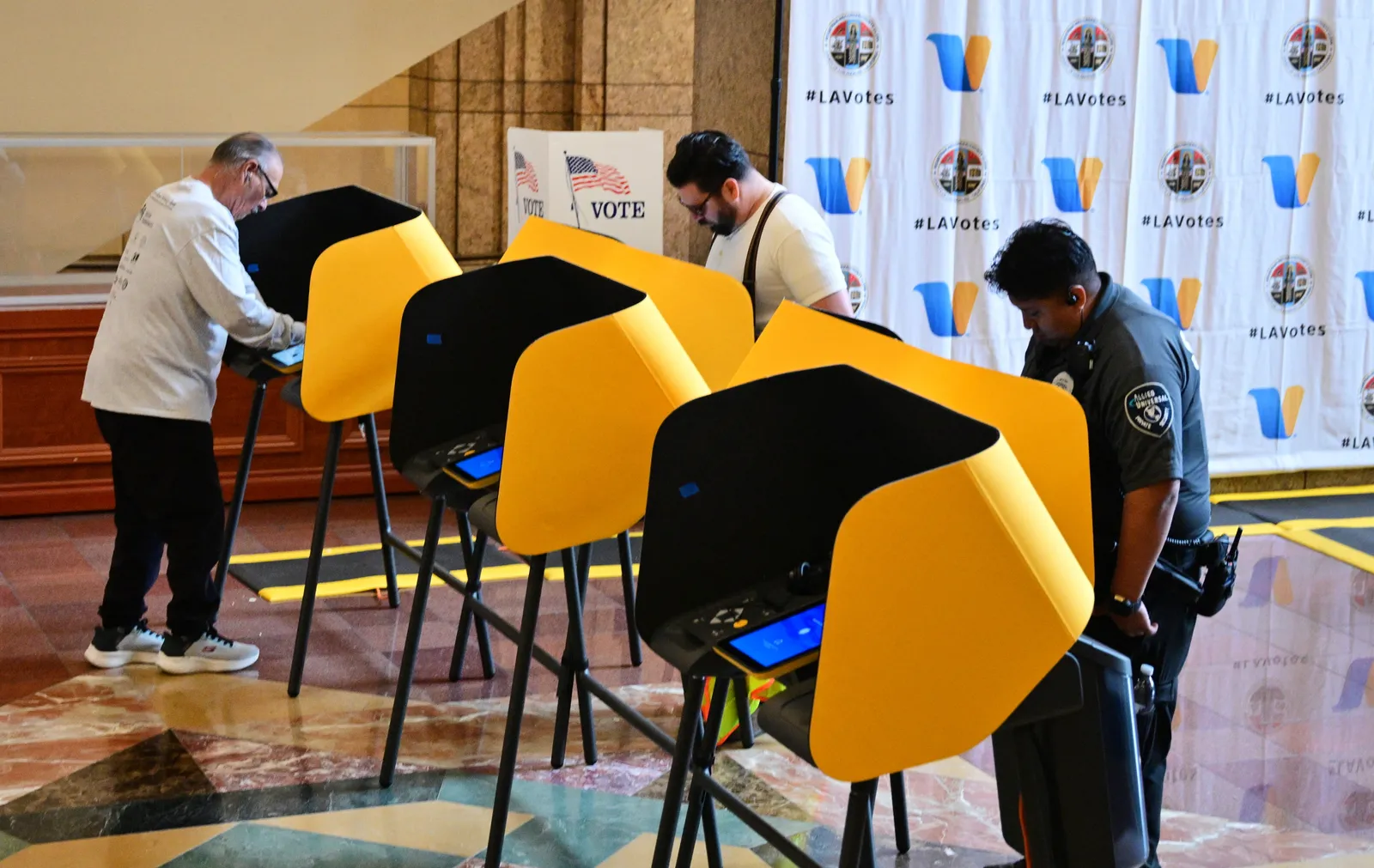
LA County: DOJ's 20,000 'noncitizen' voter list is 'unreliable,' includes U.S.-born
Preliminary review by Los Angeles County election officials finds errors in the federal list, raising the stakes for voter roll integrity ahead of November.

Trump's $1.5B Pentagon chip investment lands in North Carolina
A $1.5 billion defense infusion for North Carolina chipmaking signals a new era of Pentagon-backed reshoring - here's what it means for the industry.

Nigeria confirms first Ebola case in Abuja, a woman just off a Uganda flight
Health Minister Muhammad Ali Pate says the patient flew in from Uganda, putting Africa's latest outbreak on Nigeria's doorstep.