

Rare’s 1998 Banjo-Kazooie runs natively on a pocket device, no analog stick required
The HyperMegaTech Super Pocket Rare Edition keeps classic Rare games ready, with one marquee N64 title rebuilt for the handheld.
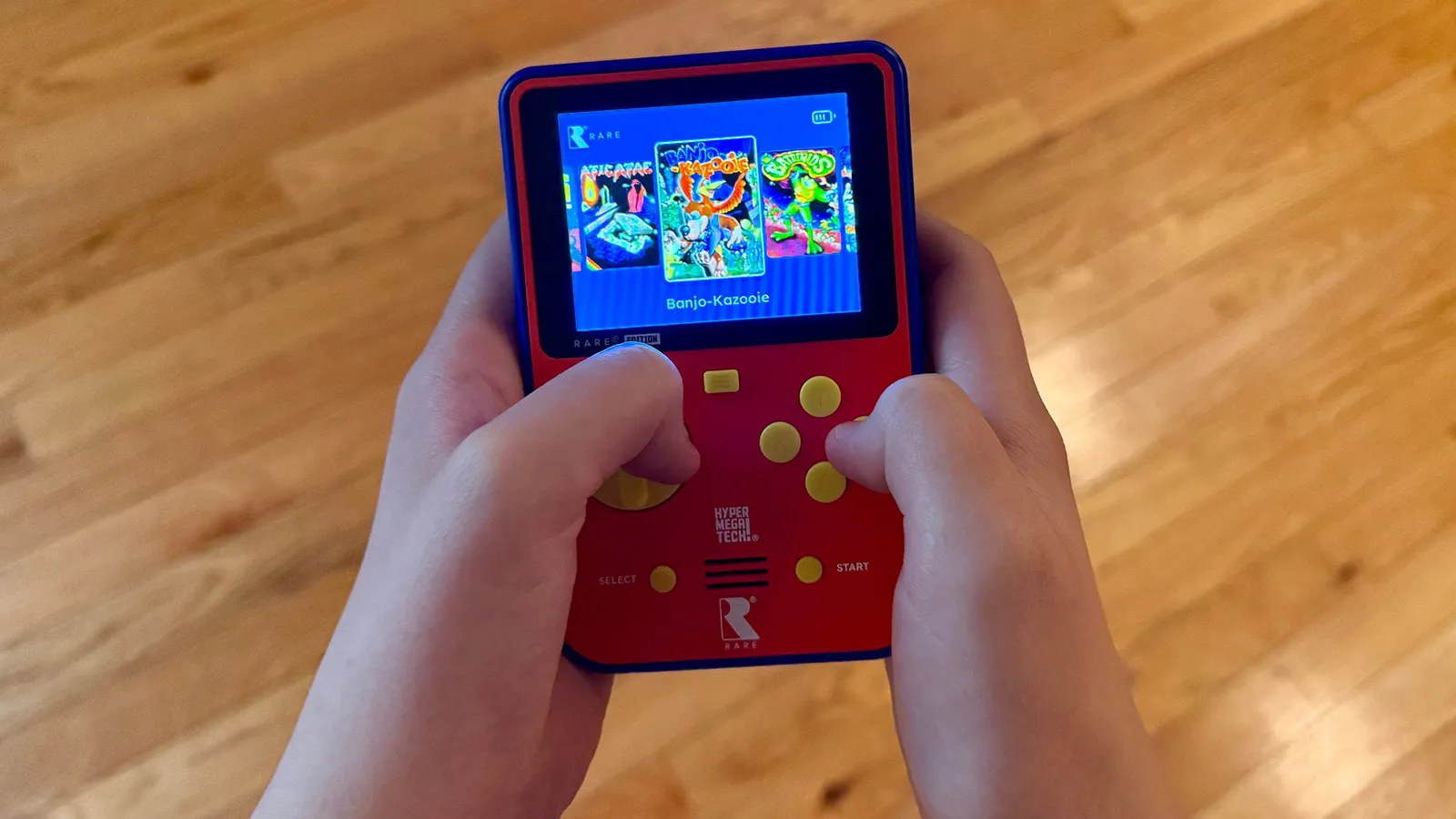
Blaze Entertainment’s HyperMegaTech Super Pocket Rare Edition adds 14 built-in Rare-developed classics, including Banjo-Kazooie (1998). For decision-makers, it is a clear signal that Evercade is pushing “premium portability” through native ports and a cartridge ecosystem.
If you have ever tried to play N64 classics on a handheld, you immediately run into the same problem: analog stick and button layout. The HyperMegaTech Super Pocket Rare Edition solves that exact pain point by running Banjo-Kazooie (1998) natively on Evercade hardware, and it does so without pretending the missing analog controls do not matter.
Blaze Entertainment says this is not standard emulation and it is not a remake. Instead, the original game logic runs natively on the Evercade system, which is why you get Replay Mode and Retro Mode as control approaches rather than a one-to-one controller replica. In other words, the game is the marquee title, but the experience is built around the handheld, including learning curve reality, in-game button prompts for the updated scheme, and the fact there is no controller rumble.
That native approach matters because the Super Pocket Rare Edition is basically the Evercade ecosystem condensed into a pocketable form factor. This is the seventh Super Pocket from Blaze Entertainment, and it keeps the same overall hardware design as previous Super Pocket models. What changes is the built-in library: 14 classic games developed by Rare, paired with a matching color scheme. Rare is now part of Microsoft, but the collection is intentionally curated across the developer’s long arc, from early 1983 British computer releases through the headliner 1998 Nintendo 64 classic. It also keeps a key Evercade advantage intact: you can play any Evercade cartridge, not just the built-ins. That combination is what helps the Super Pocket sustain the “relative value” pattern viewers have seen with earlier versions.
On the physical side, it is a plug-and-play handheld that ships with a USB-C to USB-A charging cable, quickstart guide, and instructions for Banjo-Kazooie. The built-in games include control summaries accessible by pressing the Game Menu button, which is a practical way to make older control schemes less opaque. The device is compact, Game Boy-adjacent at 3.07 x 4.92 x 0.98 inches and 0.36 lbs, with a 2.8-inch IPS display at 320 x 240 resolution and a 4:3 aspect ratio. You can switch display options including Original, Pixel Perfect, or Full Screen aspect ratios, plus Shaders/Scanlines. Bright sunlight visibility is a plus, but the glossy screen cover can create glare. The reviewer flags a comfort issue that is relevant if you are thinking about the user base: if you are in the 40+ demographic, you may not find it comfortable with today’s smaller text and the small screen.
For the control and audio experience, the Super Pocket Rare Edition leans on membrane-based buttons with tactile response. It includes a Game Menu button, direction pad, front speaker, Select/Insert Credit button, Start Game button, and face buttons A, B, X, and Y. On the rear are a cartridge slot with a blank dummy cartridge, volume control, and shoulder buttons R1, L1, R2, and L2, where R2 and L2 fast scroll menus. Audio comes from front and rear speakers, and there is a 3.5mm headphone jack for better sound. The trade-off is connectivity: Blaze has not supported Bluetooth audio here, at least until the release of its Nexus handheld.
Power is straightforward. A 3000mAh battery provides up to roughly four hours of runtime, and a charging indicator light shows red while charging and green when fully charged. The practical takeaway for operators and product teams is that the handheld is positioned for “grab it, play it, move on,” with quick access features like menu button control summaries and no requirement for paired audio devices.
Now the built-in lineup is the real pitch, because it is not just one famous name. The 14 built-in games are Atic Atac, Banjo-Kazooie, Battletoads, Battletoads in Battlemaniacs, Cobra Triangle, Conker's Pocket Tales, Gunfright, Jetpac, Knight Lore, Lunar Jetman, R.C. Pro-Am II, Slalom, Snake Rattle 'n' Roll, and Solar Jetman. The source notes these games originally appeared on the ZX Spectrum, Nintendo 64, NES, SNES, and Game Boy Color. Context matters here: the reviewer frames the ZX Spectrum era as particularly charming despite limitations like limited memory, sound, and graphics, plus attribute clash that causes bleeding or flickering when foreground characters interact with backgrounds. Rare is described as one of the best ZX Spectrum developers, and that is why the early era representation includes standouts like Atic Atac (1983) and Knight Lore (1984), both notoriously difficult isometric 3D action-adventure games. On this handheld, high-contrast visuals against black background “pop” on the Super Pocket display, and controls are described as spot-on.
But the collection is also a reminder that not every classic translates cleanly to modern expectations. Several titles are described as acquired taste, with grating sound called out for Atic Atac-adjacent experiences like Gunfright (1985) as well as Jetpac (1983) and Lunar Jetman (1983). Control nuances show up repeatedly, including awkward use of L1 or R1 to hold a hover in the Jetman series. Even within the marquee Banjo-Kazooie, the save and exit flow differs from typical Evercade behavior: instead of save states, it uses original “Witchywarp” pads and save pedestals. And unlike other titles, you power cycle the handheld to exit the game rather than exiting from the Game Menu button.
For the boardroom version of this story: the Super Pocket Rare Edition is more than nostalgia hardware. It is a product strategy built around curated built-ins, native handling for a flagship 3D title, and the durability of the Evercade cartridge ecosystem. That combination can expand the addressable audience beyond hardcore emulator users, because it reduces the “will this work on my device?” friction. It also raises the bar for future handheld collections: if you are going to sell a premium portable, you either solve control reality or you design around it. Here, Blaze and Rare are leaning into the second approach, and for Banjo-Kazooie, they do it in a way that is clearly explained and visibly intentional.
This story's Key Insights and Take-aways are locked.
Create a free account to unlock Executive Actions for one credit.
Register to UnlockAlways free for Executives Club members. Join the Club
More in Entertainment

12TB Steam 'teraleak' goes beyond Valve: GTA 3, Mafia 2 prototypes exposed
A 12-terabyte dump of Steam data reveals prototypes and builds of third-party classics like GTA 3 and Mafia 2, plus unreleased Valve content, rewriting game history.

LinkedIn's romance problem: 1 in 4 workers say dating on it is fair game
A new survey shows a quarter of U.S. employees treat the professional network as fair game for romance, even as LinkedIn bans it and removes hundreds of thousands of offending posts.

Enhypen's first No. 1 album breaks K-pop's Billboard 200 streak
The K-pop group's 98,000-unit debut tops the chart while Dolly Parton's catalog reentry shows how death reshapes streaming.