
Rising Star’s Homo naledi fossils are all female, and paleoanthropology is rethinking the whole story
Dental enamel proteins suggest every Homo naledi skeleton found in South Africa’s cave system was female, overturning assumptions.
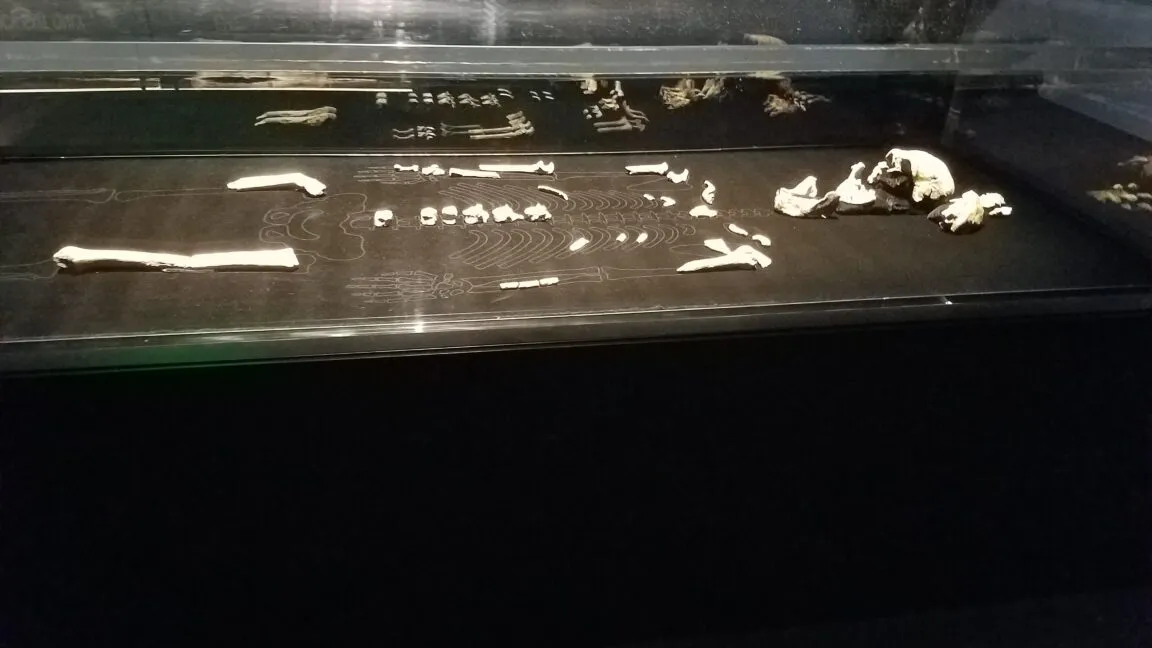
Researchers studying the Homo naledi remains from Rising Star Cave System in South Africa report that all individuals are female based on dental enamel proteins. The finding intensifies the debate over whether the fossils accumulated by accident or were deliberately placed.
In the Rising Star Cave System in South Africa, the Homo naledi fossils dug up since 2013 are not just unusual. They are, by the best biological evidence available, all female. The conclusion comes from proteins in dental enamel, and it lands with the force of a plot twist because it challenges the default assumption that mass death sites are random in age and sex.
To be clear on what we are dealing with: in 2013, a team of anthropologists led by Lee Berger unearthed the remains of more than 20 small-bodied hominins, ancient relatives of humans, dated between about 335,000 and 236,000 years old. The new angle is that all those hominins in Rising Star are female, at least according to the dental-enamel protein evidence. That means the “who was where” question, and not just the “how old were they” question, is now driving the mystery.
So why is this such a big deal beyond the thrill of being weirdly specific about ancient sex ratios? Because Rising Star has already been a battleground. Excavations at the site sparked debate over whether these small hominins ended up inside the cave system by tragic accident or whether they were carefully placed there by other members of their enigmatic species. When the sex pattern is this lopsided, it makes “random accident” harder to treat as a satisfying explanation.
At this point, paleoanthropology has to do what other data-heavy fields do when the evidence refuses to behave: reconsider incentives and mechanisms, not just narratives. In a mass-accumulation scenario, you would typically expect a more balanced representation of sexes, especially when the sample size is “more than 20.” In a deliberate-placement scenario, however, a consistent pattern can be a clue about selection, behavior, or social structure. None of that is automatically proved by “all female,” but it changes what kinds of hypotheses feel plausible and which ones look like they were never properly tested.
The crucial scientific line in the source underscores that the pattern is not currently understood. As paleoanthropologist John Hawks is quoted saying, “There is no natural explanation.” That phrasing matters for decision-makers in adjacent worlds because it signals a confidence gap: the data is strong enough to force a conversation, but the causal mechanism is not yet there. In practical terms, it means the field is staring at an anomaly that does not map cleanly onto known natural processes, at least as far as current reasoning goes.
If you zoom out, this is also a reminder of how biology meets forensics in deep time. Dental enamel is a relatively durable archive, and proteins extracted from it can be used to infer sex. That is the opposite of a vibes-based conclusion. It is also a case study in how small technical differences can reframe big questions. In Rising Star, the debate was already about agency and placement. Now, the sex uniformity adds a new axis for interpretation, effectively raising the burden of explanation for any theory that leans too heavily on accident.
Now, you might be wondering: what does any of this have to do with executives, investors, or boards? The relevance is less about Homo naledi and more about how organizations should think when evidence forces a narrative shift. When a key dataset changes, the “story” that stakeholders believed often becomes the thing that needs to be updated first. Here, that means ongoing work will likely focus on whether the evidence generalizes across the Rising Star sample and what behavioral or ecological mechanism could produce such a uniform result. For leaders, the pattern is familiar: an assumption gets stress-tested, and suddenly the strategic question becomes, “What will we fund next, and what will we stop assuming?”
For peers tracking other research frontiers, the second-order lesson is that anomalies can be operationally expensive. They demand new analyses, new comparisons, and more cautious interpretation. In a world of limited time and attention, the temptation is to move on when a finding is hard to explain. Rising Star is doing the opposite. It is keeping the debate alive, now sharpened by sex-based evidence that makes easy answers feel inadequate.
And at the core, the stakes are still the same: what happened in the Rising Star Cave System, between roughly 335,000 and 236,000 years ago, to produce more than 20 small-bodied hominins whose remains suggest they were all female? Until the mechanism is found, the site will remain a rare kind of research magnet, pulling the field toward deeper questions about Homo naledi behavior, the role of other members of their species, and the limits of “accident” as a catch-all explanation.
This story's Key Insights and Take-aways are locked.
Create a free account to unlock Executive Actions for one credit.
Register to UnlockAlways free for Executives Club members. Join the Club
More in Technology

Nvidia's $89B data center quarter: the 9 companies cashing in
The AI buildout is minting fortunes beyond GPUs, and memory, cloud, and cooling suppliers are riding the same wave.

Google quietly links your phone number to every Android account on your SIM
Adding a SIM now ties your phone number to all Google accounts - and future accounts inherit it. Here's the security and privacy stakes.

Hijacker AI 'Skynet mode' runs 100,000 attack steps against exposed models
Symantec caught a criminal AI agent that borrows other models, steals data, and mines crypto; the only relief is no confirmed victims yet.