
Roblox adds AI game-building to mobile with a one-prompt “Build” feature
The new “Build” lets users generate basic games from text in the app, raising new questions for platform, safety, and creators.
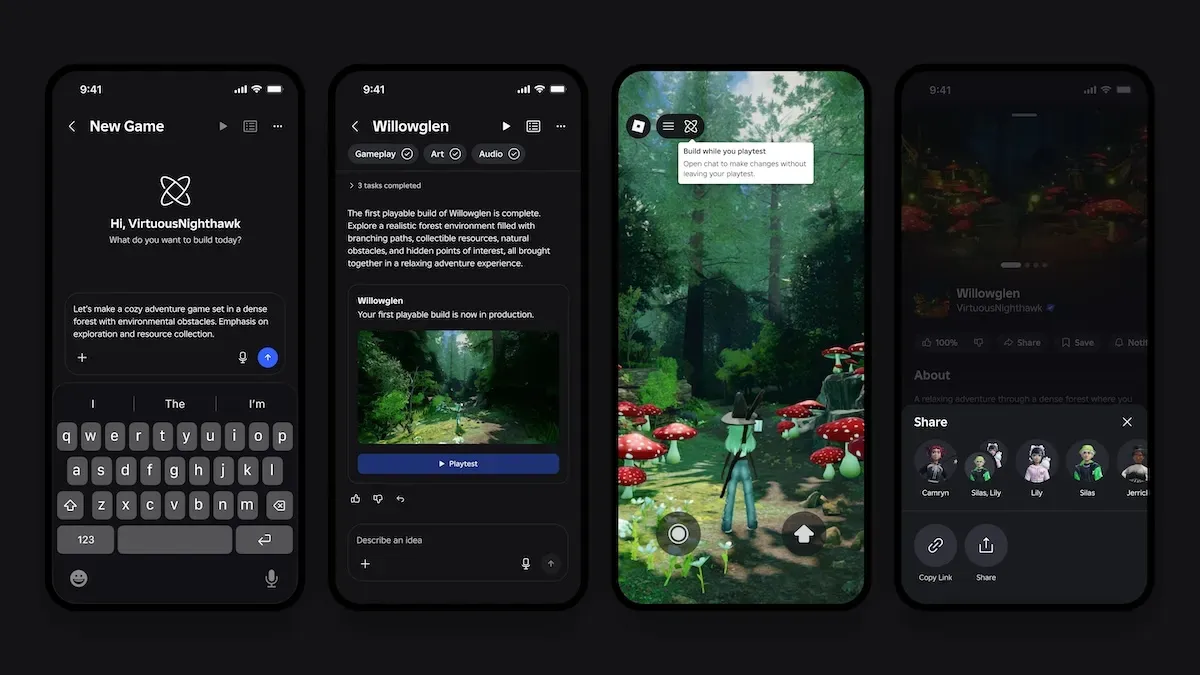
Roblox has launched an AI-powered game-creation feature in its mobile app called “Build.” The feature lets users generate basic games using a single text prompt, which means Roblox is now pushing game creation closer to mass-market players.
Roblox is rolling out a new AI-powered game-creation feature in its mobile app called “Build,” and it works with one simple input: a single text prompt. In other words, you are not just browsing experiences anymore. You are starting from an idea, typing it, and getting a basic game you can take further inside the platform. That is a meaningful shift in how Roblox frames its product. It turns creation into a front-and-center workflow, not a side quest for the technically inclined.
The headline benefit is also the practical one: “Build” generates basic games from text prompts. That matters because mobile is where most users live, and mobile creation has historically been harder than mobile consumption. Roblox is trying to collapse that gap. The company is effectively saying, “If you can type it, you can build something in Roblox.” For decision-makers watching the creator economy, this is the kind of feature that can change user behavior quietly but quickly: people who would never open an advanced editor now have an entry ramp.
To understand why this is big, zoom out to how platform ecosystems make money and how they retain users. Roblox has long been a two-sided marketplace: players consume experiences, and developers create them. AI tools can change both sides at once. On the player side, a text-to-game flow can raise engagement by increasing novelty and lowering the effort to get involved. On the developer side, it can increase the volume of prototypes and early-stage ideas, which might speed up what gets built next. But it also introduces a new operational question: what counts as “a game” when it is generated from a prompt, and how do you make sure those games fit the platform’s standards?
There is also a governance angle. When content generation becomes easier, moderation becomes harder. A platform can control distribution, but it cannot fully control what users ask for in their prompts. Even when the generated output is “basic,” a huge number of small creations can produce big moderation workloads. Regulators around the world have been pushing for more transparency, safer design, and better enforcement practices as AI systems have become more capable and more widely accessible. That is the background context for why the feature’s mechanics matter: the more creation is democratized, the more a platform has to prove it can handle scale without turning safety into a reactive scramble.
From an incentives perspective, “Build” also changes the creative economics inside Roblox. Traditional creators often rely on tooling, iteration loops, and the ability to translate skill into differentiation. If AI can generate a usable starting point from plain text, some users will experiment more. That can be great for discovery, but it can also pressure traditional creators to spend more time on customization, polish, and unique mechanics rather than starting from scratch. Platforms tend to support this by ensuring creators still see value in their workflows. The strategic question for Roblox is whether AI-generated creations become a bridge into deeper development, or whether they become a dead-end novelty that does not convert into long-term engagement.
Another second-order implication: this feature turns Roblox’s mobile app into more of a production environment, not just a consumption portal. That could influence product roadmaps across the ecosystem. When a platform successfully makes creation faster, other tools and ecosystems tend to race to match the “time to first outcome.” You see this pattern in many categories. Game engines, design tools, and social platforms have all been moving toward simpler creation surfaces. Roblox is now explicitly joining that movement from inside a massive, already engagement-driven universe.
For peers, investors, and board members, the stakes are not just about whether the feature works. The stakes are about what it signals. Roblox is betting that AI-assisted creation can expand its addressable audience and reinforce its position as a creation-led platform, right from mobile. That can support retention, diversify content supply, and potentially create new engagement loops. But the board-level concern will be operational: scaling moderation, maintaining quality, and preserving the value of the creator ecosystem while the entry bar drops.
Bottom line: Roblox’s “Build” feature brings text-to-game creation into the mobile app, generating basic games from a single prompt. That is a clear product bet with real implications for user growth, creator workflows, and safety governance. The question executives will watch next is not whether people can generate something, but whether Roblox can turn those basic outputs into a healthy stream of experiences that fit the platform’s standards at scale.
This story's Key Insights and Take-aways are locked.
Create a free account to unlock Executive Actions for one credit.
Register to UnlockAlways free for Executives Club members. Join the Club
More in Entertainment

12TB Steam 'teraleak' goes beyond Valve: GTA 3, Mafia 2 prototypes exposed
A 12-terabyte dump of Steam data reveals prototypes and builds of third-party classics like GTA 3 and Mafia 2, plus unreleased Valve content, rewriting game history.

LinkedIn's romance problem: 1 in 4 workers say dating on it is fair game
A new survey shows a quarter of U.S. employees treat the professional network as fair game for romance, even as LinkedIn bans it and removes hundreds of thousands of offending posts.

Enhypen's first No. 1 album breaks K-pop's Billboard 200 streak
The K-pop group's 98,000-unit debut tops the chart while Dolly Parton's catalog reentry shows how death reshapes streaming.