

Roblox adds “Build” mobile tab: text prompts become playable games, no Studio needed
The company is betting on frictionless creation, and executives should map the impact on engagement, moderation, and platform economics.
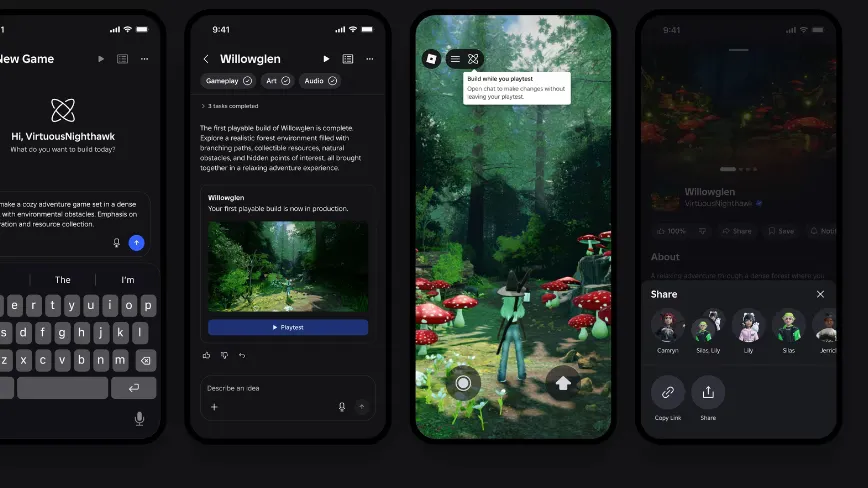
Roblox announced Build on Wednesday, a new creation tab inside the Roblox mobile app that turns text prompts into basic playable games without Roblox Studio or code. For decision-makers, it raises immediate questions about user growth, creator tooling competition, and how moderation scales when creation becomes instant.
Roblox just made game creation dramatically easier. On Wednesday, the company announced Build, a new creation tab inside the Roblox mobile app that lets anyone turn a text prompt into a basic playable game without touching Roblox Studio or writing a line of code. In other words, the barrier between “I have an idea” and “I can play it” is getting thinner, and it is happening inside the app where Roblox already lives.
The core promise is simple: you describe what you want, and Build generates a playable starting point. The Next Web describes a creator sketching something like a cozy forest adventure game with environmental obstacles, and then Build generating a basic playable game from that text prompt. That shift matters because Roblox has historically centered creation around more hands-on workflows, including Roblox Studio for developers who want deeper control. Build changes the default path. It pulls more casual, mobile-first would-be creators into the process, right where players already spend time.
Why should executives care? Because the creator-tool experience is not just a developer feature. It is a growth lever, an engagement engine, and a moderation stress test all at once. When creation requires specialized tooling, the number of new worlds coming online tends to grow more slowly and in more predictable waves. When creation becomes prompt-to-play, volume can jump fast. That can be good for discovery and retention, but it also increases the surface area for inappropriate content, broken experiences, or low-quality spam games that ride the generation wave.
This is also a strategic move inside Roblox’s competitive landscape. Roblox is already a platform where user-generated content drives the ecosystem. Build effectively adds a new “on-ramp” for people who want to participate but cannot or will not learn studio tooling. That matters for both sides of the marketplace. For players, it can mean more variety and more frequently refreshed experiences. For creators, it can mean faster iteration and lower time-to-first-project. Over time, that can widen the funnel from casual curiosity to active creation.
There is a subtle but important second-order effect here: it can change the role of “creator skill” in the ecosystem. If the platform can generate basic playable games from text, then fewer people need to start as formal builders. More people can start as idea generators. That can shift community dynamics, compensation expectations, and how advanced creators differentiate themselves. In many platforms, once the baseline becomes easier, power users often move up the stack, using the tool for customization, polish, and unique systems rather than basic scaffolding. Build could accelerate that transition.
Executives should also consider how this intersects with the broader push for AI-assisted content. While the announcement, as summarized by The Next Web, focuses on text prompts converting into playable games without code, the operational implications are unmistakable. If creation is largely automated, then the platform must validate what gets generated, how it behaves, and what it contains. Even if generated games start “basic,” they still enter the world. That means moderation and safety controls need to keep up with both scale and the creative intent that generated content can encode.
For boards and senior leaders, the questions become practical. How does Roblox measure quality and safety when generation is immediate? How quickly can it detect and respond to problematic experiences that appear in the app? And how does it preserve trust with parents and regulators, who often care about platform conduct more than the engineering elegance of the underlying creation system? In a world where more people can ship more content, compliance and risk management are not optional side quests. They are core product work.
Finally, Build has strategic implications for peers across consumer tech and developer platforms. If Roblox makes prompt-to-play creation feel normal inside a mobile app, that sets user expectations. Competing platforms that rely on longer creation cycles may see pressure on onboarding, creator retention, or discovery. It also raises the stakes for differentiation. The question is no longer just “who has the best engines.” It is “who makes creation accessible and safe at the same time, without turning the feed into a landfill.” Roblox is betting it can pull off that balancing act, and the early signal is that it is willing to move quickly, directly inside the mobile app, for anyone to try.
This story's Key Insights and Take-aways are locked.
Create a free account to unlock Executive Actions for one credit.
Register to UnlockAlways free for Executives Club members. Join the Club
More in Entertainment

12TB Steam 'teraleak' goes beyond Valve: GTA 3, Mafia 2 prototypes exposed
A 12-terabyte dump of Steam data reveals prototypes and builds of third-party classics like GTA 3 and Mafia 2, plus unreleased Valve content, rewriting game history.

LinkedIn's romance problem: 1 in 4 workers say dating on it is fair game
A new survey shows a quarter of U.S. employees treat the professional network as fair game for romance, even as LinkedIn bans it and removes hundreds of thousands of offending posts.

Enhypen's first No. 1 album breaks K-pop's Billboard 200 streak
The K-pop group's 98,000-unit debut tops the chart while Dolly Parton's catalog reentry shows how death reshapes streaming.