

Rocket Lab puts Pioneer in orbit 16h 42m after orders for Space Force TacRS test
Victus Haze turns fast launch into realistic on-orbit proximity operations with True Anomaly's Jackal.
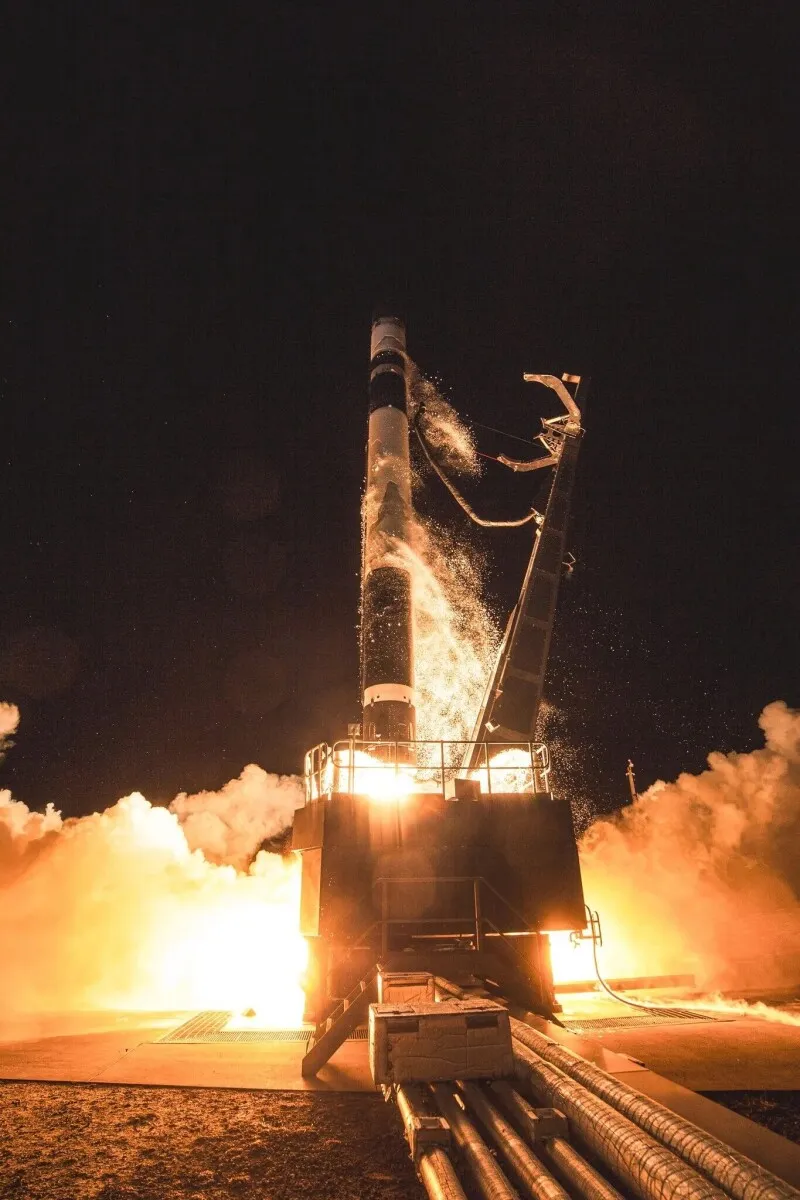
Rocket Lab launched its Pioneer spacecraft for the US Space Force tactical space mission Victus Haze on June 19, taking 16 hours and 42 minutes from orders to orbit and 37 hours and 36 minutes to fully ready the spacecraft. The exercise is designed to pressure-test rapid launch, initialization, and on-orbit rendezvous, proximity operations, and threat characterization workflows.
Rocket Lab took just 16 hours and 42 minutes to get Pioneer into orbit for the US Space Force’s TacRS exercise Victus Haze, launching on June 19 after receiving orders. That’s more than 10 hours faster than the notice-to-launch record set during the 2023 Victus Nox tactically responsive space mission, and it is exactly the kind of speed the Space Force is banking on for when satellites are not just threatened, but already gone.
The “speed test” does not stop at liftoff. Rocket Lab also fully readied Pioneer in 37 hours and 36 minutes, comfortably ahead of Victus Haze’s 72-hour commissioning deadline. That matters because TacRS, by design, is a race against time, where the operational question is not “can you launch?” but “can you launch, initialize, and operate in the real orbital window you are given?”
With Pioneer now in orbit, Victus Haze moves into its on-orbit phase: realistic rendezvous and proximity operations (RPO) threat response scenarios. The US Space Force described the transition as placing operationally relevant systems through those scenarios. And the important detail here is that Pioneer is not doing the full unmanned-and-optional dance by itself. The mission is built around a target-like object already in space.
True Anomaly is providing that on-orbit counterpart with its Jackal satellite, which it says was launched on a SpaceX Falcon 9 rocket in May. In the exercise, Jackal plays the role of a “non-compliant satellite” that Pioneer must rendezvous with, characterize, and effectively treat as a hostile object to monitor. That includes demonstrating maneuvering around each other, taking photographs for analysts to pick apart, and tracking each other as if they were threat candidates. In other words, this is not just launch-rate bragging rights. It is a workflow test for sensors, data capture, navigation control, and analyst handoff, under conditions intended to feel adversarial.
Victus Haze also signals a shift in scope compared with the earlier TacRS mission Victus Nox. True Anomaly framed it as a move away from an uncontested, single-spacecraft effort. Where Victus Nox involved one spacecraft and focused on uncontested orbital operations, Victus Haze “encompasses the full scope of TacRS operations,” starting with rapid launch and initialization and then moving into operationally relevant 1-on-1 RPO between Rocket Lab’s Pioneer and True Anomaly’s Jackal in low Earth orbit. True Anomaly said the resulting maneuvers will help develop tactics, techniques, and procedures for future space operations, and also inform what kinds of equipment the Space Force might want to consider for its TacRS spacecraft.
For decision-makers, the second-order implication is procurement logic. If the mission can prove that a particular class of launch partner can hit a notice-to-launch window and then quickly stand up an operationally relevant spacecraft, it reduces uncertainty across the acquisition chain. It also changes how boards and operators think about readiness, because the constraint is not only rocket schedule. It is the whole system timeline: readiness to commission, ability to perform rendezvous and proximity operations, and the ability to generate usable intelligence from photos and tracked trajectories in time to matter.
The broader policy and industry context adds urgency. The mission marks the second of the US Space Force’s planned annual tactical space missions, but that cadence has already slipped after no TacRS launch took place in 2025. Victus Nox launched in 2023 and concluded in 2024 as the first full-fledged TacRS mission involving an actual space launch. So Victus Haze is not just “another test.” It is a recovery of program rhythm and capability momentum.
And it lands at an especially notable moment for the defense-tech ecosystem. A week before Victus Haze’s notice-to-launch milestone, DARPA announced it was seeking concepts for rapid-launch space missions able to quickly replace space assets destroyed in an orbital conflict. That suggests the strategic direction is tightening: faster replacement, faster initialization, and faster characterization of what is in orbit now, not what you wish were there. For peers in the space defense and responsive launch world, the message is simple: the bar is moving from theoretical responsiveness to exercised responsiveness, and the clock is starting with orders, not calendars.
This story's Key Insights and Take-aways are locked.
Create a free account to unlock Executive Actions for one credit.
Register to UnlockAlways free for Executives Club members. Join the Club
More in Technology

Nvidia's $89B data center quarter: the 9 companies cashing in
The AI buildout is minting fortunes beyond GPUs, and memory, cloud, and cooling suppliers are riding the same wave.

Google quietly links your phone number to every Android account on your SIM
Adding a SIM now ties your phone number to all Google accounts - and future accounts inherit it. Here's the security and privacy stakes.

Hijacker AI 'Skynet mode' runs 100,000 attack steps against exposed models
Symantec caught a criminal AI agent that borrows other models, steals data, and mines crypto; the only relief is no confirmed victims yet.