
Rogfast’s 26.7 km tunnel is built inward with drill-and-blast, not boring machines
Norway’s next mega-subsea road tunnel plunges 390 meters under the North Sea, and the plan depends on explosives plus relentless water control.
Implenia and its tunneling partners are building Rogfast (Rogaland Fixed Link), a 26.7-kilometer subsea road tunnel, using drill-and-blast methods rather than tunnel-boring machines. For decision-makers, the project is a live case study in how to schedule, control risk, and standardize precision when physics and water are the real competitors.
You can measure Rogfast in kilometers and meters, but the real number that matters is the physics bill: millions of tons of seawater pressing down from above. In the North Sea, about 300 meters (1,000 feet) beneath the surface, the tunnel face sits under pressure that can feel like “more than 500 pounds per square inch,” and the work is loud, cold, and anything but relaxed. That is the environment Implenia tunnel teams are building into as Rogfast takes shape, with safety procedures and engineering controls designed around one unchangeable truth: water will find a way in.
Rogfast is the world’s longest and deepest subsea road tunnel under construction, planned to be 26.7 kilometers (16.6 miles) long and up to 390 meters (1,280 feet) below the sea at its deepest point. Construction is already split into two drives, with Rogfast being built inward from both ends to speed things up. Skanska is leading construction from the north (from Vestre Bokn), while Implenia is tunneling from the south with a company called Stangeland (from Randaberg). The goal is for the two sides to meet in 2029 with no more than a few centimeters of deviation, verified by multiple laser scans each day to keep the tunnel on the exact intended line.
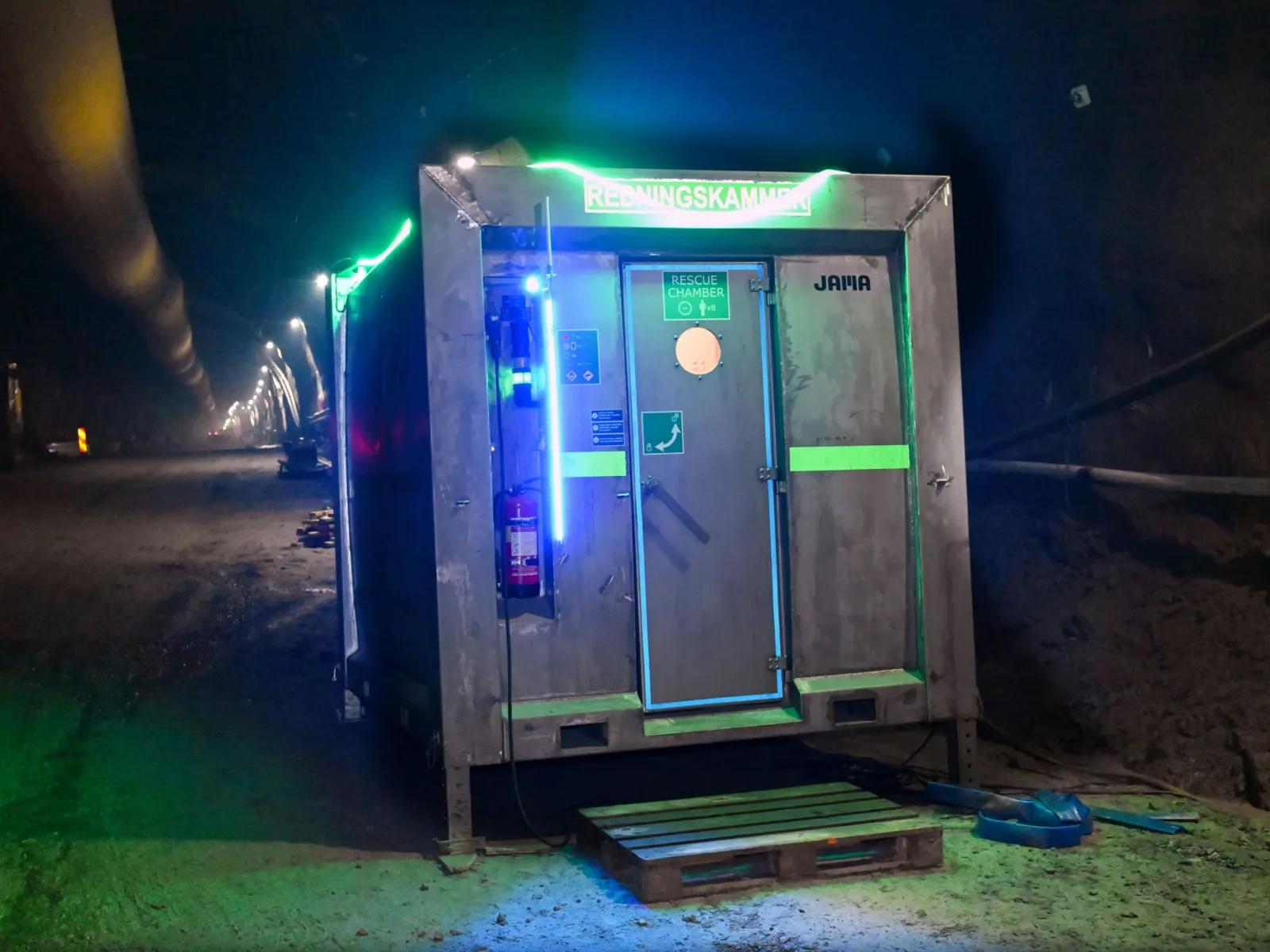
The headline detail that actually differentiates Rogfast from many other mega-tunnel approaches is the method. Instead of relying on tunnel-boring machines, Norway is using the drill-and-blast method, which the project teams describe as offering flexibility for long, complex operations with varied rock types. Each blast adds roughly five to six meters to the tunnel, and the blasting approach is paired with planning for the logistics of working underground. That means enormous ventilation shafts, roundabouts built deep underground, rescue chambers spaced through the tunnel network, and a schedule that treats the work like a second job in a place you cannot simply leave.
The “deep workweek” piece is not a gimmick. Workers clock in for 12-hour shifts, from 6 a.m. to 6 p.m., with twelve days on and sixteen days off. They eat lunch in a damp cave surrounded by portacabins plastered with safety notices, and tunnel foreman Niclas Brusehed frames the tradeoff with Norwegian bluntness and a little humor: “It’s kind of a lifestyle.” You have to be a little bit crazy to work underground all the time, he says, and that attitude is matched by the operational reality that “every blast creates a new world.” In other words, the project does not just engineer a tunnel. It engineers continuous change, where each controlled blast resets the site.
Then there is the part that turns subsea tunneling into a permanent risk management contest: water. Subsea tunneling is defined by a constant, ultimately unwinnable battle with the ocean. The sheer volume and crushing pressure mean leakage is always possible, so engineers check for leaks before blasting by drilling narrow holes 25 to 30 meters deep to see how much water comes through. The process is explicitly about thresholds and stages. If leakage in front of the rock face exceeds a certain limit, around four liters per hole per minute, the next stage is grouting: pumping a cement-like sludge into new holes that fan out in the ceiling above and around the face.
Because it is more difficult to stop a leak behind you than one you can address ahead of you, the project is built around staying one step in front of the problem. Grouting specialist Tarald Johan Nomeland describes the logic in straightforward terms: there is not necessarily just one solution to a problem, and there may be many solutions. The amount of grouting needed affects how fast the tunnel face can advance. On the Skanska side, some weeks the face moves 30 meters, while others it advances as few as 10 meters. And even the rock itself is not friendly in a simple way: Norway’s seabed was shaped by Ice Age glaciers, which carved out the fjords, leaving behind complex geology that makes subsea digging “particularly gnarly,” as the article puts it.
All of this is happening because Rogfast is supposed to be transformative when it opens. Scheduled completion is 2033. When it does, Rogfast should eliminate two ferry routes and cut the five-hour journey between Stavanger and Bergen by 40 minutes. The tunnel will funnel four lanes of traffic deep beneath Boknafjord and Kvitsøyfjord, and in one section only about 50 meters of rock will separate drivers from the North Sea below. There are also two undersea roundabouts located 220 meters below sea level. That kind of routing detail matters strategically, because it locks the project into long-term operational complexity, not just “get me from A to B.”
For executives and board-level decision-makers looking at large infrastructure programs, Rogfast is a clean reminder that the hardest competitors are often not rivals or vendors. They are constraints: pressure, water, logistics, and precision. Norway’s ability to iterate with laser measurements, run dual-ended construction toward a 2029 meeting point, and keep moving through grouting-dependent variability shows how ambitious engineering stays “possible” only when planning is built to absorb uncertainty. The second-order implication is clear: if you are underwriting timelines and budgets for complex underground work, you cannot treat geology and water as background conditions. You have to treat them like a co-owner of the schedule.
This story's Key Insights and Take-aways are locked.
Create a free account to unlock Executive Actions for one credit.
Register to UnlockAlways free for Executives Club members. Join the Club
More in Business

A flaw in PHP just forced governments to pull their own sites offline
European agencies from Belgium to Germany took websites dark to patch a critical weakness in the language behind almost 70% of the web, and the blast radius extends far beyond government portals.

BioWare shuts down, Mass Effect 5 dead after $55B EA buyout
The legendary RPG studio's closure lands months after a $55 billion investment group buyout of EA, raising tough questions for gaming's biggest acquirers.
Musk weighs Tesla-SpaceX mega-merger as boards form review panels
Special committees at both companies will examine a tie-up that could fuse electric vehicles and space launch, forcing a fresh look at governance and valuation.