

Roman camp near Šurany yields hastily buried soldiers, including bodies tossed into wells
A 18.2-acre marching camp in Slovakia with 5 gates and intact sandal nails is forcing new questions about how it ended.
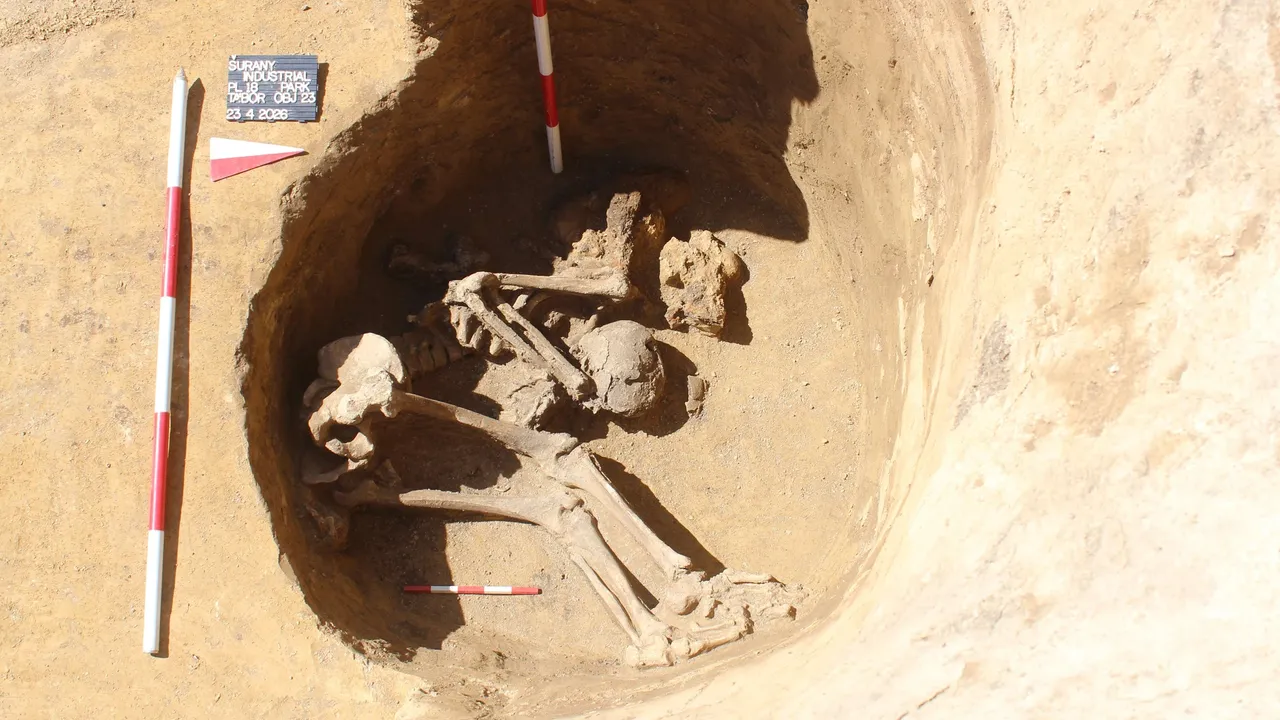
Archaeologists excavating near Šurany in southwestern Slovakia uncovered an “extremely rare” Roman marching camp tied to Marcus Aurelius’ Marcomannic Wars. The remains include soldiers likely buried in ditches, wells, and shallow pits, with Roman equipment and intact footwear, raising unresolved questions about death, looting, and abandonment.
Archaeologists in southwestern Slovakia have uncovered a Roman military camp near the town of Šurany, and it does not look like a neat, ceremonial battlefield burial. The site, covering 18.2 acres (7.4 hectares), contains the hastily buried remains of numerous soldiers in unusual graves, including bodies dumped into wells, according to a translated July 17 statement from MH Invest, which excavated the area with the Institute of Archaeology at the Slovak Academy of Sciences (SAS). The headline fact is the weirdness: this camp seems to have disappeared immediately after the military conflict between the Romans and the Germans, but the soldiers’ remains show scrambling, not order.
The camp is also a once-in-a-generation research opportunity. SAS director of the Institute of Archaeology Matej Ruttkay called it “a unique opportunity to explore practically an entire Roman marching camp, which is extremely rare in the European context,” adding that investigators are “clearly investigating a place that disappeared immediately after the military conflict between the Romans and the Germans.” That matters because it turns a historical curiosity into something archaeologists can test with evidence, from burial context to material culture. And for decision-makers who think about national institutions, heritage funding, and international research capacity, the subtext is simple: this kind of site draws expert attention for years, not months.
To understand why this camp is so consequential, you have to place it in the late second century. Between A.D. 166 and 180, the Romans fought a series of battles against a Germanic people called the Marcomanni, who lived north of the Danube along the border of the Roman Empire in what are now Slovakia and the Czech Republic. Marcus Aurelius, who reigned as Roman emperor from 161 to 180, commanded troops in what are known as the Marcomannic Wars, with the aim of defending and securing the empire’s border against “barbarian invasions.” Those wars ended upon Marcus Aurelius’ death, when his son Commodus negotiated a peace with the Marcomanni, according to third-century Roman historian Cassius Dio.
The newly discovered Šurany camp shows defensive planning that matches the region’s marching and legionary camp traditions. The statement says it has clear defensive characteristics including five entrance gates, fortifications, and a curved ditch-and-rampart system typical of marching or legionary camps. It is only the second Roman military installation ever found in western Slovakia. The first, discovered in 2024 by SAS archaeologists, is thought to be where Marcus Aurelius wrote part of his Meditations. So, in addition to the immediate human story of burial practices, the broader map of where Roman activity clustered in this frontier landscape is getting sharper.
But the center of gravity here is the burials. According to the statement, the Šurany camp surprised archaeologists with a large number of skeletons, or parts of skeletons, buried in ditches, wells, and hastily dug shallow graves. Preliminary findings indicate “in most cases these are Roman soldiers,” said archaeologist Marek Vojteček of the SAS Institute of Archaeology. The evidence is not only the bones. Numerous components of Roman military equipment and weaponry were found with the skeletal remains, including spears, arrowheads, parts of helmets, segmented and scale armor, legionary brooches, coins, and the characteristic caligae military sandals. Those sandals matter because the statement notes iron nails on the soles have been preserved.
In a rare moment where the past feels almost tactile, X-ray analysis of blocks of clay revealed intact sandal nails, which are now stored at the SAS Institute of Archaeology’s specialized laboratory for further analysis. Archaeologist Michal Cheben said, “It is literally a miracle to see the original footwear of a Roman soldier and even to be able to determine its size.” For the executive world, this is the kind of detail that changes timelines and budgets because it typically requires specialized lab work, repeat sampling, and long-running comparative studies. When you find original footwear in an intact enough state to measure, you do not just file it away. You build a multi-year research plan.
The unusual burials also raise questions that go beyond “what happened here” into “why did it happen this way.” Cheben said the team is investigating whether the soldiers died from combat injuries or disease and why the bodies were not looted before being thrown into storage pits and wells. That is not a rhetorical question. The answer likely depends on the sequence of events after the conflict, the speed of retreat or collapse of the camp, and what was considered salvageable. The statement says laboratory analyses and further genetic and anthropological research may provide answers.
Because the camp is large and the artifacts are numerous, a comprehensive analysis will take several years and involve international experts in carbon dating, soil analysis, isotopic analysis, and ancient DNA, according to the statement. Ruttkay said, “This is a long-term process, so many results will only become known in the coming years.” Translation for decision-makers: the value of the discovery will compound, but only if the right funding, lab capacity, and cross-border coordination stay in place. For boards, funders, and leaders of research institutions, it is a reminder that archaeology is not just digging. It is project management across years, methods, and partners, with real reputational and cultural stakes.
And for anyone tracking how institutions handle public trust, heritage oversight, and international collaboration, this discovery lands with urgency. A rare camp with hastily buried remains, including bodies dumped into wells, is exactly the kind of evidence that can reshape narratives about frontier wars. The soldiers are not just names in a textbook. They are bones, gear, and footwear that survived long enough for new questions to begin.
This story's Key Insights and Take-aways are locked.
Create a free account to unlock Executive Actions for one credit.
Register to UnlockAlways free for Executives Club members. Join the Club
More in Science

Alaska's 1,580-foot tsunami had warning signs. Scientists just found them.
Rapid glacier retreat, heavy rainfall, and thousands of tiny tremors preceded Alaska's 1,580-foot tsunami, a warning for every coastal community in a warming world.

The rare mutation that lets high-risk brains dodge Alzheimer's
Scientists found a natural defense against protein buildup, opening a new path to preventive treatments.

3,000 steps a day may halve Alzheimer's decline, study finds
New research links a modest daily walk to less tau buildup and nearly half the cognitive and functional decline, even for those with early signs.