
Roman Telescope loads 1,350,144 names into deep space plaque bound for L2
NASA installs a memory card with 1,350,144 global submissions at Kennedy, and Roman heads to L2 aboard a Falcon Heavy launch.
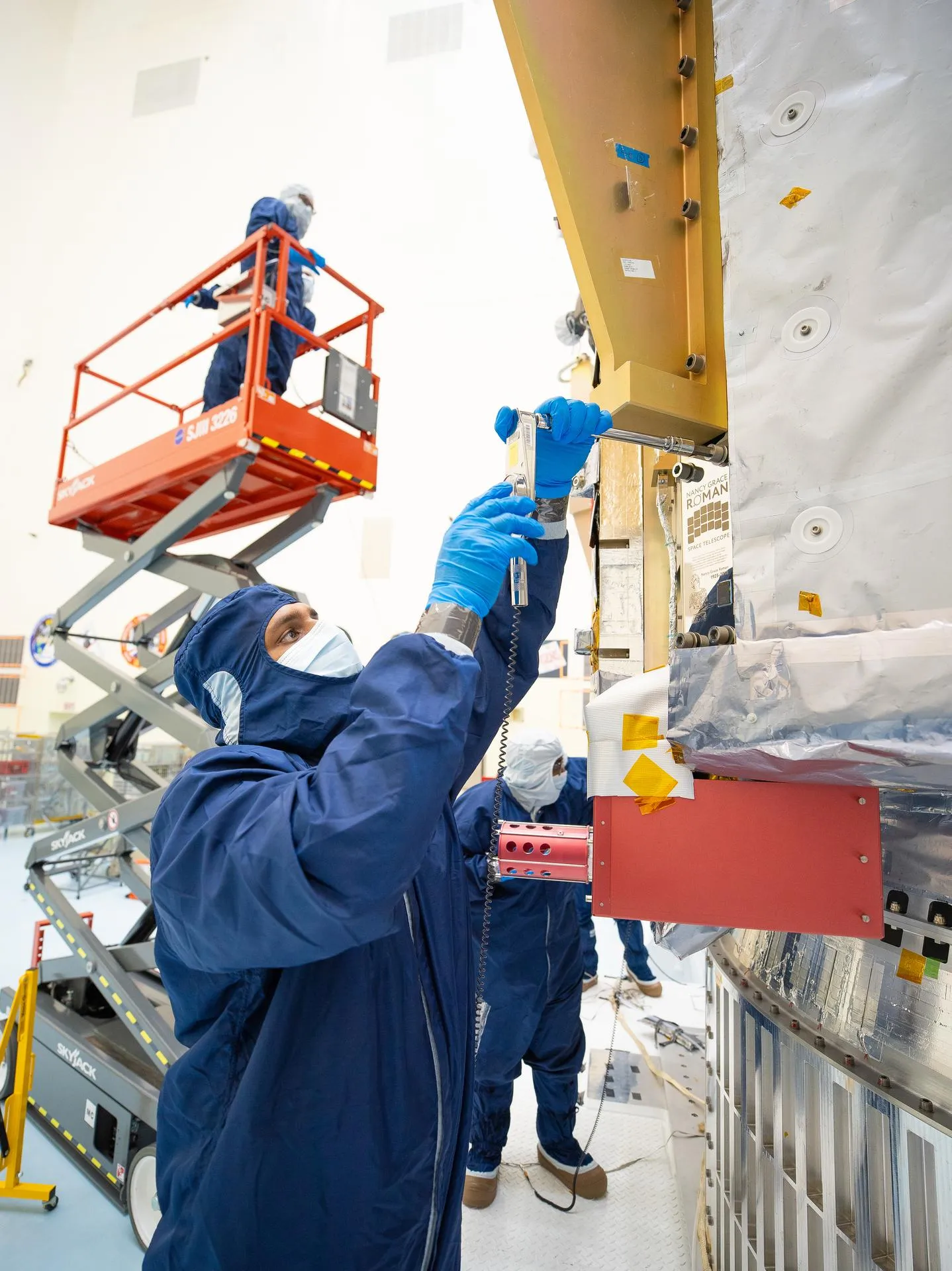
NASA’s Kennedy Space Center technicians installed a memory card holding 1,350,144 names as part of a commemorative plaque on the Nancy Grace Roman Space Telescope on July 27. For decision-makers, the deployment spotlights how mission communications, public engagement, and launch execution converge with major schedule and supply-chain commitments.
On July 27, technicians at NASA’s Kennedy Space Center in Florida installed a memory card containing 1,350,144 names as part of a commemorative plaque on the Nancy Grace Roman Space Telescope. The names were submitted by people globally, including astronauts from Artemis II and Artemis III. It is a small physical object with a huge symbolic job: it turns a scientific observatory into a two-way address, sending humanity’s “you are here” up with the spacecraft.
That memory card is not staying on Earth. It will travel with the Roman observatory to the Sun-Earth Lagrange point 2, or L2, about one million miles from Earth, where the Sun’s and Earth’s gravity balance out. In other words, the plaque is going along for the ride to the kind of deep space operating environment that is designed for long, stable observation campaigns, not quick returns. For executives, this matters because it shows how NASA treats even commemorative components like operational payloads: they must survive integration, launch, transit, and the mission environment itself.
Roman is named after Dr. Nancy Grace Roman, NASA’s first chief astronomer and one of the architects of the agency’s modern science program. NASA’s own description of her influence also frames why Roman is built the way it is: Roman championed space-based observatories that could study the universe from above Earth’s hazy atmosphere while making their data broadly available to the scientific community. That “above the atmosphere” advantage is the classic physics headline. The “data broadly available” piece is the governance and ecosystem headline. When a mission is designed to widen access to datasets, it affects downstream planning across universities, research institutions, and the broader science community that will interpret and reuse the observations.
Mission execution, meanwhile, is already in the critical runway phase. NASA and SpaceX are targeting launch for no earlier than 7:26 a.m. EDT Sunday, Aug. 30 aboard a SpaceX Falcon Heavy from Launch Complex 39A at Kennedy. That “no earlier than” wording is more than scheduling trivia. It signals a go/no-go cadence that is common to high-stakes aerospace operations, where a launch window is constrained by technical readiness, range requirements, and the final checkouts that determine whether everything is green across the stack. In board terms, it is the difference between a launch date on a slide and a launch time in real life.
There is also an important second-order story here about stakeholder alignment. The memory card includes submissions from people globally, and it specifically calls out astronauts from Artemis II and Artemis III among those contributors. That detail is not just feel-good branding. It links Roman to the broader NASA cadence of crewed exploration and public-facing milestones, which can influence how agencies prioritize narratives, communicate progress, and manage expectations when complex missions are unfolding in parallel. In modern space programs, narrative is not fluff. It is part of stakeholder management, and stakeholder management is part of execution.
And then there is the L2 choice, which is where the operational logic really clicks. L2 is often described as a stable region for long-duration science because of that gravitational balance between the Sun and Earth. When you place a telescope there, you are betting on a repeatable observing environment. That makes mission planning, calibration cycles, and long-horizon data generation more manageable. If the telescope is going to become a steady producer of scientific output, every component that rides along, including a commemorative memory card, has to be treated with the same seriousness as other integrated hardware.
For peers in decision-making roles across aerospace, research tech, and capital-intensive engineering programs, the strategic stakes are clear: Roman is combining public engagement artifacts with mission-critical delivery logistics. It is also showing how large science missions map people, priorities, and governance into hardware that must survive deep space realities. The names on the card are a ceremonial bridge, but the launch clock and the destination physics are the real backbone. In the weeks ahead, the headline number, 1,350,144, is going to be easy to read as a publicity stat. The deeper story is that it is being installed, integrated, and shipped like payload, because for missions like Roman, symbolism and systems engineering have to coexist. To learn more about the Roman mission, visit: https://www.nasa.gov/roman. Image credit: NASA/Jolearra Tshiteya.
This story's Key Insights and Take-aways are locked.
Create a free account to unlock Executive Actions for one credit.
Register to UnlockAlways free for Executives Club members. Join the Club
More in Science

Alaska's 1,580-foot tsunami had warning signs. Scientists just found them.
Rapid glacier retreat, heavy rainfall, and thousands of tiny tremors preceded Alaska's 1,580-foot tsunami, a warning for every coastal community in a warming world.

The rare mutation that lets high-risk brains dodge Alzheimer's
Scientists found a natural defense against protein buildup, opening a new path to preventive treatments.

3,000 steps a day may halve Alzheimer's decline, study finds
New research links a modest daily walk to less tau buildup and nearly half the cognitive and functional decline, even for those with early signs.