

Salman Rushdie returns after fatwa and knife attack, and “The Eleventh Hour” tests limits
The novelist, speaking at Porto's BABELL, links survival and censorship to why fiction is still society's safest weapon.
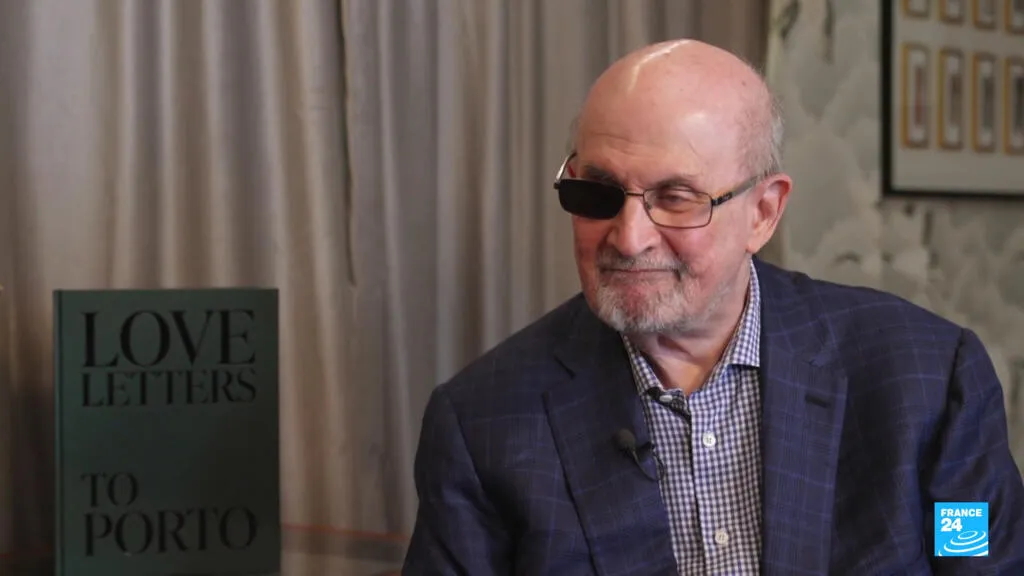
Salman Rushdie, nearly four years after a knife attack left him blind in one eye, returns with “The Eleventh Hour,” his first fiction since the assault. In conversation with arts24's Eve Jackson at Porto's new BABELL literary gathering, he reflects on resilience, censorship, mortality, and the freedom power of storytelling.
Salman Rushdie returns to fiction with “The Eleventh Hour,” his first work of fiction since a knife attack nearly four years ago that left him blind in one eye. This time, he is not just promoting a book. At Porto's new BABELL literary gathering, in a conversation with arts24's Eve Jackson, he also frames the stakes behind the story itself, connecting survival, censorship, mortality, and the idea that storytelling remains one of humanity's greatest acts of freedom.
That matters because Rushdie's public life has long been defined by a collision between art and force. More than three decades ago, a fatwa over “The Satanic Verses” placed him at the center of a global debate about who gets to control language and narrative. So when an author who has survived both ideological punishment and physical violence chooses to publish fiction again, the question for executives, publishers, and platform leaders is not abstract. It is operational: what happens to creative output, distribution decisions, and risk posture when censorship is not a theoretical concern but a lived, recurring threat.
BABELL gives that debate a very modern stage. Literature in 2026 does not sit in isolation. It moves through publishers, translators, festivals, streaming catalogs, social media promotion, and increasingly algorithmic recommendation systems. Rushdie's return is therefore more than a literary milestone. It is a stress test for the entire ecosystem that turns books into public experiences. When censorship is part of the background noise of a creator's life, the downstream questions multiply. Will an event proceed as planned? Will a partner back out? Will distribution be limited, not because the content changed, but because the risk calculation did?
From a governance standpoint, censorship is also a board-level topic, even if the board never reads the chapters. Risk committees tend to look at reputational damage, legal exposure, and operational disruption. Rushdie's story highlights how those categories can be triggered by speech itself, not by a breach of contract or a technical violation. The lesson for publishers and platform operators is that freedom of expression debates can quickly become operational constraints. Policies around moderation, content warnings, licensing, and marketing might not just be about safety and compliance. They can become tools used, intentionally or not, to reduce attention, limit reach, or avoid backlash.
Rushdie's emphasis on resilience, censorship, and mortality shifts the conversation from legal frameworks to human incentives. Resilience is not only personal. In industries built on creators, it also becomes institutional. Companies that support controversial work often face internal friction: editorial staff want to publish, commercial teams worry about partner fallout, legal teams run scenarios, and leadership weighs whether the company can take the heat. Rushdie's return with a first fiction work after the assault is a reminder that the creator's persistence can force organizations to make choices in public. Silence, delays, or partial promotion can be interpreted as concessions, while full-throated support can be interpreted as escalation. Either interpretation carries consequences.
For executives in adjacent sectors, the second-order implications are about timing and credibility. If a platform builds its brand on open access and then shrinks its posture when a creator faces threats, the mismatch shows up quickly. Conversely, if a company leans too hard into controversy, it can lose partners and advertisers that do not want to be associated with censorship battles. The Rushdie case is extreme, but the dynamics are familiar. The difference is that here, the subject is not a hypothetical future scenario. It is an author whose experience spans a fatwa over “The Satanic Verses” and a nearly four-year gap since the knife attack that left him blind in one eye.
None of this is to reduce the story to business risk alone. Rushdie's comments, as described in the report, place storytelling at the center of freedom. He ties mortality to the urgency of making meaning, and he treats fiction as an act that does something to the world rather than merely reflecting it. That is why the return is consequential beyond publishing calendars. In an era where content decisions are increasingly shaped by pressure, moderation rules, and geopolitical friction, fiction that insists on its own right to exist becomes a live argument about culture.
Strategically, peer leaders should treat “The Eleventh Hour” as a signal, not a spectacle. When censorship and threats are part of a creator's history, every decision around publication, promotion, translation, and event hosting is a governance moment. Rushdie's return underscores that the freedom to write and the freedom to distribute are not separable in practice. For boards and executives, the real question is whether you can protect creative work while staying resilient under pressure, without letting fear dictate which stories survive.
This story's Key Insights and Take-aways are locked.
Create a free account to unlock Executive Actions for one credit.
Register to UnlockAlways free for Executives Club members. Join the Club
More in Politics

Glacial collapse, not rain, killed 180 in Nepal's Himalayan flood
The Himalaya's extreme geography hid the true cause of Nepal's catastrophic flood, a glacial collapse that turned a geological battleground into a mass-casualty zone.

Iran’s Esmail Baghaei says Oman talks start shipping via Hormuz, not US talks yet
Temporary route plans with Oman aim to restart commerce while Tehran says Washington dialogue is not on the table.

Standards watchdog opens probe into Reform UK deputy leader Richard Tice over interests
The parliamentary standards commissioner says it began an investigation on 28 July into a possible undeclared interest.