
Sotheby’s sells a near-complete T. rex for $20m-$30m, scientists call it research poison
Ahead of Sotheby’s New York auction on Tuesday, paleontologists warn wealthy collectors are distorting fossil science.
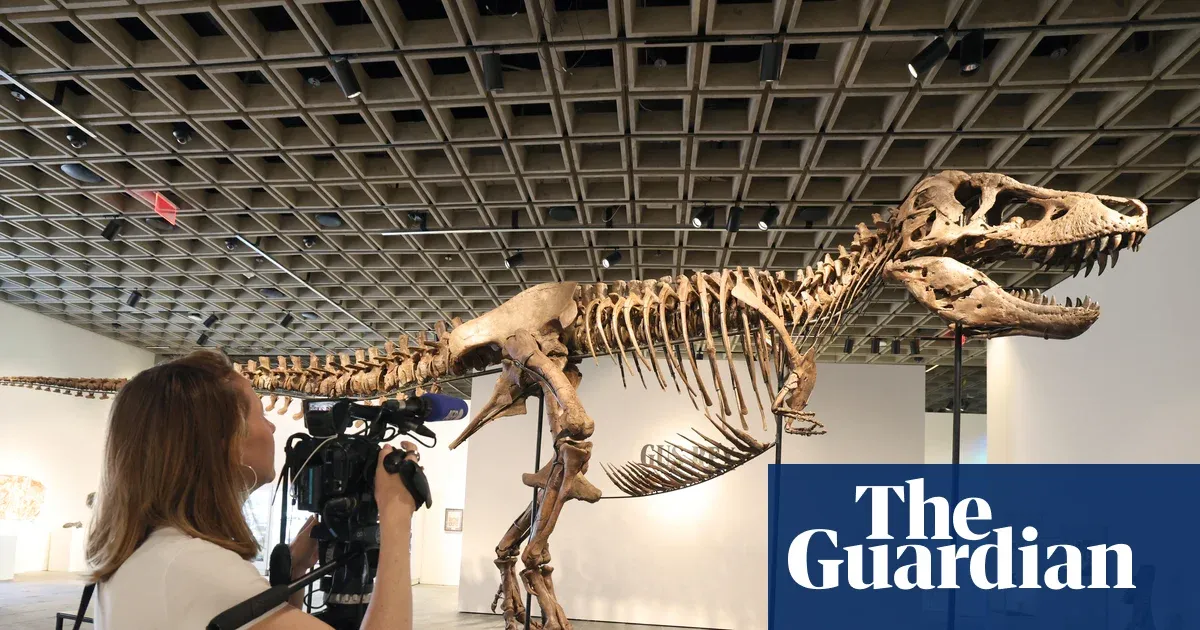
Sotheby’s in New York is set to auction one of the largest and most complete T. rex skeletons discovered, with an estimated sale price of $20m-$30m (£15m-£22.4m). Paleontologists say super-rich collectors are harming research by turning priceless fossils into investment trophies.
On Tuesday, Sotheby’s in New York is set to auction one of the largest and most complete Tyrannosaurus rex skeletons discovered to date, with an estimated sale price of $20m-$30m (£15m-£22.4m). The number is so large it reads like a plot twist, because the fossil is not just a spectacle. It is raw scientific material, the kind that can help researchers answer basic questions about how T. rex lived and grew.
And that is why paleontologists are sounding the alarm before the sale. They warn that super-rich collectors are harming research, turning specimens that could be studied in a scholarly setting into high-stakes trophies that circulate through private hands. In other words, the auction house sees a market moment. Scientists see an obstacle in the way of evidence.
To understand the tension, you have to look at what is being auctioned. This particular T. rex is described as having dagger-like teeth, a bone-crushing bite, and a behemothic size. It ruled western North America during the late Cretaceous period. That makes it inherently valuable scientifically, not because dinosaurs are trendy, but because more complete skeletons tend to carry more information. When you can examine multiple parts of an animal’s anatomy together, you can compare patterns and reduce guesswork.
Yet the auction setting changes the incentives fast. When the price tag climbs into the tens of millions, the buyer is not simply paying for a mount on a wall. They are effectively buying control. Once a major fossil leaves a public or research-oriented institution, scientists may find it harder to access the specimen at the level of detail they need, and the timeline of study can become hostage to private ownership decisions. The Guardian’s reporting frames this as a “big headache” for scientists, which is a polite way of saying that the marketplace can move faster than research.
There is also a classic second-order effect that boards and executives in adjacent industries should recognize: when high-end collectors reward scarcity with large bids, it encourages more extraction and more buying competition. Even if this specific auction is a single event, the attention and money around it can shape behavior across the fossil trade. The paleontologists’ warning about wealthy collectors harming research is basically an argument about incentives, not just this one skeleton.
Auction houses sit at the center of that incentives engine. Sotheby’s will be selling a physical object, but the broader consequence is about who gets to set the rules for how that object is used. In markets for collectibles, ownership usually comes with discretion. In science, discretion matters too, but the goal is different. Researchers generally want consistent access, careful handling, and transparent documentation so the work can be checked and built upon.
Regulatory background matters here, even if the source does not dive into specific statutes. Fossil trade and museum access are typically shaped by a mix of international norms and national rules, including how specimens are documented and where they can legally be transferred. When high-value items are moving through auctions, regulators and institutions often face the practical question of whether the flow is supporting preservation and study or simply enabling monetization. That is why the paleontologists’ pre-auction warning is significant: it is a public signal that scientists believe the system is tilting.
For decision-makers, the takeaway is that this is not merely a dinosaur story. It is a test case for how markets handle scientific commons. If the most complete and scientifically rich specimens increasingly land with super-rich collectors, the research pipeline can become patchwork. And when access becomes patchwork, the entire ecosystem pays. The strategic stakes for any executive who thinks about knowledge infrastructure, philanthropy, or cultural assets are clear: the highest bidders can end up shaping not just prices, but the pace and direction of discovery.
This story's Key Insights and Take-aways are locked.
Create a free account to unlock Executive Actions for one credit.
Register to UnlockAlways free for Executives Club members. Join the Club
More in Science

Alaska's 1,580-foot tsunami had warning signs. Scientists just found them.
Rapid glacier retreat, heavy rainfall, and thousands of tiny tremors preceded Alaska's 1,580-foot tsunami, a warning for every coastal community in a warming world.

The rare mutation that lets high-risk brains dodge Alzheimer's
Scientists found a natural defense against protein buildup, opening a new path to preventive treatments.

3,000 steps a day may halve Alzheimer's decline, study finds
New research links a modest daily walk to less tau buildup and nearly half the cognitive and functional decline, even for those with early signs.