

SpaceX launches Starship Flight 13 today, deploying 20 V3 Starlink satellites for first time
Catch the July 16 test live: Starship targets pad-ready reusability while proving next-gen Starlink capacity gains.
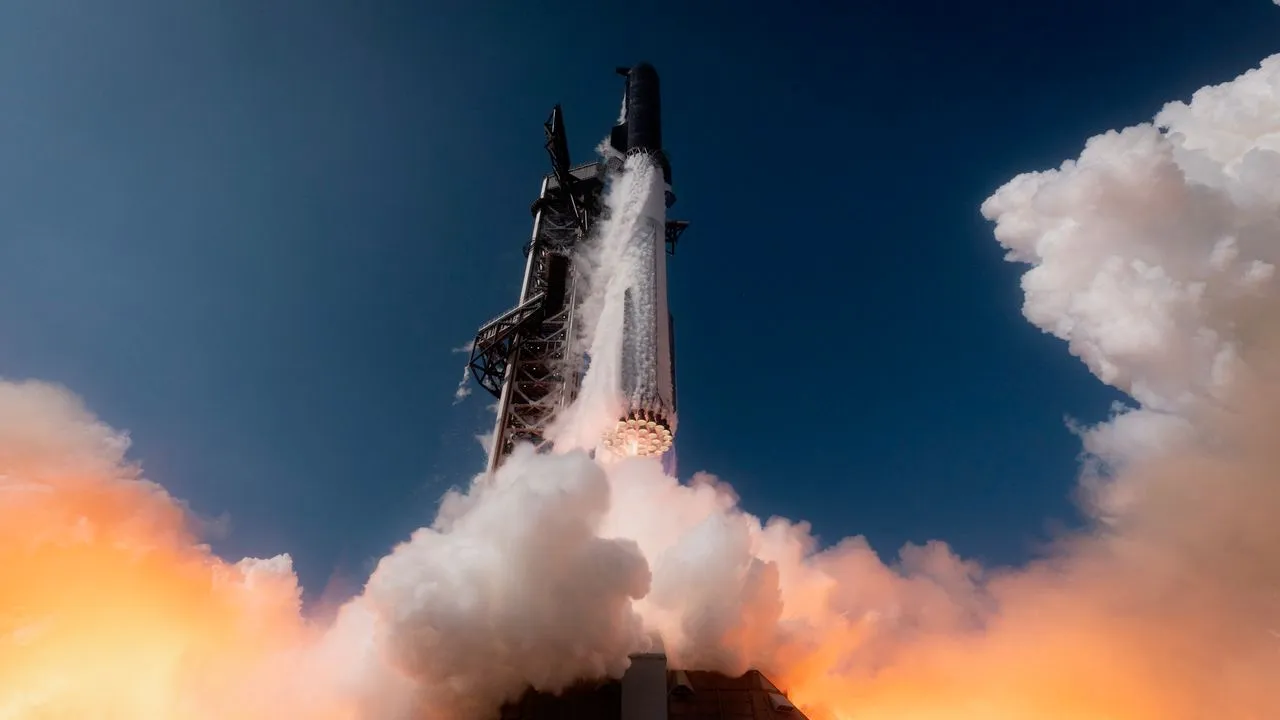
SpaceX will launch Starship Flight 13 on July 16 from Starbase in South Texas, deploying 20 Starlink V3 satellites for the first time. The test matters for decision-makers because it stress-tests hardware, heat-shield data collection, and the rollout pathway for a future V3 megaconstellation.
SpaceX is taking Starship back to the sky today, July 16, and Flight 13 is not just another try. The mission’s headline act is a first: deploying 20 Starlink V3 satellites in suborbital space for the first time ever. Liftoff is scheduled from SpaceX’s Starbase site in South Texas during a 90-minute window that opens at 6:45 p.m. EDT (2245 GMT; 5:45 p.m. local Texas time), and coverage begins about 30 minutes before liftoff.
This is Starship’s 13th flight overall and its second mission of 2026. The timing has a nice layer of symbolism, too: the launch is happening on the 57th anniversary of NASA’s Apollo 11 moon mission. But symbol isn’t the point. What matters is the specific risk map of Flight 13: SpaceX wants to run a version of its reusable architecture while collecting the data it needs to progress toward the more ambitious goal of catching Starship’s components, including the “chopsticks” catch with Ship that it has never attempted before.
Starship itself is a stack of two stainless-steel vehicles designed for rapid, repeated reuse. The first-stage booster is Super Heavy, and the upper-stage vehicle is known as Starship (or “Ship”). Together they stand more than 400 feet (122 meters) tall and can carry more than 110 tons (100 metric tons) to Earth orbit. SpaceX’s big bet is that stainless-steel hardware and reusability can change the unit economics of spaceflight, and by extension make large-scale moon and Mars exploration more practical.
To understand why Flight 13 is a big deal for the broader industry, you have to connect Starship hardware progress to Starlink’s evolution. Starship debuted in April 2023 and has flown 11 more suborbital flights since. Most recently, Starship’s Flight 12 test on May 22 was the first mission for Starship Version 3 (V3). During that mission, Ship deployed 22 payloads via its “PEZ dispenser” slit: 20 dummy versions of Starlink broadband satellites and two actual Starlinks equipped with imaging sensors. Ship came back to Earth successfully, splashing down off the coast of Western Australia as planned.
But Flight 12 was not a perfect victory lap. Super Heavy suffered engine issues during its return and ended up crashing in the Gulf of Mexico rather than making a controlled splashdown there. That history is the reason Flight 13’s objectives stay focused while still moving the program forward. SpaceX plans to rerun the same overall themes, but with “several modifications to hardware and software to address issues seen on the previous flight,” as stated in the Flight 13 mission description.
Here’s how the recovery plan works. SpaceX’s long-term strategy is to return both Super Heavy and Ship directly to the launch pad after liftoff, catching each with the “chopstick” arms attached to Starbase’s two launch towers. The company says that approach would let each vehicle fly multiple times per day. Super Heavy has been caught three times to date, with the most recent snag coming on Flight 8 in March 2025. For Ship, this is where the program gets harder: SpaceX has never tried a chopsticks catch with Ship.
On Flight 13, the expected outcome is more conservative than the ultimate dream, but still demanding. If all goes to plan, Super Heavy will steer to a controlled splashdown in the Gulf of Mexico (the Trump administration has renamed the Gulf of America) about seven minutes after launch. Ship will target a splashdown in the Indian Ocean off the coast of Western Australia about 65 minutes after launch. Meanwhile, the deployment portion is where Flight 13 makes its most meaningful step forward: Ship will deploy 20 V3 Starlink satellites, and those satellites are designed to “greatly expand the network’s capacity and user speeds,” according to SpaceX’s mission description.
The V3 rollout is audacious by design. SpaceX says it eventually wants to operate up to 100,000 V3 Starlinks in low Earth orbit. For context, the current megaconstellation, the largest such network ever assembled, contains only about 10,800 spacecraft. Getting from 10,800 to 100,000 is a logistics problem, not a marketing problem. SpaceX even notes that the V3 plan will require thousands of launches, beyond what Falcon 9 can handle; Falcon 9 flew 165 times in 2025.
And the satellites are heavier than the previous generation. Each V3 satellite will apparently weigh around 4,400 pounds (2,000 kilograms). That’s part of why Starship matters. When payload mass rises, launch cadence and cost per kilogram stop being theoretical board slides and start dictating whether the constellation can scale.
Flight 13 also uses the satellites as a data-gathering mechanism. The 20 Starlink V3 satellites will extend solar arrays and antennas and will attempt to connect with the larger Starlink constellation via high-capacity lasers. They will be deployed on the same suborbital trajectory as Starship and are expected to “demise upon reentry” approximately 20 minutes after deployment. Six of the 20 spacecraft are equipped with cameras, which will scan and study Ship’s heat-shield tiles.
That heat-shield work is the bridge between today’s test and tomorrow’s more aggressive recovery attempts. SpaceX wants more data about the heat-shield system before it attempts to bring Ship back to the launch pad for a chopsticks catch. It is not just collecting passive images; it is running experiments. The shield will include load-sensing tiles to take measurements as the vehicle experiences higher dynamic pressure on ascent than previous flights. That means added stress on the tile attachments in exchange for increased payload-to-orbit capability, per the mission description. In other words, Flight 13 is both a flight and a stress test for the pathway to higher performance.
For executives watching this from the business side, Starship Flight 13 is a rare convergence of aerospace engineering, communications infrastructure, and scaling math. Starlink V3’s capacity ambitions depend on thousands of launches and heavier satellites. Starship’s reusability ambitions depend on heat-shield reliability and a credible path to pad recovery. Put those together, and you get a mission that is too technical to be exciting on paper and too commercially consequential to ignore in practice.
This story's Key Insights and Take-aways are locked.
Create a free account to unlock Executive Actions for one credit.
Register to UnlockAlways free for Executives Club members. Join the Club
More in Technology

Google quietly links your phone number to every Android account on your SIM
Adding a SIM now ties your phone number to all Google accounts - and future accounts inherit it. Here's the security and privacy stakes.

Hijacker AI 'Skynet mode' runs 100,000 attack steps against exposed models
Symantec caught a criminal AI agent that borrows other models, steals data, and mines crypto; the only relief is no confirmed victims yet.

Nvidia's AI-financier shift faces its first big test as neoclouds stumble
A rout in neocloud stocks is forcing investors to weigh Nvidia's hidden exposure as both supplier and lender to the AI buildout.