

SpaceX will attempt first-ever double Starship catch next month, Musk says
The next Starship test flight targets a first for orbital launch: catching both the Super Heavy booster and Ship upper stage with the launch tower's chopstick arms.
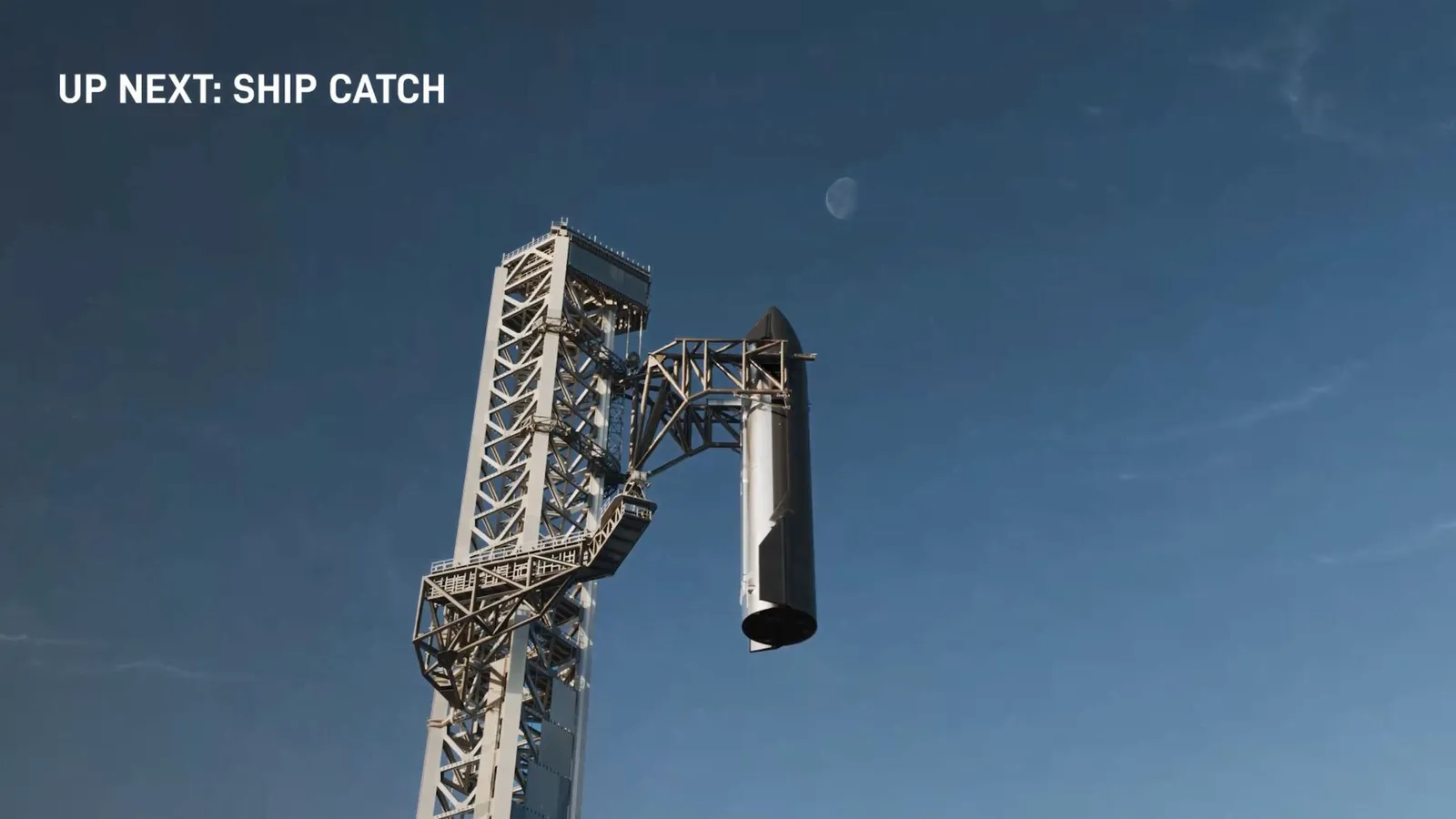
Elon Musk announced during SpaceX's Q3 earnings call that Flight 15, expected in November, will attempt to recover both Starship stages, a first for an orbital launch vehicle. Success would validate full reusability and support SpaceX's projected path to $500B-$1T in annual recurring revenue by end of 2027.
SpaceX is aiming for a first in orbital spaceflight next month. During the company's Q3 earnings call on Oct. 20, founder and CEO Elon Musk said the next Starship test flight, Flight 15, will attempt to catch both stages of the megarocket: the Super Heavy booster and the Ship upper stage. "This will be the first time that an orbital launch vehicle has been fully recovered," Musk said, calling it "a profound technology milestone in the history of civilization and consciousness."
The stakes are literal: Starship is the largest and most powerful rocket ever built, standing more than 400 feet tall when fully stacked. Unlike Falcon 9 and Falcon Heavy, which are partially reusable with expendable upper stages, both Starship stages are designed to be fully and rapidly reusable. Instead of landing on pads or drone ships, Super Heavy and Ship will steer themselves back to the launch tower, where "chopstick" arms will catch them. SpaceX has already pulled off three booster catches, but has never tried to catch Ship, which travels higher, farther, and faster. Musk said he thinks it is "more likely than not" the catch succeeds on the first try.
A successful double catch would follow a landmark Flight 14. On Sept. 28, Ship reached orbit for the first time ever and deployed 26 Starlink Version 3 satellites, the first members of a next-generation broadband constellation that will eventually include about 100,000 spacecraft. That means back-to-back Starship flights with huge milestones, and it explains why Musk is pushing for a steady stream of flight attempts through the end of the year and accelerating next year.
The announcement came as an aside during a call dominated by SpaceX's financial performance, and the numbers explain the urgency. SpaceX recorded $14.6 billion in Q3 revenue, up 161% from $5.6 billion in the same period a year earlier. Net income hit $4.4 billion, a $5.5 billion swing from the $1.1 billion loss in Q3 2025. Notably, only $1.8 billion of revenue came from launch. The vast majority came from connectivity, driven by Starlink, and artificial intelligence, which the Trump administration has recently rebranded "superintelligence."
That revenue mix is why full reusability matters so much. SpaceX is building infrastructure to support thousands of Starship launches per year, with Musk envisioning more than 10,000 launches annually by 2030. The purpose is not just to reach orbit, but to loft large numbers of Starlink satellites and AI data centers into low Earth orbit. On the call, Musk projected SpaceX annual recurring revenue by the end of 2027 at somewhere between $500 billion and $1 trillion, a figure that would put the company in the same league as the largest corporations on Earth.
For executives watching from outside the space industry, the double catch attempt is a signal about cost curves. Full and rapid reusability has long been the missing piece for making orbital infrastructure economically feasible. Falcon 9 proved booster reuse, but its upper stage is still expendable. If Starship can be caught, inspected, refurbished, and refueled quickly, the marginal cost per launch could fall dramatically, opening the door to constellations and orbital data centers that are currently too expensive to build.
The risk is real. Catching Ship is a more difficult proposition than catching the booster, and a failure would not be a surprise. But Musk's confidence, combined with a pipeline of additional flight attempts, suggests the company is treating this as an engineering problem with a near-term solution. For competitors, regulators, and customers, the message is that the era of expendable orbital hardware may be ending faster than expected.
This story's Key Insights and Take-aways are locked.
Create a free account to unlock Executive Actions for one credit.
Register to UnlockAlways free for Executives Club members. Join the Club
More in Business

Musk barred from the room as Tesla, SpaceX boards weigh $3.5 trillion merger
The CEO of both companies is a 'conflicted party' watching independent directors negotiate a tie-up that would create a $3.5 trillion giant he would own about a third of.

Elon Musk just showcased a flying car - and it wasn't at Tesla
The Tesla CEO's latest reveal came at SpaceX, not Tesla, signaling where vertical mobility is headed.

Apple's $2,000 iPhone Duo opens preorders, taking on Samsung and Google
Apple's first foldable hits the market at a premium price, reshaping a category Samsung and Google have led.