

Steam makes game gifting account-free and finally organizes wishlists by category
New Steam gifting and wishlist sorting updates aim to reduce friction for buyers and clarity for players.
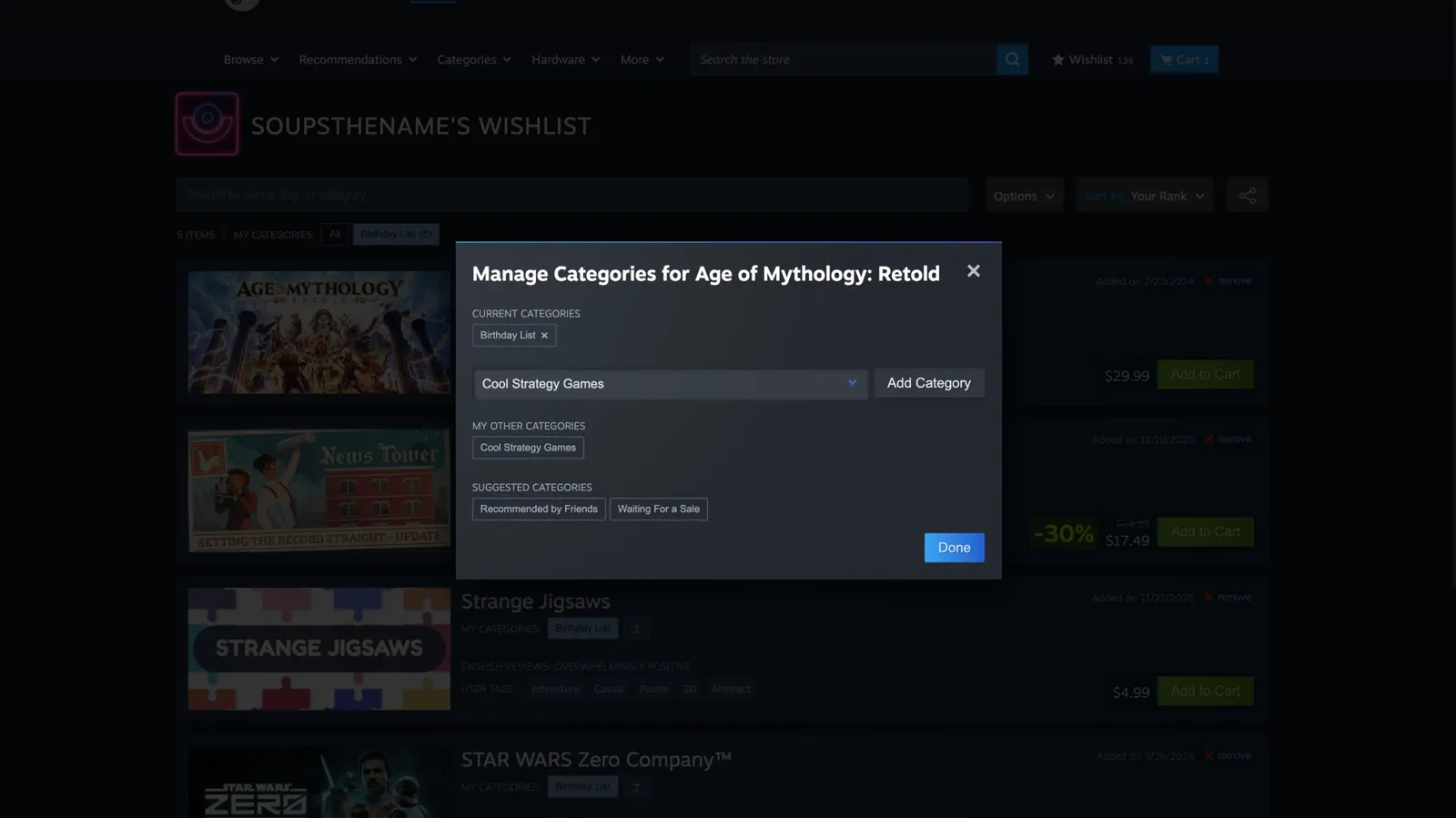
Steam rolled out gifting changes that let users gift games without a Steam account and introduced wishlist updates that allow sorting into categories. For decision-makers, the updates target conversion friction and improve purchase intent signals inside the Steam store.
Steam just quietly changed two consumer flows that matter way more than they sound: gifting and wishlist management. According to Engadget, Steam now lets you gift games without the recipient needing a Steam account. It also adds wishlist updates that let you sort your wishlist into categories.
That pair of tweaks hits the exact moment where customers either move forward or stall out. If you can gift without forcing the other person to create an account, you remove a pointless hoop at the worst time, right when someone has money ready and only needs the game. And if you can categorize what you want, you stop wishlists from turning into a chaotic junk drawer of “maybe someday” titles. In other words: Steam is smoothing the path from intent to transaction, and it is doing it in the two places most stores historically struggle, gifting conversion and long-term purchase decision-making.
For executives watching platform commerce, these are not flashy features. They are funnel features. Gifting is typically a high-friction behavior because it forces the gift receiver into a decision before they even know they want to play. Traditionally, a store can reduce gift redemptions if it makes the recipient jump through onboarding steps, even if those steps are “free.” Making Steam account creation optional for gifting reframes the entire experience. Instead of “create an account first, then maybe we’ll buy,” it becomes “here is the gift, then you can decide.” That changes the incentives on both sides: the buyer has fewer barriers to completing the purchase, and the recipient has more autonomy to come to Steam when they are ready.
Wishlist categorization is the other half of the same coin. In consumer commerce, wishlists act like a memory system. But when every item sits in one undifferentiated list, customers spend attention re-finding the right title at the right time. Categorization turns a wishlist from a dump into a tool. It creates a better internal structure for planning purchases around events, moods, genres, or budgets. Even if Steam does not spell out the mechanics beyond sorting into categories, the business implication is straightforward: clearer organization makes it more likely a user will notice an item when they are actively shopping.
Zoom out and you see why this matters right now. Digital game storefronts are locked in a constant race for purchase convenience. The big platforms do not only compete on content and pricing. They compete on reducing steps. Every extra screen, account requirement, or confusing interface element is a tax on conversion. That is why account-free gifting and structured wishlists are meaningful. They cut friction at the exact points where users are most likely to hesitate: gifting where the recipient is not yet committed, and wishlists where the user’s intent is real but untapped.
There is also a regulatory-adjacent angle worth noting, even if the source does not mention specific regulators. Account requirements and data collection have been a frequent point of scrutiny in different contexts across the tech industry, from consent to onboarding to consumer protection norms. Steam is not “solving regulation” by itself, but moving toward fewer required steps can indirectly reduce friction and simplify the user experience for consumers who prefer to minimize upfront account actions. For platforms, that can matter because consumer expectations keep shifting toward just-in-time choices instead of forced setup.
The second-order implications for boards and senior leaders come from how these changes influence behavior. When you improve gifting without demanding an account, you expand the pool of potential gift recipients. That can increase the frequency of gift purchases and potentially broaden discoverability, because gift redemption often leads to browsing. When you improve wishlist organization, you increase the chance that users return to the store with a clearer plan. In a marketplace where timing is everything, better structure can translate into more repeat shopping sessions and more responsive purchases.
If you are an executive at a competing digital storefront, a payments provider tied to digital goods, or a subscription business adjacent to gaming, this is a reminder that product teams do not need to reinvent the store to move revenue. They can change the smallest moments that decide whether a customer completes checkout. Steam’s update, as described by Engadget, is deceptively simple. But the operational message is loud: remove unnecessary gates, organize intent, and let transactions happen before skepticism has time to grow.
Over time, the strategic stakes are clear. Storefronts win when users feel the path is easy and the next step is obvious. Account-free gifting makes the first step easier for both sides. Wishlist categories make the next step clearer for the buyer later. Together, they tighten Steam’s conversion loops, and they raise the bar for how quickly a platform can go from “I want that” to “I bought that.”
This story's Key Insights and Take-aways are locked.
Create a free account to unlock Executive Actions for one credit.
Register to UnlockAlways free for Executives Club members. Join the Club
More in Technology

doubleAI's Maxwell rewrites code while it runs, claims 38x speedups
The Tel Aviv startup's code execution model formally verifies optimizations, turning AI into an agent for the hardware itself.
Saudi military official paid to fly OpenAI bugging suspect's family out, prosecutors say
A court filing says a Saudi military official funded the family's exit and Riyadh offered bail, putting foreign-influence risk squarely on AI boards.

AI researcher's 26,000-word claim: Neural nets aren't tangled after all
Nick Cammarata's Goodfire post has the AI world split - if he's right, monitoring frontier models just got a lot easier.