
Summer Triangle unlocks the night sky with Vega, Deneb, Altair, and one wild distance trick
A naked-eye guide to using three familiar stars, plus exactly where to look around 11 p.m. this week.
Space.com walks readers through the Summer Triangle and how to “reacquaint yourself” with it in late July using Vega, Deneb, and Altair. The payoff for decision-makers: faster situational awareness in the sky, better observing, and clearer context for spotting what comes next.
There’s an oddly satisfying moment every July when the night sky “clicks” for you. According to Space.com, once you find the Summer Triangle, the rest of the northern summer sky stops feeling random and starts lining up. The anchor is three bright stars that are simple enough to spot even through twilight and light pollution: Vega, Deneb, and Altair.
The trick, though, is that it is not actually a true triangle in space. Space.com explains that Vega and Altair are relatively nearby, while Deneb is about 2,600 light-years away, so far that it feels almost impossible it can look this bright from Earth. When you mentally push Deneb way back, “it’s not a triangle anymore,” it becomes an arrow pointing into the distant starfields of the Milky Way. That single distance correction is the whole reason the Summer Triangle is more than a pretty pattern, it is a practical way to train your eyes to see structure, depth, and direction.
Why this matters is not just for hobbyists with telescopes. The same mental model shows up in how people navigate fast-changing environments: you need stable reference points, and you need them to be consistent with reality. Space.com frames the Summer Triangle as one of the best seasonal anchors because it appears right when the northern sky can feel vague and washed out during late twilight. In other words, it is a recognition tool, and it arrives exactly when you need one.
Then comes the “there is no blanket” lesson. Space.com criticizes the cliché that the sky is a blanket of stars because it makes the cosmos sound flat. Instead, the Summer Triangle teaches depth fast. Altair, the lowest star, is at about 17 light-years away and shines brightly largely because it is close. Vega sits around 25 light-years away, but it is intrinsically far more luminous. The article also notes that Vega once served as Earth’s North Star thousands of years ago and will become the North Star again many millennia from now due to Earth’s slow axial wobble.
So far, the story is local, “we’re in the sun’s backyard” by cosmic standards. Deneb is the jump cut to the far frontier. Space.com describes Deneb as a supergiant radiating tens of thousands of times more energy than the sun, with light that began its journey toward Earth while the Roman Empire still existed. That backstory does more than flex scale. It changes how you interpret brightness: you are not just seeing “bright stars,” you are seeing objects with wildly different distances and intrinsic power that line up from our perspective.
All of which sets up when and where to look. Space.com says that this week is a perfect time to reacquaint yourself with the Summer Triangle using just naked eyes. Around 11 p.m. local time at mid-latitudes of the Northern Hemisphere, look high in the southeast. Vega is usually the first to appear, high and brilliant with a slightly blue-white color. To Vega’s lower left sits Deneb. Farther south is Altair. By midnight, the entire Summer Triangle stands high overhead and remains a defining feature of the northern summer sky through October.
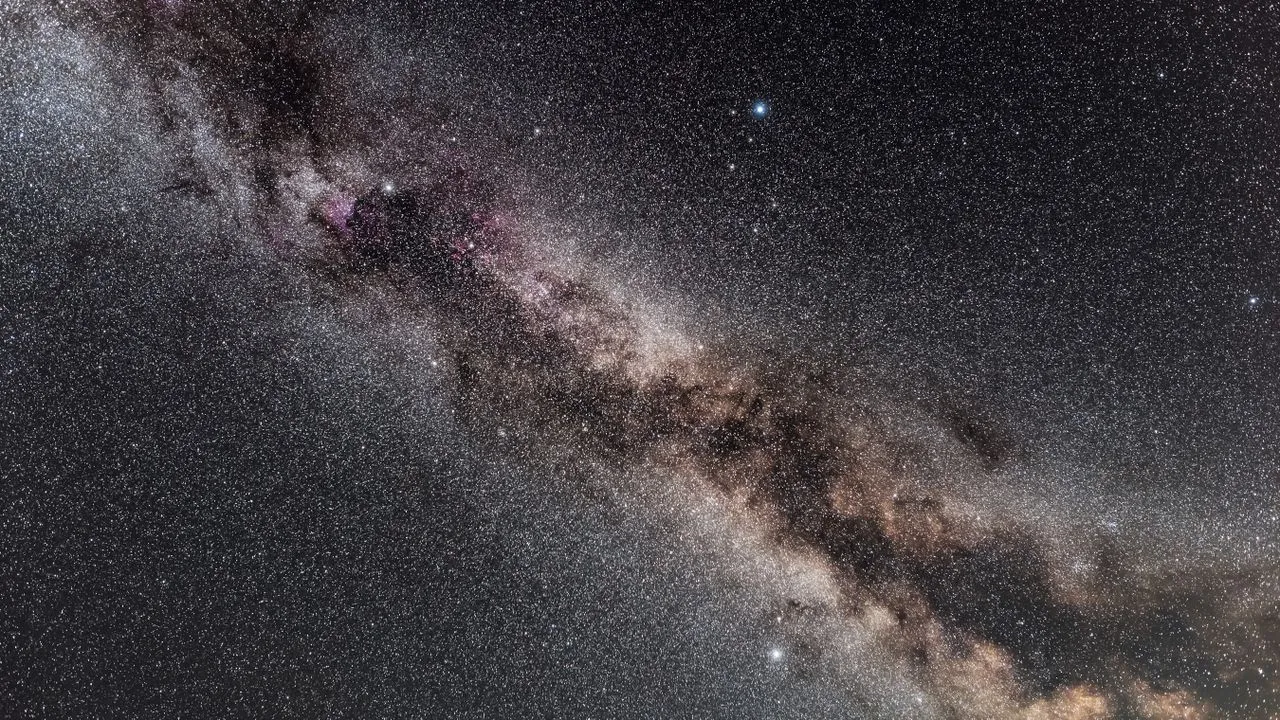
From there, Space.com ties the pattern to what you can actually observe next. Stretching directly through the Summer Triangle is the view into the Orion Arm of the Milky Way, the spiral arm that contains the solar system itself. Farther south, the glowing river of starlight continues toward the galactic core near the constellations Sagittarius and Scorpius, low on the horizon. Under dark skies, the Milky Way visibly streams behind Deneb and through Altair like a river of stars. In other words, once you have the anchor points, you can trace structure rather than chase objects one by one.
If you want to go beyond “spot three stars,” Space.com recommends shifting from object hunting to region exploring. The article says that when you sweep binoculars slowly through the Summer Triangle, you lose planning because dense star clouds spill into view everywhere, with dark lanes slicing through the Milky Way and tiny clusters appearing almost accidentally. Inside the Summer Triangle itself lies the Cygnus Star Cloud, described as one of the richest naked-eye sections of the Milky Way visible from northern latitudes. Nearby are the Ring Nebula and the Dumbbell Nebula. Space.com also highlights Albireo, a beautiful double star with one bright yellow component and one fainter blue companion, at the beak of Cygnus, the Swan.
And because good observing habits scale, Space.com includes smaller constellations that fill gaps between the big, obvious patterns. Delphinus, the Dolphin, hovers to the left of Altair. Tiny Sagitta, the Arrow, hangs above Altair. Space.com frames this as another instruction: astronomy improves dramatically once you stop hunting objects individually and start exploring regions instead. It calls it armchair travel of the grandest kind.
Finally, there is timing for what you might catch this late July. Space.com’s “Stargazer’s corner: July 24-31, 2026” notes that the moon will move beneath the Summer Triangle this week, appearing as an 81%-illuminated waxing gibbous moon as it shines close to supergiant star Antares in Scorpius on Friday, July 24. It also says that on Wednesday, July 29, the night before the full Buck Moon, the Summer Triangle will appear to point straight at it. Meteor context matters too: late July marks the gradual strengthening of the Perseid meteor shower, with occasional early meteors now appearing after midnight. The Southern Delta Aquariids and Alpha Capricornids peak around Thursday-Friday, July 30-31, though the full moon will reduce visibility of fainter meteors considerably.
The “Consolation of the week” is Sagitta. Space.com says Sagitta is one of the smallest constellations but one of the easiest to recognize once you find it. It appears as a short line of five stars, all between 450-650 light-years distant, arranged like an arrow with an arrowhead, shaft, and two stars as the fletchings. It sits between Cygnus and Aquila, is not bright, but is well-defined, and once spotted becomes a reliable reference point.
So for anyone trying to build better “understanding fast” habits, the Summer Triangle is the right kind of training. It gives you three stable anchors, and then it forces you to respect real distance. That combination is what turns a pattern into a mental map, and a mental map into quicker, better observing of the summer Milky Way and whatever shows up next.
This story's Key Insights and Take-aways are locked.
Create a free account to unlock Executive Actions for one credit.
Register to UnlockAlways free for Executives Club members. Join the Club
More in Science

Alaska's 1,580-foot tsunami had warning signs. Scientists just found them.
Rapid glacier retreat, heavy rainfall, and thousands of tiny tremors preceded Alaska's 1,580-foot tsunami, a warning for every coastal community in a warming world.

The rare mutation that lets high-risk brains dodge Alzheimer's
Scientists found a natural defense against protein buildup, opening a new path to preventive treatments.

3,000 steps a day may halve Alzheimer's decline, study finds
New research links a modest daily walk to less tau buildup and nearly half the cognitive and functional decline, even for those with early signs.