
Sun launches 10 M-class flares in 24 hours, NOAA warns of G2 to G3 aurora chances
July 3-5 CMEs could trigger geomagnetic storms and visible auroras across more than a dozen states.
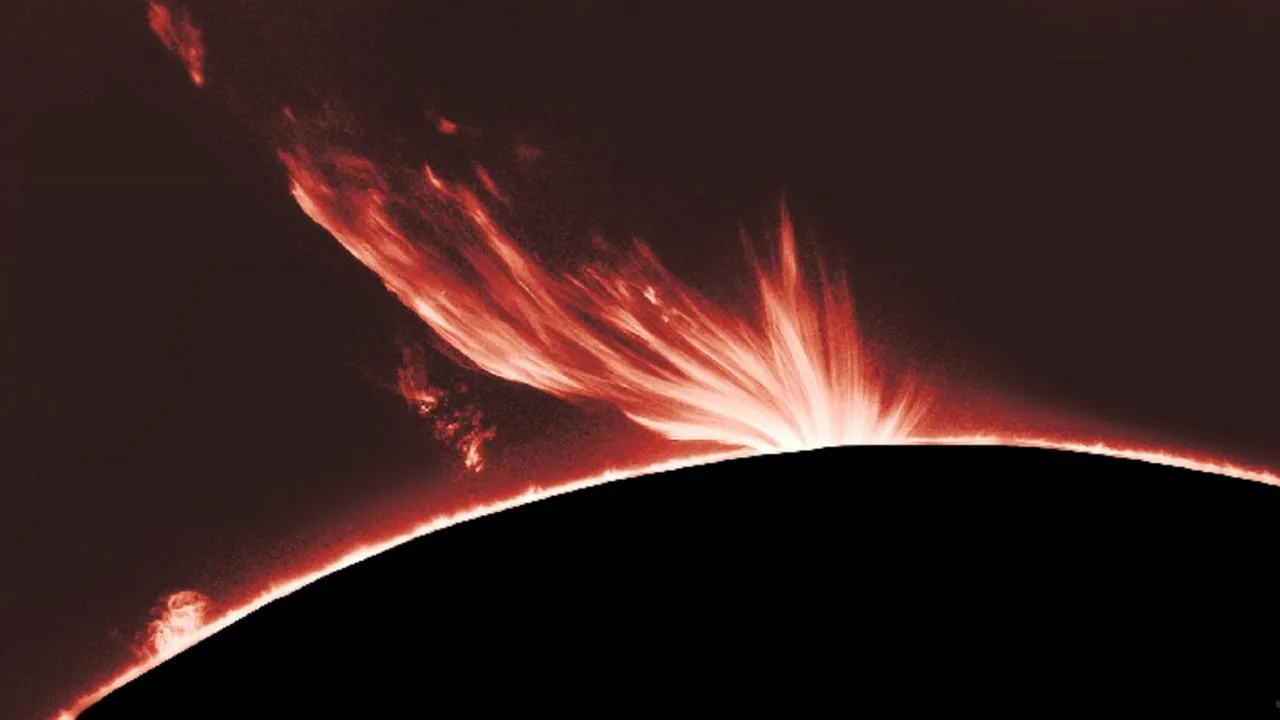
The sun fired off 10 M-class solar flares over 24 hours and is also producing multiple coronal mass ejections aimed at Earth on July 3 and July 5. NOAA’s Space Weather Prediction Center expects a moderate (G2) geomagnetic storm with the possibility of strong (G3), expanding aurora visibility well beyond the usual high-latitude regions.
This Fourth of July weekend, parts of the US could get an aurora show far from the poles, and the reason is brutally specific: the sun launched 10 M-class solar flares over 24 hours. Those flares came with multiple coronal mass ejections, or CMEs, which are expected to slam into Earth on July 3 and July 5. If you live anywhere between the usual “aurora belt” and the Midwest, that window matters because the storms can push the lights much farther south than normal.
The forecast is not just “maybe.” NOAA’s Space Weather Prediction Center says the CMEs are expected to create conditions for a moderate (G2) geomagnetic storm, and it is also possible they strengthen to become strong (G3) depending on how they interact with Earth’s magnetic field. With G3-class geomagnetic storms, auroras are often visible in northern states including Washington, Idaho, Montana, Wyoming, North Dakota, South Dakota, Minnesota, Wisconsin, Michigan, New York and Maine, and NOAA also lists visibility chances farther south in Oregon, Nebraska, Iowa, Illinois, Indiana, Ohio, Pennsylvania, Massachusetts, Connecticut, Rhode Island, Vermont and New Hampshire.
To understand why this turns into a practical planning headache for decision-makers, you have to connect the physics to real-world systems. CMEs are large, fast-moving clouds of magnetized plasma and solar radiation that are sometimes launched with solar flares when kinks in the sun’s magnetic field snap. When those magnetized clouds strike Earth, they disturb the planet’s magnetic field, producing what NOAA calls geomagnetic storms. Those storms can trigger partial radio blackouts and can generate vibrant aurora displays farther from Earth’s magnetic poles than usual. Translation: you get both optical drama and operational risk.
A key detail here is timing. Tamitha Skov, a space weather physicist at Millersville University of Pennsylvania, wrote in a July 2 post on X that “NOAA and NASA model predictions do not show all the storms yet” and that “the first should hit before noon July 3 UTC.” That lines up with NOAA expecting CMEs to arrive July 3 and July 5. In other words, the sun is firing rapidly enough that models may lag the reality on the ground. For executives, that should sound familiar even outside space weather: when events cascade faster than forecasts update, contingency planning becomes the differentiator.
There is also a second-order “keep watching” signal. The article notes that two gigantic sunspots currently “pimpling” its face are displaying “beta-gamma-delta” magnetic fields, described as the most tangled and unstable type. According to spaceweather.com, that gives the sunspots potential to launch powerful X-class flares. That matters because it is a reminder that the July 3 and July 5 impacts may not be the end of the story. The forecast is currently anchored around particular CME arrival dates, but the underlying driver, magnetic instability, can escalate.
Zoom out further and the weekend looks less like a random fireworks show and more like a glimpse of the sun in a complicated phase. Live Science explains that the recent record number of powerful X-class flares has partly reflected improvements to scientists’ solar monitoring technologies, but also that the sun reached its 11-year peak in sunspot production, known as solar maximum, in 2024. After that peak, the sun has entered the “battle zone,” a relatively understudied solar phase where instabilities across the sun’s newly flipped magnetic field ramp up production of solar holes, giant, highly tangled sunspots, and subsequent geomagnetic storms.
For executives who think in risk scenarios, the article also includes the worst-case benchmark: the 1859 Carrington Event. It released roughly the same energy as 10 billion 1-megaton atomic bombs, set telegraph systems on fire, and produced auroras brighter than the light of the full moon as far south as the Caribbean. The flare was about X45 magnitude, which remains a record, though the piece notes it is likely far from the worst the sun can muster, with ancient tree rings indicating even more powerful blasts occurred long before humans existed.
So what should business leaders take from a “machine-gun sun” moment? Even if your organization is not monitoring space weather, the underlying lesson is operational resilience under uncertainty. Geomagnetic storms can bring partial radio blackouts, and the same days when people are looking up for photos are also the days when communications and navigation can be stressed. Boards and operators in energy, transportation, telecom, satellite services, and any system that depends on reliable radio and signal integrity should treat these forecasts as a prompt to verify readiness, not to panic. The sun is not asking permission before it fires; the only control is how quickly your organization can respond when nature’s timing outruns the models.
This story's Key Insights and Take-aways are locked.
Create a free account to unlock Executive Actions for one credit.
Register to UnlockAlways free for Executives Club members. Join the Club
More in Science

Alaska's 1,580-foot tsunami had warning signs. Scientists just found them.
Rapid glacier retreat, heavy rainfall, and thousands of tiny tremors preceded Alaska's 1,580-foot tsunami, a warning for every coastal community in a warming world.
The rare mutation that lets high-risk brains dodge Alzheimer's
Scientists found a natural defense against protein buildup, opening a new path to preventive treatments.

3,000 steps a day may halve Alzheimer's decline, study finds
New research links a modest daily walk to less tau buildup and nearly half the cognitive and functional decline, even for those with early signs.