

Swift J1727.8−1613 jets flare, then keep blowing after feeding ends
A VLT watch of a 2023 black hole outburst shows dense winds persist long after the finale fireworks.
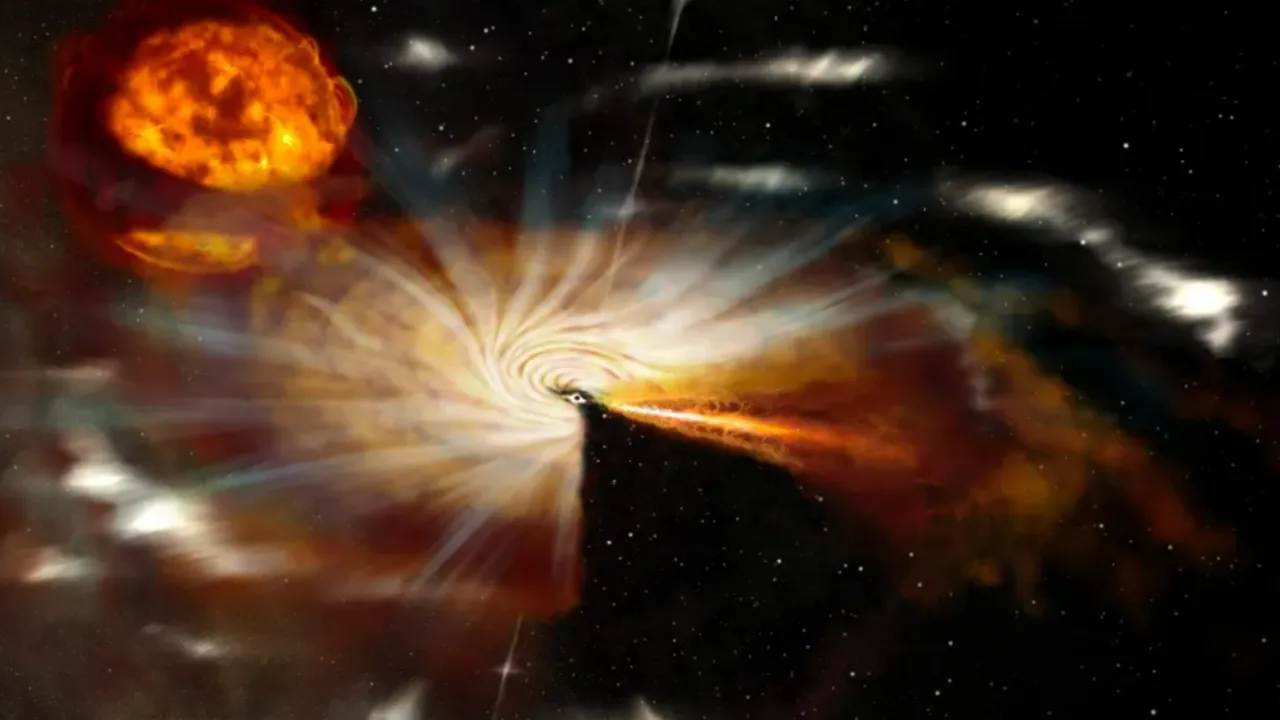
Astronomers used the Very Large Telescope to track the distant black hole system Swift J1727.8−1613, about 8,800 light-years away, from its 2023 feeding frenzy into a windy, messy finish. The findings, published Wednesday (July 29) in MNRAS, reshape how decision-makers and researchers think about what black holes actually “consume” versus expel.
Astronomers expected a clean story: a black hole feeds, it flares, then the show stops. With Swift J1727.8−1613, that tidy ending never comes. Using the Very Large Telescope (VLT), a team observed the violent outflow of material from the black hole and found that the biggest expulsion happened when the system’s feeding activity was actually lower than previously thought. Even more striking, after the 2023 “feeding frenzy” subsided, the black hole still appeared to be powering black hole winds of dense gas.
This matters because it turns the headline mental model into something messier. Team leader Noel Castro Segura of the University of Warwick in the UK described the process as far more complex than “simply swallowing everything around them.” In other words: matter falls in, the system processes it, and a surprising amount is expelled again. That is exactly what the VLT “movie” revealed as the accretion disk changed over time while the black hole blasted jets.
Start with the setup. Swift J1727.8−1613 is a black hole system located around 8,800 light-years away. It became one of the brightest X-ray sources in the sky over Earth after a bout of cosmic indigestion and bright eruptions in 2023. That episode is also what initially led astronomers to discover Swift J1727.8−1613 in 2023. Since then, it has been the kind of cosmic lab instrument science usually dreams about: a system that changes in real time, not only at the start of an outburst.
Here’s the physical sequence the paper lays out. The black hole strips material from a companion star, forming a structure called an accretion disk. The key detail is angular momentum, meaning the incoming stellar material is still rotating, so it cannot directly fall straight into the black hole. Instead, friction and tidal forces in the disk superheat the gas, causing it to glow brightly. That glowing disk is what Segura and colleagues could track in detail. Their observations differed from previous studies because they let the researchers watch the Swift J1727.8−1613 system evolve as it fed on the star, essentially capturing the connection between matter infall and outflow, rather than just observing two endpoints.
Now zoom out to the “feeding frenzy ends with a bad case of cosmic indigestion” theme, because it is not just a poetic framing. The team found that while some of the stripped stellar material was consumed, other stellar material was blasted back into space. The two big delivery routes were high-speed jets and powerful black hole winds. The most massive outflows occurred when the black hole’s feeding activity was much lower than previously thought, which implies the outflow strength does not map neatly to “how hungry the black hole looks” at every moment.
After the finale, the plot twist is the persistence. The researchers found that even after the feeding frenzy of the black hole had subsided, it seemed to still be powering black hole winds of dense gas. They suggest that the amount of material flung away by the black hole may eventually amount to the same mass as that consumed by the black hole, meaning half of its stellar meal was eventually lost to space. Segura connects that to efficiency: if black holes can continue shedding material even after their largest outbursts, they may be much less efficient eaters than previously assumed. A significant fraction of the “meal” may never reach the black hole at all.
If you are wondering why astronomers care about this, it is because it changes the bookkeeping of galaxy evolution. Segura added that this could change understanding of how binary stars in galaxies evolve, since a binary system’s evolution depends on how mass transfer and energy output play out over time. And because Swift J1727.8−1613 is a bright and dynamic system, it helps calibrate the theoretical expectations for how accretion and feedback behave in the real universe.
There is also an important communication takeaway hidden in the way the team talks about their data. Kyle Solomons, a Doctoral Researcher at the University of Cape Town, said the community tends to gravitate toward the dramatic fireworks when a black hole outburst begins, but these observations show the finale can be just as intense. For decision-makers and research leaders, that is a reminder that timing is not a footnote. The late phase, not only the initial flare, can dominate the total energy and mass expulsion, which affects how models are validated and how resources are allocated for follow-up campaigns.
The paper’s publication also anchors the timeline: the team’s research was published on Wednesday (July 29) in the Monthly Notices of the Royal Astronomical Society (MNRAS). Taken together, the observation of the entire feeding cycle, from initial flare to windy end, paints a clearer and more dynamic picture than scientists have previously had access to. It’s a rare kind of dataset: one where the outflow is not a one-off event, but a process that continues, evolves, and sometimes refuses to stop when the feeding story seems finished.
This story's Key Insights and Take-aways are locked.
Create a free account to unlock Executive Actions for one credit.
Register to UnlockAlways free for Executives Club members. Join the Club
More in Science

Alaska's 1,580-foot tsunami had warning signs. Scientists just found them.
Rapid glacier retreat, heavy rainfall, and thousands of tiny tremors preceded Alaska's 1,580-foot tsunami, a warning for every coastal community in a warming world.

The rare mutation that lets high-risk brains dodge Alzheimer's
Scientists found a natural defense against protein buildup, opening a new path to preventive treatments.

3,000 steps a day may halve Alzheimer's decline, study finds
New research links a modest daily walk to less tau buildup and nearly half the cognitive and functional decline, even for those with early signs.