
Tianwen-2 sends home photo of quasi-moon Kamo'oalewa, revealing a 16-20m target
China’s first asteroid sampling mission snaps a July 2 image, then moves toward sample return that could test lunar-origin theories.
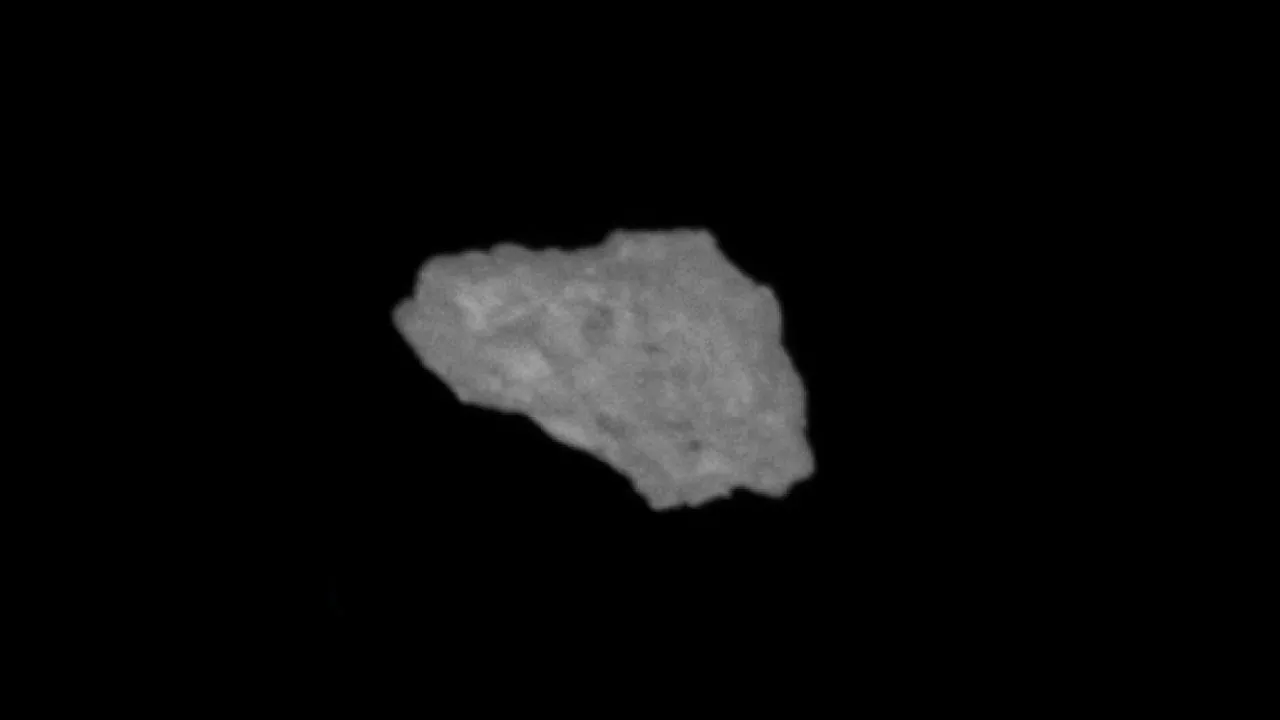
China’s Tianwen-2 probe beamed home the first photo of its asteroid target, Kamo'oalewa (2016HO3), on July 2. The image confirms a small 16-20m object and sets up a near-year science campaign before Tianwen-2 attempts to collect and return a surface sample to Earth.
China has released its first-ever photo of an asteroid it’s trying to sample, and it’s of the oddly named “quasi-moon” Kamo'oalewa, also cataloged as asteroid 2016HO3. According to China’s Xinhua news outlet, the Tianwen-2 probe took the picture on July 2 at a safe distance of about 12 miles (20 km) from the target, after traveling roughly 620 million miles (1 billion kilometers) to get there. The image shows a small, asymmetrical rock measuring around 50-65 feet (16-20 meters) in diameter. That size detail matters more than it sounds, because a mission to a small, lopsided object is a different engineering problem than a quick flyby. It also immediately raises the stakes for what happens next: nearly a year of scientific observation, followed by an attempt to collect a sample from its surface and send it back to Earth.
The “safe distance about 12 miles (20 km)” and the fact the photo shows Kamo'oalewa’s shape are not just astronomy trivia. They are the first public checkpoint in a mission that is explicitly about sampling, which means landing decisions, sampling mechanism performance, navigation accuracy, and surface interaction all have to line up. Tianwen-2 launched on May 28, 2025 atop a Long March 3B rocket from Xichang spaceport in southwestern China, and the spacecraft’s look was not revealed until it was 1.8 million miles (3 million km) away from Earth, just over a week past launch. Now, with the July 2 image on the record, Tianwen-2 effectively moves from “mission concept” to “mission reality,” and that reality is a small asymmetrical target you can see.
To understand why Kamo'oalewa is such a big deal, you have to understand what “quasi-moon” means. Quasi-moons, or quasi-satellites, are small bodies that circle the sun on orbits that keep them close to our planet. Earth has at least seven known quasi-satellites, and the planet’s gravity can temporarily capture additional objects before flinging them back out into orbit around the sun. In general, the orbits of these quasi-moons are less stable than the orbits of true moons. That instability is part of why they’re interesting to scientists, but it also helps explain why they can be tricky targets. A near-term, temporary dynamical relationship is not the same thing as a stable, predictable companion orbit.
Kamo'oalewa is also interesting because its origin is not settled. Some scientists believe it could have formed when a massive impact knocked a chunk of our own moon into space between 1 million and 10 million years ago. A 2024 study published in Nature Astronomy proposes a more specific version of that story: Kamo'oalewa could be material ejected from the moon by the impact that formed the Giordano Bruno crater. Tianwen-2’s sample would be the kind of evidence that turns a “could be” into data. In other words, the mission is not just about collecting rock. It’s about testing whether Earth’s gravitational neighbor is actually related to Earth’s own history, via lunar ejecta.
For executives and investors watching space programs, this is where the second-order implications kick in. Tianwen-2 is China’s first-ever asteroid sampling attempt, and it joins a small club already proven by Japan and the United States. Japan’s Hayabusa executed the world’s first asteroid sample return mission when it sent material from asteroid 25143 Itokawa back to Earth in 2010. The United States accomplished the feat in 2023 with OSIRIS-REx, which snagged material from asteroid Bennu. Those samples already produced surprising scientific data, including the fact they contain amino acids vital for life here on Earth. That line from amino acids to “what it means for scientific understanding of origins” is exactly why governments keep funding sample-return missions and why boards pay attention: sampling is slow, expensive, and failure-prone, but the payoff can be outsized.
China is also not starting from a blank page in planetary exploration. Tianwen-2 is described as China’s second planetary exploration mission overall, after Tianwen-1, which saw an orbiter and a rover reach Mars in 2020. More Tianwen missions are in the works, including Tianwen-3, a Mars sample-return mission planned for 2028, and Tianwen-4, slated two years later to study Jupiter and Uranus. For leadership teams, the continuity matters: if Tianwen-2 succeeds, it reduces perceived program risk for the next mission in the series, because it demonstrates not just launch and cruise, but proximity operations and the core sampling chain. If it stumbles, the lessons still inform the pipeline, but the credibility hit can be real in a sector where timelines and reliability are everything.
And there’s a practical, operational clock ticking in the background. After the July 2 photo, Tianwen-2 will spend nearly a year studying Kamo'oalewa with a suite of 11 different scientific instruments before attempting to collect a sample from its surface. That schedule turns the near term into a monitoring phase for anyone tracking the mission, because the public evidence of progress will likely come through additional instrument results and operational milestones. For peer programs, the strategic stakes are straightforward: demonstrated capability in asteroid sampling is a technical moat. It signals mastery of rendezvous, navigation, surface contact, and return planning. In the same way that telecoms or cloud providers compete on reliability metrics, space sample-return programs compete on their ability to do the hard parts, in the right order, under real constraints.
This story's Key Insights and Take-aways are locked.
Create a free account to unlock Executive Actions for one credit.
Register to UnlockAlways free for Executives Club members. Join the Club
More in Science

Alaska's 1,580-foot tsunami had warning signs. Scientists just found them.
Rapid glacier retreat, heavy rainfall, and thousands of tiny tremors preceded Alaska's 1,580-foot tsunami, a warning for every coastal community in a warming world.

The rare mutation that lets high-risk brains dodge Alzheimer's
Scientists found a natural defense against protein buildup, opening a new path to preventive treatments.

3,000 steps a day may halve Alzheimer's decline, study finds
New research links a modest daily walk to less tau buildup and nearly half the cognitive and functional decline, even for those with early signs.