
Timothée Chalamet says Dune 3 felt like “losing a part” after 3 years as Paul
In a Dune 3 Q&A, Chalamet explains the trilogy’s ending emotion, while Denis Villeneuve hypes what he created.
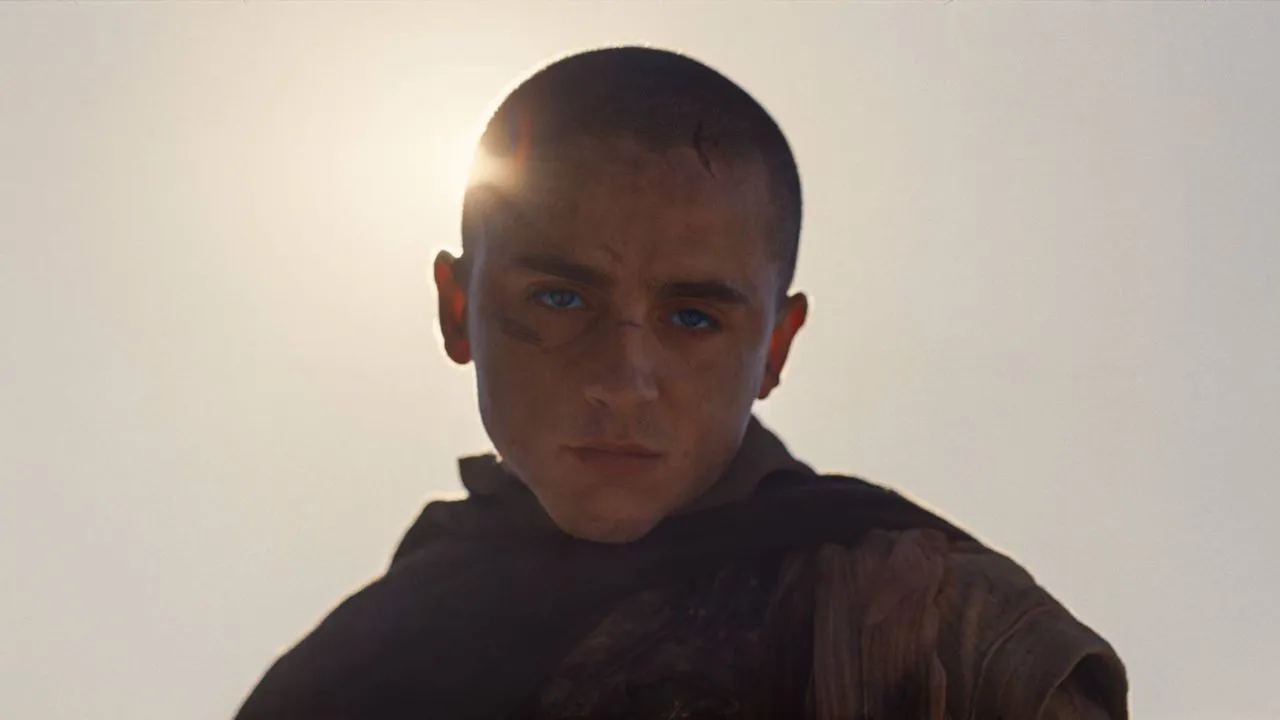
Timothée Chalamet, starring as Paul Atreides in Dune 3, told a fan Q&A he felt a personal finality as filming wrapped. Denis Villeneuve also teased how Chalamet’s arc evolves across the trilogy, as Dune 3 hits theaters December 18, 2026.
Timothée Chalamet just delivered the kind of actor confession that tells you Dune 3 is not only a franchise event, it is a personal one. In a fan Q&A with Denis Villeneuve, Chalamet said filming the final movie felt like “losing a part” of himself. He wasn’t talking about abandoning the character on paper. He was describing what it felt like to spend so long living with Paul Atreides that letting the whole exercise end came with real melancholy.
Chalamet anchored that feeling in the timeline of the work itself. He said he shot the trilogy “even though I was 29 when we shot this.” Still, he described a sense of finality, saying “I still felt like I was losing a part of me by getting through it,” and that he felt “melancholic” moving on from “this incredible family, incredible crew.” He also framed it as deeply personal and emotive, telling fans, “This was the most emotive, on a personal level,” and adding pride in living with the role and working with Denis Villeneuve and the “family” around the production.
Why does this matter beyond the feels? Because big studio and streamer-era economics often treat franchises like machines. But even when the business model is engineered for predictability, the craft is still human. Chalamet’s comments are a reminder that A-list attachment is not just marketing fuel. It is a signal to decision-makers about the seriousness of the creative process, the stability of talent commitments, and the likelihood of an experienced lead delivering a performance that has meaning to the audience.
Villeneuve’s role in the Q&A underlined that point by zooming out to the character arc. He told the audience he is “really looking for you all to see what Timothée did in this film,” calling it “really impressive.” Then he mapped a clean evolution: in the first movie, Chalamet’s character is “like, a boy discovering a planet.” In the second, the story becomes “someone becoming an adult.” And now, Villeneuve said, “he creates something very special.” That phrasing is important because it frames Dune 3 as an arc-completion film, not simply a continuation. When audiences show up for a third installment, they tend to demand closure and consequence, and directors know that emotional payoff is part of box office arithmetic.
There is also a practical industry angle embedded in Chalamet’s framing. He said the final film felt like an ending to an ongoing lived experience, and he described nostalgia for “living the moment.” Translating that into business terms: long-running productions build momentum through relationships and routines. When those end, talent often experiences a drop in daily creative adrenaline. That can influence post-production advocacy, awards campaign energy, and promotional availability. In other words, what an actor says about “moving on” can hint at how fresh the energy will be once the movie launches and the marketing cycle begins.
Chalamet’s recent awards story adds another layer. The actor “lost out on an Oscar last year for his role in Marty Supreme.” That is not a prediction, but it is a context hook for executives tracking talent value. Awards performance can affect how producers and distributors prioritize future casting, how agencies negotiate, and how investors assess brand strength. If Dune 3 becomes a breakthrough moment, it can reinforce the thesis that Chalamet is a performance-led star who carries prestige as well as opening-week traffic.
Then there is the release chessboard itself. Dune 3 arrives in theaters on December 18, 2026, “the same day as Avengers: Doomsday.” Pairing a prestige sci-fi epic with a major superhero tentpole on the exact same date is not a casual scheduling choice. It forces stakeholders across marketing, distribution, and talent management to think in terms of audience splitting, momentum windows, and how quickly word of mouth can build before competing headlines steal attention. For Chalamet, the stakes are unusually personal and unusually public: he is wrapping a defining role and stepping into a release landscape where attention is scarce and choice is crowded.
For peers, boards, and investors watching these kinds of events, the headline takeaway is simple: emotional authenticity and narrative closure are not just artistic outcomes. They feed into the confidence system that surrounds franchise decisions. When a lead actor says the experience ended with him feeling like he was “losing a part” of himself, it suggests the production delivered something that stuck. That stickiness can matter at scale, whether you are underwriting production budgets, planning release strategy, or evaluating how a third installment lands when it has to close the loop and earn the next one.
This story's Key Insights and Take-aways are locked.
Create a free account to unlock Executive Actions for one credit.
Register to UnlockAlways free for Executives Club members. Join the Club
More in Entertainment

12TB Steam 'teraleak' goes beyond Valve: GTA 3, Mafia 2 prototypes exposed
A 12-terabyte dump of Steam data reveals prototypes and builds of third-party classics like GTA 3 and Mafia 2, plus unreleased Valve content, rewriting game history.

LinkedIn's romance problem: 1 in 4 workers say dating on it is fair game
A new survey shows a quarter of U.S. employees treat the professional network as fair game for romance, even as LinkedIn bans it and removes hundreds of thousands of offending posts.

Enhypen's first No. 1 album breaks K-pop's Billboard 200 streak
The K-pop group's 98,000-unit debut tops the chart while Dolly Parton's catalog reentry shows how death reshapes streaming.