
Trionda ball’s new grooves may cut extreme distance at World Cup pace
Adidas’ 2026 World Cup ball reduces the “drag crisis” but can still shave meters off long kicks.
Researchers testing Adidas’ Trionda in a wind tunnel found it may reward clean technique while slightly punishing extreme distance. For teams and decision-makers, that means training, strategy, and equipment familiarity now matter even more.
This month’s World Cup ball, Adidas’ Trionda, is built for improved predictability in flight. But the physics team behind the testing says long-distance kicks might not go as far as in past tournaments. In wind-tunnel experiments, the research found that Trionda “may very slightly punish extreme distance, but it should reward clean technique and predictable flight,” according to John Eric Goff, who researches sports physics and is an incoming professor of engineering practice at Purdue University.
So what’s actually changing? Trionda uses four red, green, and blue panels with deep grooves, plus maple leaf, green eagle, and star emblems representing the three host countries. In the team’s analysis, that added texture delays the so-called “drag crisis” to the slowest speed since 2010. The catch is that Trionda’s drag coefficient is also higher than other recent balls at high speeds, meaning even if the dramatic behavior shift happens later, the ball can still slow down faster during the faster portion of its flight.
To understand why executives, coaches, and equipment planners should care, you have to know what the “drag crisis” is in plain terms. Air resistance is usually summarized by a drag coefficient. For smoother balls, there’s a sudden transition point where drag increases sharply. That transition makes a ball lose speed faster and can lead to less predictable trajectories. Goff’s explanation is rooted in a comparison sports fans already understand: golf balls have dimples, and baseballs have those “nice 108 double stitches.” Rough features move the transition to a smaller speed, which typically improves distance and predictability.
This is exactly why the World Cup ball design story matters beyond aesthetics. Adidas has been redesigning World Cup balls for each tournament since the 1970s, with both visual and structural changes over time. Some early changes were primarily aesthetic, like 1986’s Aztec temple graphics for Mexico and 1994’s space graphics for the moon landing’s 25th anniversary. But there were also structural differences, including upgraded foam cores and improved water resistance. For decades, the core design centered on a 32-pentagonal panel pattern stitched together.
That stitching story gets interrupted in 2006. Adidas introduced the +Teamgeist ball with just 14 curved panels, thermally bonded rather than stitched, to help keep moisture out so the ball wouldn’t grow heavier throughout play. Goff says the research he began in the years since was driven by the idea that “transformations” in surface texture and panel count can be significant enough to affect gameplay.
The current research builds on a long-running experimental framework. Goff and colleagues have analyzed the in-flight behavior of World Cup balls consistently at the University of Tsukuba in Japan, using a wind tunnel. The method attaches the ball to a metal rod connected to a force balance that measures aerodynamic forces such as drag and lift. The team exposes the ball to the same wind speeds a soccer ball would see in a real game, seven to 35 meters per second. They test different orientations too, though there are practical limits: each new test effectively destroys the ball because the Trionda is $170.
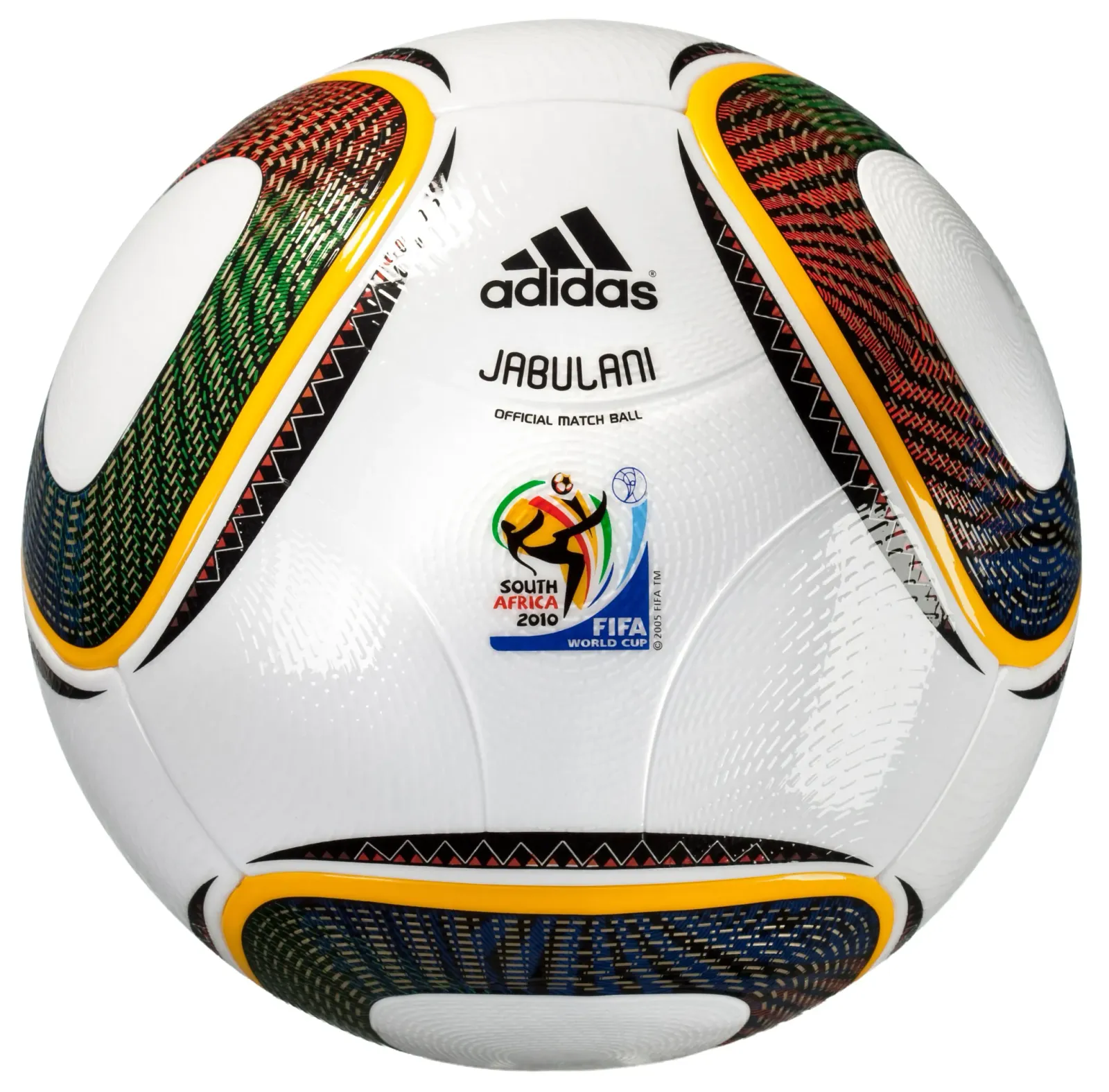
Design-wise, the comparison set matters. The 2010 Jabulani ball had eight panels and a smooth texture, and it faced significant criticism from players, especially goalkeepers, who described a deceptive trajectory that “dipped wickedly,” as one player told the Guardian. The analysis attributes Jabulani’s key flaw to smoothness: its drag coefficient stayed relatively low at high speeds, but once the ball slowed to a certain point, the coefficient ratcheted up and the ball lost speed quickly. The transition called the drag crisis occurred at higher speeds for smoother balls.
Adidas’ later designs shift that transition. The 2014 Brazuca had only six panels, but its total seam length was much longer, adding more roughness. This year’s Trionda has just four panels, but each panel has three deep grooves designed for texture. Goff and his colleagues found that Trionda experiences the drag crisis at the slowest speed since 2010, which should make the most dramatic behavior shift happen at lower velocities. That is the part that supports predictable flight and potentially longer carry for typical play speeds.
But the boardroom-friendly implication is the trade-off. More texture delays the dramatic transition, yet Trionda’s drag coefficient is higher than other balls at high speeds. Translation: during the faster portion of a kick, it may still slow down faster than recent predecessors. Goff’s bottom line is that the trajectories of long kicks may be a few meters shorter.
For teams, this isn’t just a trivia item. The upcoming World Cup runs in the US, Canada, and Mexico, and Trionda’s panel emblems are built to reflect those host countries. More practically, players should have had time to adapt, because the ball has been available for at least a few months. Goff also notes Trionda’s design similarity to Nike’s Flight ball, so players with more time on that ball may already have an advantage.
Finally, for decision-makers thinking about equipment validation and the credibility of testing, there’s an important institutional layer. Adidas does perform its own unpublished tests of each new ball, and 5-year testing process included robotics designed to kick the ball at specific speeds and testing in seven of the 16 host locations. The researchers meanwhile keep sending papers to FIFA and Adidas in hopes of informing external testing, and Goff says he’s been sent balls by Adidas in the past.
So the strategic stakes are straightforward. If your scouting and game plans lean heavily on long-distance shooting and clearance passes, you should expect a ball that is engineered to be more forgiving on clean technique but potentially less generous on maximum range. That’s the kind of quiet physics adjustment that can ripple through shot selection, defensive clearing habits, and goalkeeper expectations on the biggest stage.
This story's Key Insights and Take-aways are locked.
Create a free account to unlock Executive Actions for one credit.
Register to UnlockAlways free for Executives Club members. Join the Club
More in Entertainment

Entertainer Russell Brand denies 7 sex charges amid accuser's 'couldn't breathe' claim
The alleged victim's account sharpens the reputational and legal stakes for Brand, his platforms, and any business tied to a public figure under criminal scrutiny.

Russell Brand's accuser 'bewildered and confused' as he denies 7 sex charges
The criminal case against the comedian is a live test of how media companies manage talent risk when serious allegations go public.

'It's a Magic Trick': Ballet Experts Say Rosalía's SNL Pose Is Impossible
Three ballet experts tell Rolling Stone Rosalía's gravity-defying SNL stillness shouldn't be possible - and why the debate is now part of the show.