
Trump’s 2025 $2.2B income haul reignites “big player theory” risk for markets
When a president’s disclosures move prices more than fundamentals, executives get a new type of uncertainty: policy-as-signal.
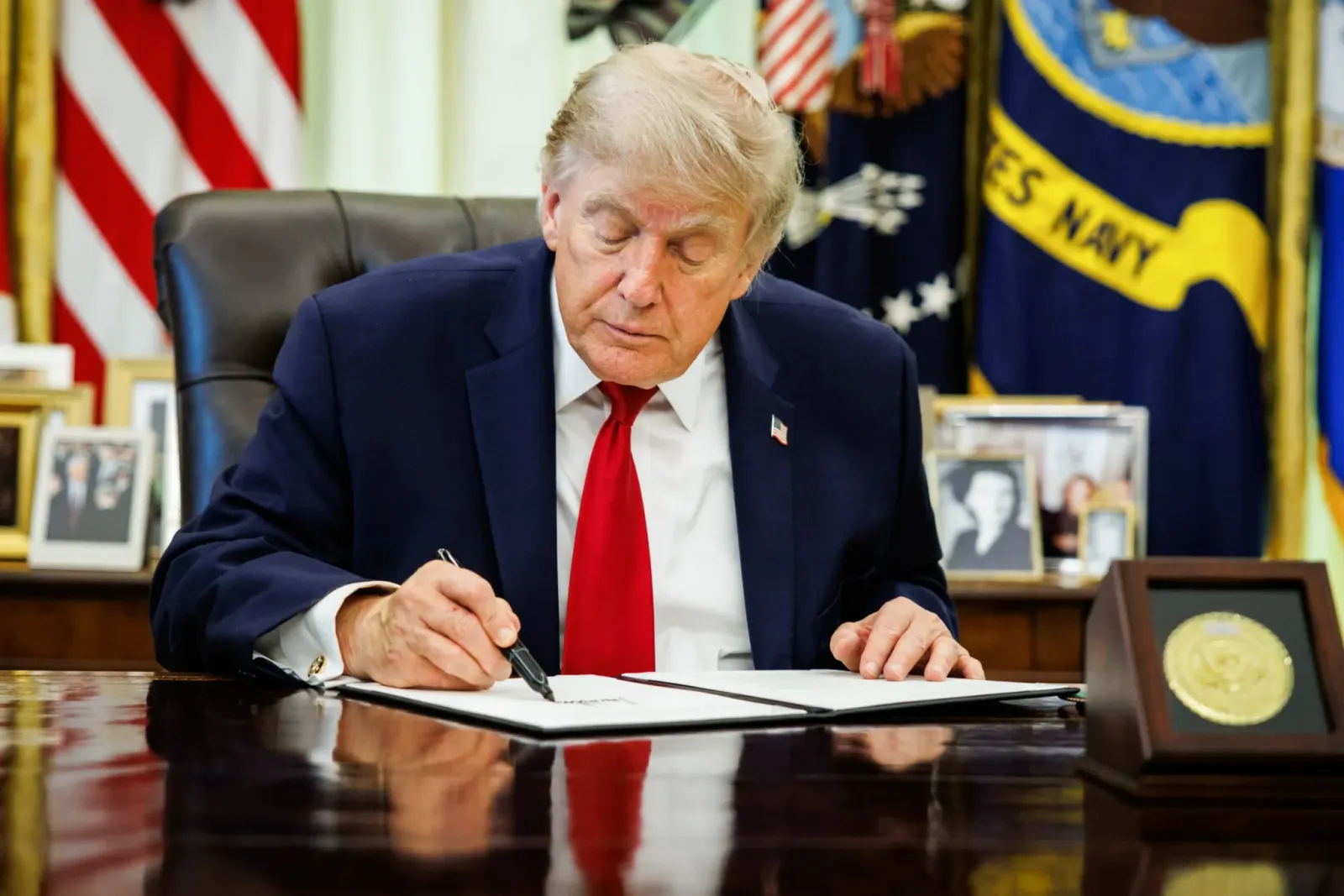
Fortune reports that President Trump disclosed a $2.2 billion personal income haul for 2025, including roughly $1.4 billion from crypto assets, according to White House disclosures. Economists trace the pattern to “big player theory,” arguing that discretionary actors can corrode expectations and create “noise trading” conditions.
President Trump’s reported 2025 personal income haul is $2.2 billion, with roughly $1.4 billion tied to crypto assets, according to White House disclosures reported by Fortune. And the unusual part is not the sheer size by itself. It is how closely the outcome resembles what economists call “big player theory,” where market moves can start to depend on who is signaling and when, not on underlying fundamentals.
Steve Hanke, the Johns Hopkins economist Fortune calls the “Money Doctor,” says the moment he saw the disclosure he “flashed onto the economics of big players.” Hanke’s core claim is that we are in “a new era” where a central planner is no longer just a background constraint. A “big player,” in his formulation, can be a central bank head, a finance minister, or a president “big enough to independently move supply, demand, and market expectations.” When that happens, the market’s usual discipline gets weaker, because the signals become harder to interpret as rational information and easier to treat like the start of a herd move.
So what exactly is “big player theory,” and why are economists digging into it now? Fortune reports that both Hanke and Robert Koppl, the Syracuse University professor who originated the theory decades ago, describe three characteristics of the phenomenon. First, the actor is big enough to shift markets. Second, the actor is not disciplined by profit and loss the way ordinary firms are. Third, the actor operates by discretion rather than any knowable rule. Koppl’s line is blunt: a big player “introduces personality into markets,” and that “corrodes our ability to form reasonable expectations of the future.” Translation: when the dominant actor can act unpredictably, price discovery can start to feel less like math and more like mood.
Koppl argues the Trump episode is not an isolated quirk. It is an endpoint after decades of erosion, with a distinct American lineage. He traces two foundational ruptures to 1971. The first was Richard Nixon’s engineering of a federal bailout of Lockheed, the moment the government signaled it would rescue a politically significant corporation from consequences of its own failure. The second was Nixon’s decision to sever the dollar’s final link to gold by closing the “gold window,” removing a constraint that had limited U.S. monetary policy since Bretton Woods. Without that anchor, Koppl argues there was “no gold snapback on the money supply,” meaning the old mechanism that would have punished excess credit by draining reserves no longer applied. Remove both the monetary constraint and the market constraint in the same year, and the system becomes freer for government intervention and for large firms to take on risk.
From there, Koppl points to the “too big to fail” handling of Continental Illinois in the early 1980s, and then, after the 2008 crisis, the shift to “too big to jail” under Attorney General Eric Holder, which he frames as reluctance to bring serious criminal charges against major financial institutions. He also highlights a bipartisan habit of expanding presidential discretion. When Barack Obama said, “I have a pen and a phone,” Koppl reads it as an articulation of presidential power independent of congressional rules. Each administration, in Koppl’s account, extended the range of action a president could take alone. Trump then “elevated the level of big player intervention to a new high,” which Koppl calls “very unfortunate.”
Hanke offers the mechanism that connects discretionary power to trading behavior. Once a big player enters the scene, Hanke says signals about market fundamentals become unreliable, and traditional valuation work, like discounting free cash flow, gives way to what Fischer Black called “noise trading” back in 1986. Noise trading is driven by rumors and hype rather than fundamentals, and it produces herding, the bandwagon effect. That’s why Hanke compares it to Charles Mackay’s 1841 bubble classic, Extraordinary Popular Delusions and the Madness of Crowds, including famous panics like the tulip bubble and the South Sea bubble. In this view, the key problem is not just speculation. It is that discretionary policymaking can “divert entrepreneurial activity and attention away from economic fundamentals … and towards politics and how they might affect market sentiment.” When the market’s scorekeeping changes, skill gets devalued and luck gets paid. Even money managers, judged on relative rather than absolute performance, can end up joining the herd because if everyone drops together, fewer people get fired for being wrong.
Fortune also notes other observers have seen big player behavior in earlier episodes, such as an Iran strike occurring 33 minutes after a Friday market close, apparently timed to avoid rattling investors before the weekend, followed by markets calming again after Sunday reports of renewed diplomacy. There has also been scrutiny around outsized trades executed just ahead of Trump’s Truth Social posts on Gulf oil policy, potentially raising insider trading questions. In that same pattern, Koppl argues the latest $2.2 billion disclosure, particularly the crypto windfall, is consistent with a world where asset value depends on the big player’s actions and market timing rather than on underlying supply and demand for crypto services. Koppl says that “looks to be what happened in the Trump case,” that he was able to profit “in a way that had nothing to do with underlying supply and demand.”
Then comes the regulatory twist that makes executives pay attention, even if they are not trading crypto. Fortune frames the legal environment via Eric Talley, a Columbia Law School professor, who says the difference from historical precedent is the near-total legal accountability vacuum around the presidency itself. In other words, Trump’s huge income haul in 2025 is “not technically illegal.” Talley points to a federal statute, 18 U.S.C. § 208, that generally bars executive officials, including Cabinet members like Marco Rubio or Pete Hegseth, from participating in matters where they hold financial interests. But Talley emphasizes that the criminal prohibition explicitly exempts the president and vice president. Fortune reports Talley’s view of the likely rationale: to allow a president to act decisively in a crisis without conflict-of-interest reviews slowing action. At the same time, he argues the statute “provides an exception you could drive a truck through” if a president does not commit to being “squeaky clean.”
For decision-makers, the second-order consequence is that this kind of environment can turn markets into a polling device. When expectations are corroded and signaling depends on a big player’s discretion, companies that rely on policy stability for planning face a higher variance world, where “noise trading” can dominate short- and medium-term price signals. If you are a board, a CFO, or a founder underwriting strategy, the stake is not just whether prices move. It is whether the information in those moves still maps to fundamentals you can control.
This story's Key Insights and Take-aways are locked.
Create a free account to unlock Executive Actions for one credit.
Register to UnlockAlways free for Executives Club members. Join the Club
More in Business

Comcast shares jump 25% as it plans to split NBCUniversal and Sky
The tax-free spin-off could reshape focus, funding, and competition across media and tech for years.

Bungie cuts most Destiny 2 staff as Sony says Marathon still matters
Herman Hulst confirms layoffs affecting most Destiny and some Marathon teams after Bungie admits Destiny fell short.

SK Hynix jumps 11% after seeking up to $29.4B in Nasdaq listing
The chip giant filed for a Nasdaq listing plan that could raise $29.4 billion, instantly reshaping investor expectations.