
Ukraine’s 4th Ranger Regiment trains “watch the sky” trench assaults as drones surge
Operators keep pairs moving while one soldier constantly scans overhead for drones and engages them fast.
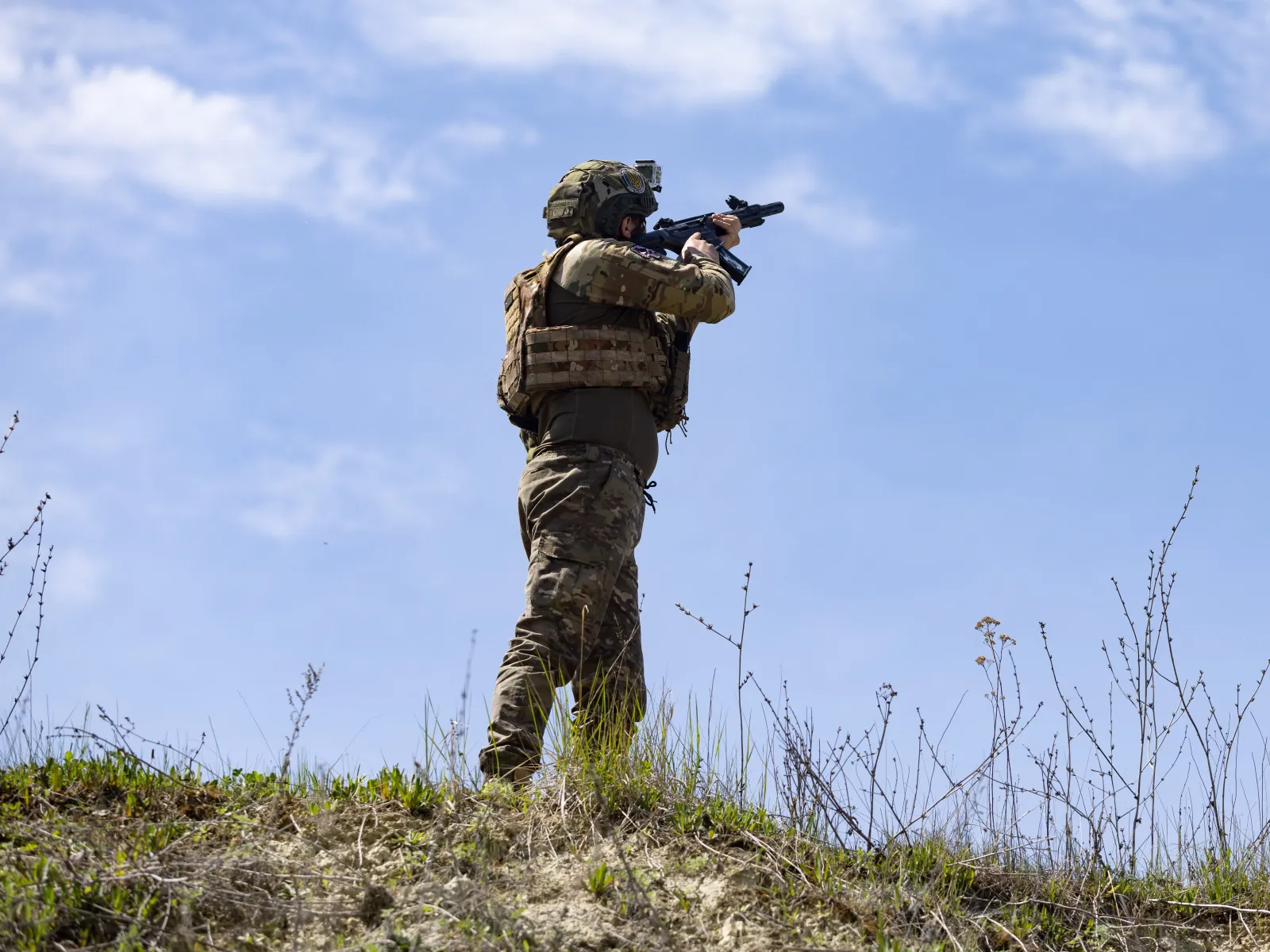
A Ukrainian special operations operator from the 4th Ranger Regiment told Business Insider that training has changed as drones proliferate. The consequence is that drone defense and small-group infiltration have become core to trench-clearing tactics.
Ukraine’s elite special operators are telling their teams something simple and hard to ignore: “Someone always has to be watching the sky.” In an interview with Business Insider, an operator in Ukraine’s 4th Ranger Regiment of the Special Operations Forces said their training has shifted because drones are now everywhere on the battlefield.
The core change is blunt. “Our training has changed,” the operator said. “We’ve started using [uncrewed aerial vehicles] more, and we pay much more attention to countering drones.” He also described how Ukrainian units constantly train to infiltrate “in small groups,” with one person assigned to watch overhead while others clear and cover. The operator, who requested to be identified only by his call sign “Gur,” said this is done for security reasons.
Why this matters beyond the battlefield is that drones have turned trench fighting into a moving logistics and training problem, not just a firefight problem. Business Insider reports that the front line across southern and eastern Ukraine has become what soldiers and officials describe as a “kill zone,” an area heavily saturated with drones that can target anything that moves, from people to vehicles. The kill zone varies in width, but it typically extends roughly 10 to 20 kilometers from the line of contact. Ukrainian officials have said it is expanding, forcing commanders to keep adjusting tactics as the danger envelope grows.
For the 4th Ranger Regiment operator, the training shift is two-part: integrate drones into exercises, and build countermeasures into movement. Gur said Ukrainian drone pilots participate in training exercises. Operators will keep an eye out for threats from above, engage “enemy” drones, cover soldiers beside them, and seek shelter. If the focus is on movement, they practice concealment and cover, and once the drone passes, they keep walking. In other words, the sky is no longer background noise. It is a live targeting channel that dictates when a team pauses, how it staggers, and who covers whom.
This is also where the “trench clearing” playbook looks less like a straight line toward the objective and more like a choreography designed around drone detection and survival. Gur described a scenario where a four-person group needs to clear a trench. They move in teams, with each pair assigned complementary roles. In each pair, the first soldier keeps a gun pointed toward the trench, while the second soldier trails a few meters behind, scanning the sky. If a Russian drone is spotted, they open fire. Gur said this can be done with either a standard rifle or a pump-action shotgun.
The shotgun detail is not just gear trivia. Business Insider adds that Ukrainian soldiers have described pump-action shotguns as an ideal, last-resort defense against first-person-view (FPV) drones, particularly fiber-optic drones that cannot be jammed with electronic warfare. That distinction matters because it changes what “countering drones” looks like in practice. If some drone types resist common electronic interference, then the tactical toolkit has to include physical and immediate defense choices, not just spectrum-based countermeasures.
Gur also explained how the team coordinates when they reach the trench. The second duo covers for the first until they reach the trench and begin clearing it. Then the first duo calls the second pair to move forward. When all four soldiers are together, at least one of them is watching the sky. If they split into pairs, one soldier works in the trench while the other helps him and watches the airspace above them. When they leave the trench, the first soldier watches the ground and the horizon, while his partner watches the sky. Gur summed it up with the line that frames the whole story: “Someone always has to be watching the sky. It has to be done constantly.”
Zoom out one more layer and the second-order implication becomes obvious: drone density forces specialization in training, and that specialization cascades into how small units organize, how they rehearse, and how they move under uncertainty. Business Insider notes that trench warfare in Ukraine has drawn comparisons to World War I, but drones and robots give it a futuristic twist, making an already difficult mission much harder. In that environment, tactics are updated under pressure, not after-the-fact. Commanders are dealing with an expanding kill zone, teams that must adapt in real time, and training pipelines that increasingly include drones, counter-drone actions, and last-resort weapons options.
For executives, founders, investors, and operators tracking defense-adjacent tech, the takeaway is not the particular unit or call sign. It is the direction of travel: training is becoming drone-native, and “countering drones” is moving from a specialized afterthought into the default muscle memory of how teams infiltrate, clear, and exfiltrate. When one part of the battlefield is constantly watching overhead, everyone else has to design for that reality. The strategic stakes are whether systems can scale faster than threats can proliferate, and whether organizations can keep their people effective in environments where the sky is treated like another contested piece of terrain.
This story's Key Insights and Take-aways are locked.
Create a free account to unlock Executive Actions for one credit.
Register to UnlockAlways free for Executives Club members. Join the Club
More in Politics

LA County: DOJ's 20,000 'noncitizen' voter list is 'unreliable,' includes U.S.-born
Preliminary review by Los Angeles County election officials finds errors in the federal list, raising the stakes for voter roll integrity ahead of November.

Trump's $1.5B Pentagon chip investment lands in North Carolina
A $1.5 billion defense infusion for North Carolina chipmaking signals a new era of Pentagon-backed reshoring - here's what it means for the industry.

Nigeria confirms first Ebola case in Abuja, a woman just off a Uganda flight
Health Minister Muhammad Ali Pate says the patient flew in from Uganda, putting Africa's latest outbreak on Nigeria's doorstep.