
Verizon Fios doubles down: a new 5Gbps plan replaces its 2Gbps flagship
The residential fiber speed jump changes how carriers pitch value, build networks, and pressure competitors to follow.
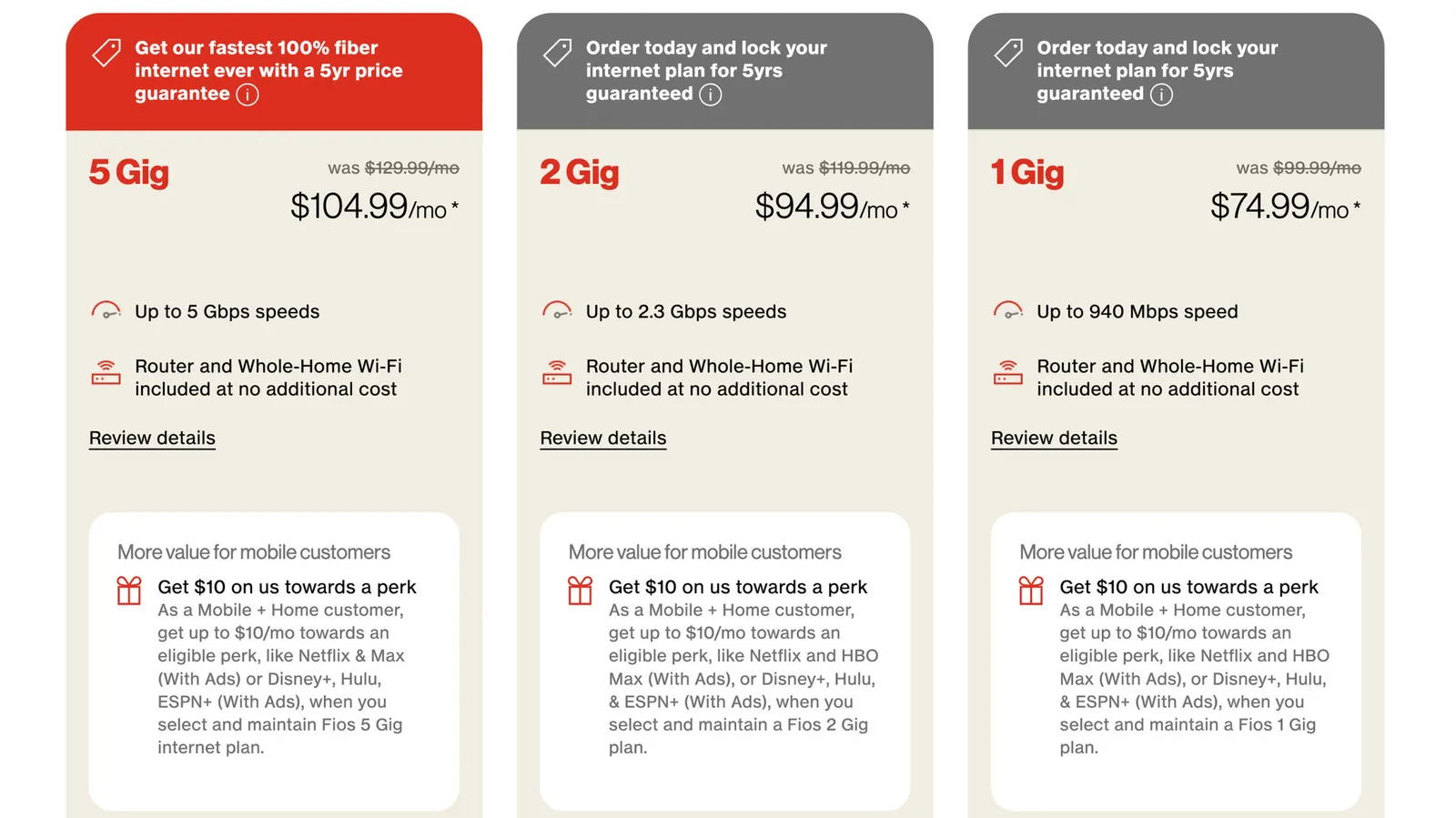
Verizon Fios has introduced a new 5Gbps home plan, positioning it as its fastest offering. The new tier is more than twice as fast as its previous flagship 2Gbps plan.
Verizon Fios just turned its residential speed dial to 5Gbps, and the move matters because it is not a minor upgrade. It is a clean statement to the market: the carrier’s previous flagship 2Gbps plan is now the “old top speed,” replaced by a new fastest tier that is more than twice as fast.
That headline number is the whole story. The new Fios 5Gbps home plan is designed to deliver over 2x the speed of the prior flagship 2Gbps plan, and this is the kind of tiering shift that ripples beyond a single product page. When a provider pushes the top end of its consumer broadband offering, it is effectively resetting expectations for what “fast” means at the high tier, and it forces competing offers to either respond with comparable speed claims or justify why their lower numbers still deliver the experience customers want.
To understand why decision-makers should care, zoom out to how fiber broadband markets typically work. Residential plans are not just about theoretical throughput. They are bundles of capacity, engineering reality, and marketing simplicity. When you introduce a faster tier, you are telling customers that the network is ready to support more demand per household. You are also giving your sales and retention teams a stronger ladder to climb when competing at the high end. In practice, carriers use speed tiers as a pricing and packaging tool: higher throughput can support higher price points, and it can also create upgrade paths that reduce churn when competitors offer promotions.
There is also a regulatory and operational backdrop that makes these moves more than pure marketing. In many broadband markets, regulators and policymakers have long focused on availability and performance, not just coverage. While the source here does not cite specific regulatory actions, it is still fair context that telecommunications oversight in the US tends to measure networks by their ability to deliver advertised service. Higher tiers increase the scrutiny on performance consistency. If a carrier sells 5Gbps, it is implicitly committing to delivering that experience reliably for customers who pay the premium. That means more than one internal team matters: network operations, performance monitoring, customer support, and billing systems that tie plan tiers to provisioning.
Then comes the competitive second-order effect. A 2Gbps flagship gets expensive and harder to defend once a provider announces a 5Gbps tier. Even if competitors are not physically identical in infrastructure footprint, the market still compares brand promises. Consumers and enterprise-adjacent households (home offices, streaming-heavy families, creators) often shop based on headline speeds, especially when they are choosing between two providers that claim fiber. The moment Verizon Fios adds a 5Gbps option, rival carriers face a new baseline: staying at 2Gbps as the top tier can make their offer look comparatively underpowered, even if real-world performance differences vary by usage.
For boards and leadership teams, this is also a competitive capital allocation signal. Rolling out a new top tier usually requires that the underlying access and aggregation capacity can support more demand without degrading service quality. That can entail equipment upgrades, capacity planning, and operational readiness work that takes time. Even when an announcement looks instant, the groundwork is typically months in motion. So the strategic signal is: Verizon Fios is not just sustaining the network, it is pushing it. That affects how investors and analysts will read the company’s network readiness and willingness to invest.
Finally, there is the “what do we do now?” question peers will ask internally. Verizon Fios has chosen to boost its fastest plan to 5Gbps, while its previous flagship sat at 2Gbps. Other broadband providers will likely look at how customers respond to the upgrade narrative, and whether that narrative leads to higher net adds, better retention, and more ARPU at the top end. In a market where churn can be driven by promotions and competitor incentives, improving the value proposition at the high tier is one of the most direct levers carriers have. It also raises the bar for marketing clarity: if customers believe 5Gbps is the new “baseline fastest,” then future competitors cannot rely on “we are fast” messaging. They have to compete with numbers.
Net-net: Verizon Fios introduced a 5Gbps home plan that is more than twice as fast as its previous flagship 2Gbps plan. That is a tangible product change with network, competitive, and commercial implications. If you are an executive in telecom, broadband, or any infrastructure-heavy connectivity business, this is a reminder that “fastest plan” is never just a marketing label. It is a competitive weapon and an operational commitment that other players must account for in their strategy, pricing, and investment timelines.
This story's Key Insights and Take-aways are locked.
Create a free account to unlock Executive Actions for one credit.
Register to UnlockAlways free for Executives Club members. Join the Club
More in Technology

Google quietly links your phone number to every Android account on your SIM
Adding a SIM now ties your phone number to all Google accounts - and future accounts inherit it. Here's the security and privacy stakes.

Hijacker AI 'Skynet mode' runs 100,000 attack steps against exposed models
Symantec caught a criminal AI agent that borrows other models, steals data, and mines crypto; the only relief is no confirmed victims yet.

Nvidia's AI-financier shift faces its first big test as neoclouds stumble
A rout in neocloud stocks is forcing investors to weigh Nvidia's hidden exposure as both supplier and lender to the AI buildout.