

Vikram-1 launches July 18 as Skyroot tests India’s first private orbital rocket
Watch Mission Aagaman at 11:30 a.m. IST from Sriharikota, and see who payloads and data say the rocket learned.
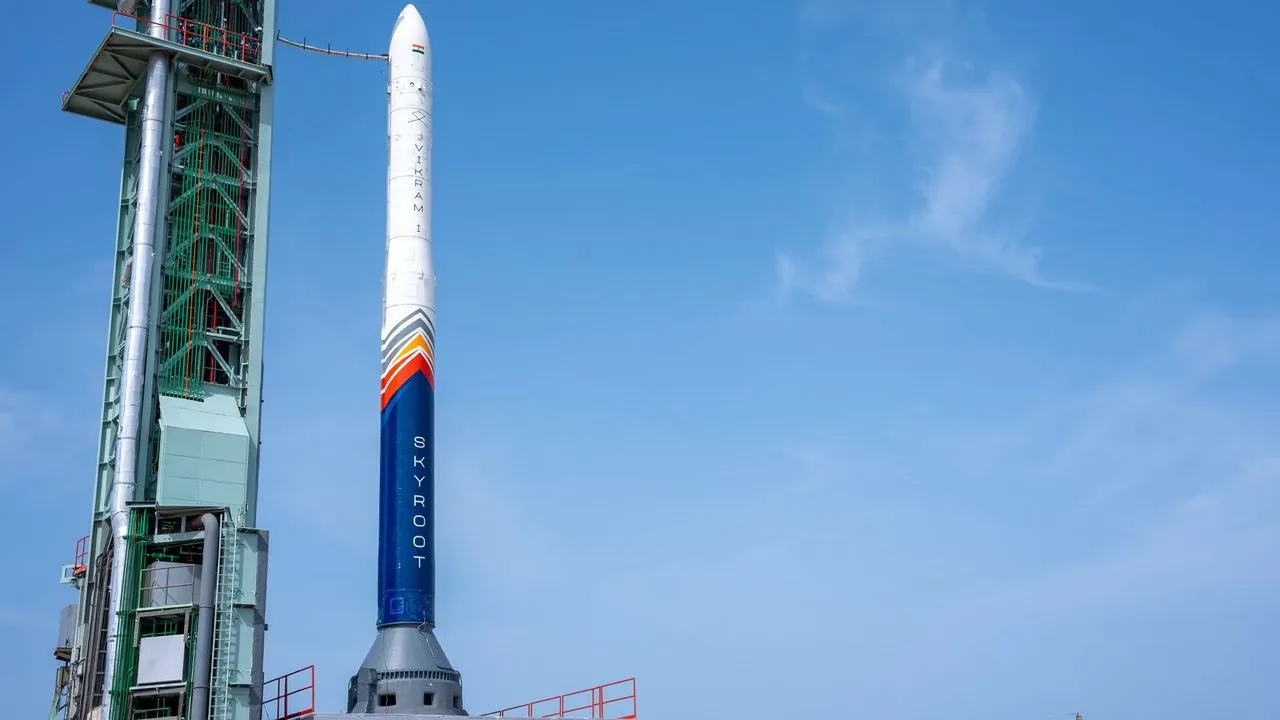
Skyroot Aerospace’s Vikram-1, India’s first privately built orbital rocket, is scheduled to launch early Saturday, July 18, on Mission Aagaman from Satish Dhawan Space Centre in Sriharikota. For executives, the flight matters because it is both a performance test and the first step toward on-demand small-satellite launches from India.
It’s July 18, 11:30 a.m. India Standard Time, and Skyroot Aerospace is about to find out if an Indian private rocket can do what the word “orbital” implies: reach space reliably, with real customer payloads hanging on the outcome. The company’s Vikram-1 launch is planned for 2 a.m. EDT (0600 GMT; 11:30 a.m. India Standard Time) from Satish Dhawan Space Centre at Sriharikota, on India’s barrier island. Skyroot says the mission will be streamed live via Skyroot starting around 12:45 a.m. EDT (0445 GMT), and Space.com will carry the feed if the company makes it available.
This is not just another rocket launch. Vikram-1 is Skyroot’s first-ever privately built Indian orbital rocket, and the four-stage, seven-story-tall vehicle is designed as a small-satellite launcher. According to the company, it can haul about 770 pounds (350 kilograms) of payload to low Earth orbit. The mission’s official goal is to test how Vikram-1 and its various systems perform during flight, and it’s also carrying payloads to be deployed at an altitude of 280 miles (450 kilometers) if all goes according to plan.
Skyroot is in Hyderabad and was founded in 2018. Its earlier milestone came four years later, when its Vikram-S suborbital rocket became the first private Indian outfit to reach space. That history matters because orbital rockets are where “we proved we can go up” turns into “we can reliably deliver.” Suborbital success can build credibility. Orbital performance is what opens doors to customers, repeat missions, and the kind of long-term contracts that turn one-off engineering wins into a launch business.
And Skyroot is pitching a business problem it thinks it can solve. In an emailed statement on Thursday (July 16), Skyroot Co-founder and CEO Pawan Kumar Chandana said the small satellite launch market is “deeply constrained on the supply side,” while demand for services enabled by satellites in space “will only continue to grow.” The company is effectively using Mission Aagaman as a commercial argument: it’s not just testing flight hardware, it’s positioning Vikram-1 as a path toward more frequent, on-demand orbital service for small payloads.
So what is actually on board? The flight includes a technology demonstration from the German company DCUBED, the Solaras S3 nanosatellite pathfinder from Indian startup Grahaa Space, and Embrace, a robotic arm built by the Indian company Cosmoserve Space that is designed to capture space debris. There is also Skyroot’s SCOPE satellite, which will collect a variety of data to help the company assess rocket performance during flight. In other words, the mission is built to generate learning that can be fed back into engineering, not just a one-time “did it launch” headline.
There are also two symbolic payloads, because sometimes space is serious engineering plus human storytelling. The mission includes a small 18-karat gold rocket from the artist Ajay Kumar Mattewada and “Cosmic Bloom,” designed by Cosmos Diamonds, a company that makes jewelry using lab-grown gems. These elements won’t determine orbital success, but they do reinforce a key point for a broader audience: India’s private space push is selling both technical capability and a wider cultural moment.
Skyroot’s leadership is framing the launch as a bigger milestone than a single flight. In the same statement, Skyroot Co-founder and Chief Operating Officer Naga Bharath Daka said: “What we are aiming to do on 18 July is bigger than a single launch. It represents the hopes and hard work of around 1,000 people, the contributions of over 400 suppliers, and nearly 3,000 days of resolve to build a global offering from India.” Daka added: “With the in-flight data gathered from this mission, we will return to the shop floor to learn, improve, and build further,” and called it “the first step towards creating a reliable, on-demand launch company for the world from India.”
For decision-makers watching from similar corners of the industry, the implication is straightforward: space markets reward reliability, and reliability comes from data. Mission Aagaman runs in a defined launch window through Aug. 4, which gives Skyroot some leeway if Vikram-1 is not able to fly as planned on Saturday. But the signal from this test flight will land immediately across the ecosystem, because it answers whether an Indian private orbital launcher can execute the dual job investors and customers care about most: performance under real-world payload load, and the kind of flight data that can tighten the odds next time.
This story's Key Insights and Take-aways are locked.
Create a free account to unlock Executive Actions for one credit.
Register to UnlockAlways free for Executives Club members. Join the Club
More in Business

Uber buys Delivery Hero for nearly $15B, vaulting to top food delivery outside China
The deal doubles Uber's dual-services footprint and pushes a ride-and-eats bundling play into 50 more markets.

Epic and Google drop settlement bid, forcing rival Android app stores by July 22
Google told the court it is ready to carry third-party app stores starting Wednesday, July 22.

SK Hynix opens at $170, raises $26.5B, and tops foreign IPO records
In Friday's Wall Street debut, SK Hynix turns AI RAM demand into a $26.5B fundraising moment that rewrites comps.