
VIVIFY’s Jason Herring pushes on-site hydrogen to cut food businesses’ grid dependence
The CEO argues on-demand hydrogen generation could let food operators power themselves, shifting resilience and cost risk off the grid.
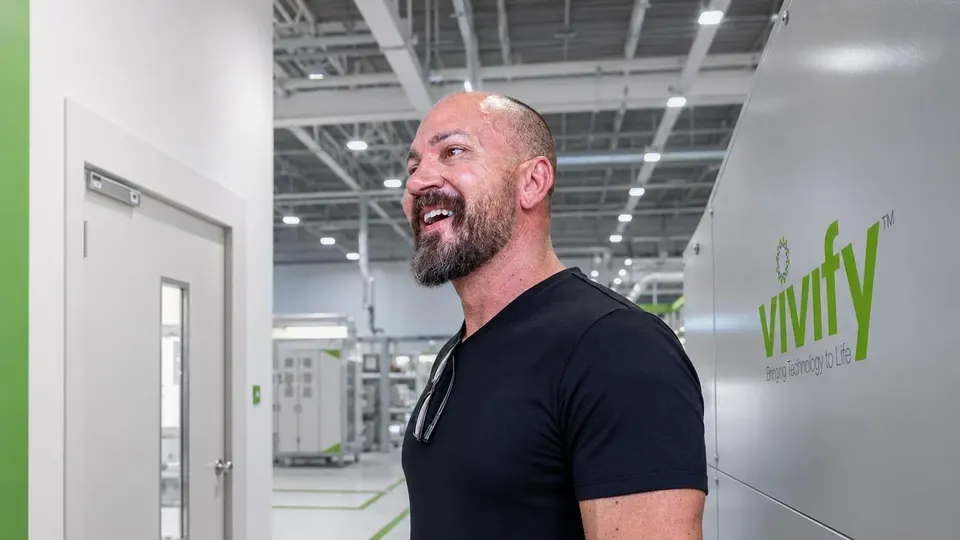
Jason Herring, CEO of VIVIFY Technology, says on-demand hydrogen generation could help food businesses generate power on-site. If the approach scales, food operators could reduce reliance on the grid and better handle power availability and resilience challenges.
Jason Herring, CEO of VIVIFY Technology, is pitching a very specific way to make food companies less dependent on the power grid. His claim: on-demand hydrogen generation could allow food businesses to generate power on-site, rather than relying on electricity delivered through the grid. For operators who run freezing, refrigeration, processing, and storage, that is not a marketing sentence. It is a resilience and continuity strategy, the kind that matters when grid reliability, pricing, or outage risk turns from background noise into a line item that hurts.
In plain English, the idea is to bring energy production closer to the facility that consumes it. If power can be produced on-site using on-demand hydrogen generation, then the facility does not have to wait for the grid to perform. Herring frames it as a reduction in reliance on the grid, which is the central stake: food systems that are less grid-bound can, in theory, keep running when electricity supply or cost becomes unpredictable.
This is also a moment where “off-grid” is no longer only a niche prepper concept. Energy and logistics are increasingly treated as operational systems, not just utilities. For food businesses, electricity is tightly coupled to equipment uptime. When power is constrained or expensive, the business does not just pay more. It experiences throughput limits, potential spoilage risk, and planning headaches across schedules and suppliers. Even for companies with sophisticated procurement strategies, the grid is still the bottleneck for many decisions.
Hydrogen sits at the center of a long-running energy debate, mostly because hydrogen can be produced from multiple inputs and used in different ways. In this case, the key feature Herring highlights is “on-demand generation.” That matters because the power value proposition changes when production is aligned with demand rather than depending on large-scale, always-on supply. On-demand generation can also reduce the friction associated with storage and logistics. The source does not provide technical specs, timelines, or performance metrics, but the strategic thrust is clear: use hydrogen as an on-site energy pathway that can be activated when the business needs power.
There is also a regulatory and policy backdrop to understand, even at a high level. Energy transitions usually move through a mix of regulation, incentives, and utility frameworks. In many jurisdictions, the grid is treated as essential infrastructure, and any shift away from it triggers questions about interconnection rules, safety standards, permitting, and how costs and responsibilities are allocated. While the source does not cite specific regulators or policy instruments, the broader reality for executives is that “on-site power” is rarely just a technology decision. It is also a compliance roadmap and a stakeholder map, involving facility safety, environmental considerations, and coordination with local authorities.
Second-order implications for boards and CFOs follow quickly when you think about the balance sheet. If a food operator can generate power on-site, it changes the shape of energy risk. Instead of being primarily exposed to grid price swings and outage events, the operator becomes exposed to the costs and reliability of the hydrogen system itself. That is a different risk profile. It can be beneficial if the system is dependable and cost-competitive, but it is not automatically a win. Executives will want to pressure-test what “on-demand” really means operationally, including how quickly power can be produced, what happens during system faults, and how maintenance affects uptime.
There is also a strategic signaling element here. A CEO claiming the ability to take parts of food systems “off-grid” is effectively arguing for a new operating model: energy procurement becomes less like buying a commodity and more like running an internal energy service. For investors and other operators watching, it signals where innovators believe leverage exists. The grid is still the default, but the direction of travel is toward more controllable, localized energy generation in critical sectors. Food is one of the most punishing places to experience disruption, because time equals waste.
For peers in similar roles, the question is not whether hydrogen is trendy. It is whether on-demand hydrogen generation can credibly change day-to-day operational economics and resilience in food facilities. Herring’s core message is that on-site hydrogen generation could help food businesses generate power on-site, reducing reliance on the grid. That is a bet on continuity and autonomy. If it holds up in real-world deployments, it could reshape how food operators think about uptime, energy contracting, and resilience planning, and it could move hydrogen from “future promise” into “systems you can operate.”
This story's Key Insights and Take-aways are locked.
Create a free account to unlock Executive Actions for one credit.
Register to UnlockAlways free for Executives Club members. Join the Club
More in Technology

OpenAI says 10,000 agents cracked a 90-year math problem in 88 hours
The company's claim is audacious, but one mathematician is pushing back. Here's what it means for AI-driven discovery.
Meta still serves child sexual abuse ads on Instagram in India - BBC report
A new report following the BBC Eye investigation says the ads are still there - what it signals for every platform with a self-serve ad engine.

White House yanks 'Build the Wall' game after Tetris Company copyright warning
The administration's arcade game vanished in hours - and the takedown playbook every brand can learn from.