

Webb finds early black holes and galaxies that shouldn't exist, sparking a theory scramble
New James Webb observations of the early universe are forcing astrophysicists to compete over which explanations survive.
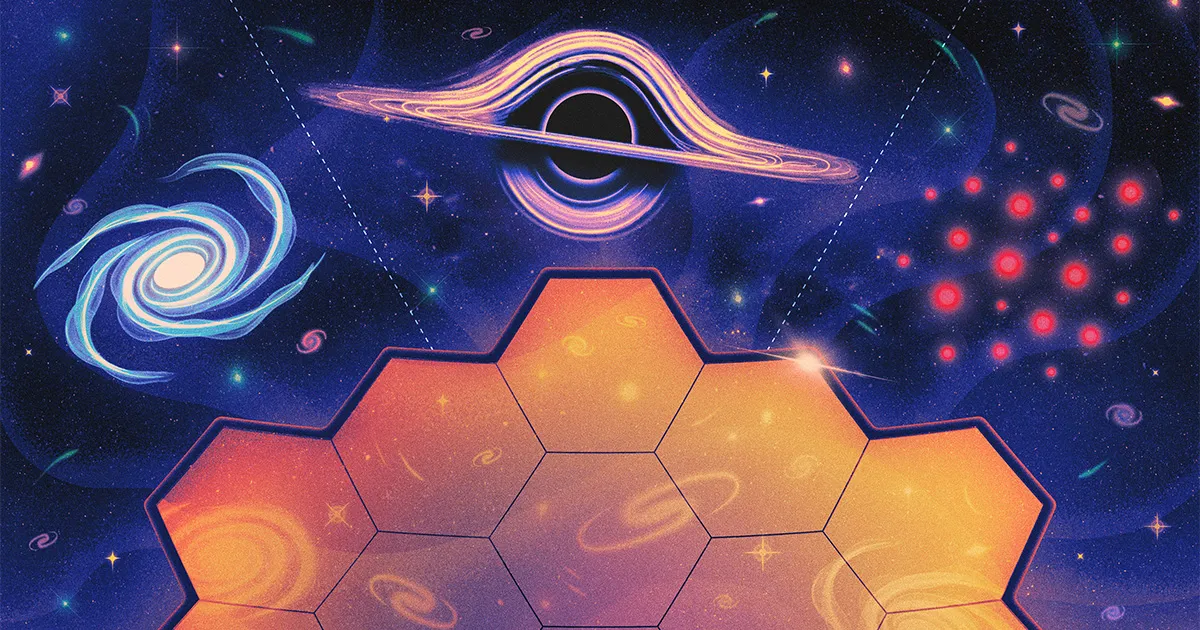
Astrophysicists are puzzling over James Webb Space Telescope observations of early black holes and galaxies that weren’t expected to exist. For decision-makers watching science, tech, and funding priorities, the scramble signals where future research bets may concentrate.
Astrophysicists are wrestling with a simple problem that is also the most expensive kind: James Webb Space Telescope images are showing early black holes and early galaxies that do not line up with what many researchers expected.
The stakes are not just academic. When observations come in that seem to contradict the timeline or behavior implied by existing models, researchers cannot merely refine the data. They have to re-check the assumptions baked into those models, then generate and test new theories fast enough to matter before the next wave of telescope time arrives. Quanta Magazine describes how scientists now face a “wealth of new theories” meant to explain these unexpected early-universe findings, paired with the hard part: figuring out which ones are actually true.
One of the featured researchers in Quanta’s reporting is Charlotte Mason, an astrophysicist at the Cosmic Dawn Center in Copenhagen. Mason doesn’t just stare at spectra and images. She draws. In the article, she explains that she is a “visual person” and that she “usually draw[s] a lot of pictures trying to understand what’s going on.” Lately, that sketching has focused on “little red dots,” puzzling objects found in James Webb images “discovered by the hundreds.” That phrase matters. A finding that appears in small numbers can be treated as anomaly. A finding that shows up by the hundreds pressures entire classes of explanation.
Why does this blow up into a scramble of theories? Because early black holes and the galaxies around them are bound up with the universe’s earliest epochs, when matter was forming quickly and the physical conditions were radically different from today. If Webb sees objects that appear too early, too bright, or too numerous under the simplest expectations, then at least one link in the chain is likely wrong. It could be the timeline of formation, the efficiency of growth, the visibility of certain phases, or the way dust and light interact with the telescopes’ measurements. Quanta’s framing is clear: scientists have come up with “a wealth of new theories” precisely because the observations create tension with what was expected.
There is also a practical research-market angle hiding in the background, even for people who never touch an astrophysics paper. Large observatories like Webb are not just scientific instruments, they are national and international infrastructure. The teams that build, operate, and analyze them compete for credibility and influence, and those incentives can shape which hypotheses get accelerated. When researchers propose new theories, they are not only arguing with each other about the past. They are effectively bidding to be the framework that organizes what comes next: which follow-up observations get prioritized, how data gets interpreted, and which models attract the next round of attention and resources.
And that attention does not operate in a vacuum. In the broader ecosystem, public and private decision-makers allocate funding based on where uncertainty seems most actionable. An “unraveling” of assumptions, even if it starts as a scientific puzzle, tends to attract fresh money and fresh talent because it promises leverage: solve one key discrepancy and the whole field can realign. Conversely, when there are “many theories,” boards and funders face a classic portfolio problem. Too many competing explanations can dilute impact. But too few may lock the field into a wrong track. The Quanta story is essentially describing that moment where the field has to choose how quickly to converge.
Second-order implications show up at the interface of science and governance too. Space telescopes involve long planning cycles, international coordination, and scrutiny around how time is requested and used. When new discoveries force rapid theory updates, the community has to translate that scientific urgency into operational decisions: what gets observed next, with what instruments, and how analysis teams structure their work to keep pace. Even without any formal “regulator” in the story, the underlying reality is that observational facilities function with constraints similar to regulated systems. You cannot just rerun the experiment whenever you like.
For executives and operators adjacent to science and deep tech, the lesson is less about black holes specifically and more about the behavior of complex systems under new inputs. Webb is delivering a flood of early-universe data, including “little red dots” and other puzzling objects. Researchers now have to separate measurement artifacts from genuine physics, then determine which theories best explain the patterns. Quanta’s core point, and the one that should matter beyond astronomy, is that the field is moving from observation to selection. The world will not wait for researchers to agree. The next batch of data will arrive, and whichever theories survive will become the default language for what investors, institutions, and the public think science is learning in this era.
This story's Key Insights and Take-aways are locked.
Create a free account to unlock Executive Actions for one credit.
Register to UnlockAlways free for Executives Club members. Join the Club
More in Science

Honeybee queens offload chronic pesticide exposure into eggs, research finds
Maternal offloading turns a queen’s survival play into a colony-level contamination strategy and regulatory headache.

Godox ES45 key light hits $119 at Amazon, beating Elgato’s $180 price gap
A first-time this year sale cuts the Godox ES45 to $119, and it still brings adjustable light, color temperature, and a wireless remote.
Chris Williams captures Earth’s orange sunrise as ISS loops 16 times in 24 hours
A June 26, 2026 photo turns station orbital mechanics into a daily reality check for space programs and investors.